
User Manual: BROTHER BROTHER Word Processor Manual BROTHER Word Processor Owner’s Manual, BROTHER Word Processor installation guides
Open the PDF directly: View PDF  .
.
Page Count: 258
NB-80C
2
Word Processing, Spreadsheet, Drawing,
Scrapbook, Addressbook, Planner
Book Reader, Text File Editor, Games &
Glossary
_GEOS
®
US ENGLISH
€
AbOut this Manual
In this manual, Book 2, look for information on these desktop
personal planning, and electronic accessory programs:
•
publishing,
Creates, edits, ,and prints documents, such as
Word Processing.
memos, letters, and reports.
•
Spreadsheet.
calculations,
Creates and edits Spreadsheet
and creates charts.
•
Drawing.
Creates
and editing.
•
Scrapbook.
Processing,
art, which
Addressbook.
reference,
by drawing
and
painting,
performs
or by importing
Stores a graphic or piece of text for placing in a Word
Spreadsheet,
or Drawing
document.
Also allows you to
place' clip
•
graphics
documents,
Stores
including
is supplied
names
email
Schedules
and addresses
Planner.
•
Book
•
Text File Editor.
diskette
Creates
i
Games.
and Turnabout
Solitaire
appointments
Opens
and other
information
for
addresses.
•
Reader.
on diskette.
books
on a perpetual
calendar.
on screen.
and edits DOS text
files. This program
is on
are on diskette.
This manual assumes
you are familiar with the basics of using programs
as opening
and saving documents
and working
with menus. If not, see
Getting Started in Book 1 for basic information.
such
In Book 1 you will also find instructions on using File Manager to organize
your documents; sending email; browsing the World Wide Web; and using
the Function Key accessories: Calculator, World Clock, and To Do List.
[ Model
Number:
Geoworks®
Geoworks.
application
software and
All fights reserved. United
Part of the software
Hardware
[
in this product
and software
floating
Serial
Number:
GEOS® operating
system
States Patent 5,327,529.
is ©copyright
point
math
operating
CardTrick
system
flash file system
Word for Word import
software
library
software
export
copyright
copyright
software
copyright
copyright
1994-1997.
©1984-1991
©1989-1997
Datalight,
©1986-1993,
All rights
©1992
Datalight,
©1990-1997
Dimensions
C Library copyright
©1989-1997
copyright
software
STNC Enterprises
Portions of this work are derived
from The Standard
by Prentice-Hall,
and are used with permission.
ROM-DOS
[
reserved.
Research,
Inc.
by P.J. Plaguer,
published
Inc.
Inc.
Mastersoft,
Inc. All rights
reserved.
The American Heritage
Dictionary
licensed from Inso Corporation
© 1989 by Inso Corporation.
All rights
reserved.
Reproduction
or disassembly
of embodied
programs
or database
prohibited.
Based upon The
American
Heritage Dictionary,
Office Edition.
English Hyphenator
licensed
Reproduction
or disassembly
Elecu'onic
Thesaurus
prohibited.
from Inso Corporation
©1991 by Inso Corporation.
of embodied
algorithms
or database
prohibited.
All rights reserved.
Thesaurus
licensed from Inso Corporation.
©1987 by Inso Corporation.
All rights reserved.
U.S. Pat. No. 4,724,523.
Reproduction
or disassembly
of embodied
programs
or database
Based upon Roget'slI:
TbeNew Thesaurus
©1980 by Houghton
Mifflin Company.
International
CorrectSpell
_" English spelling correction
system
reserved.
Reproduction
or disassembly "of embodied_gorithms
Portions
of BIOS software
Portions
of software
provided
provided
by Phoenix
by Brother
The GEOS software
in this device contains
URW, GmbH, URW Roman©,
URW Sans©,
©1997
International.
© 1994 by Inso Corporation.
or database
prohibited.
by Phoenix.
©1997
by Brother
Nimbus Q from Digital Typeface
and URW Mono© are registered
Geoworks®
Geoworks
and GEOS®, are registered
trademarks
of Geoworks,
in the United States of America and other countries.
Mastersoft
is a registered
Copyright©
trademark
1997 by Brother
of Mastersoft,
International
All rights
Inc. in the
Corporation.
Black & white clip art images in this product
are licensed
protected
by U.S. and worldwide
copyright
laws.
All rights
reserved.
International
Corporation.
Corp. and typefaces
from
trademarks
of URW GmbH.
and Scrapbook
TM
is a trademark
of
U.S.A.-
All rights
reserved.
from Media
Graphics
International
and
are
Portions of color clip art images in this product
are provided
by Express Software,
Inc.© Copyright
Express Software,
Inc. Portions of color clip art images in this product
are provided
by Studio Advertising
Art, Inc. © Copyright
Studio Advertising
Art, Inc.
All-other
brand
and product
names
are trademarks
or registered
trademarks
of their
respective
holders.
Keep this manual in a safe place for future reference. We recommend that you write the unit's model
number and serial number (from the rear panel of the keyboard/printer
unit) in the blank spaces at the
top of the previous page.
FCC NOTICE
This equipment
has been tested and found to comply with the limits for a Class B digital device, pursuant
to Part 15 of the FCC Rules. These limits are designed
to provide reasonable
protection
against harmful
interference
in a residential
installation.
This equipment
generates,
uses, and can radiate radio frequency
energy and, if not installed and used in accordance
with the instructions,
may cause harmful interference
to radio or television
reception.
However,
there is no guarantee
that interference
will not occur in a
particular
installation.
If this equipment
does cause intereference,
which can be determined
by turning the
equipment
off and on, the user is encouraged
to try to correct the interference
by one or more of the
following measures:
•
•
•
Reorient or relocate the
receiver
Connect
the equipment
Consult the dealer or an
not expressly
approved
This product uses
using a compatible
RJllC/W
modular
receiving
antenna
or increase
the separation
between
the equipment
and
to an outlet on a circuit different from that to which the receiver
is connected
experienced
radio/television
technician
for help (changes
or modifications
by Brother International
Corporation
could void the warranty)
jacks and is designed
to connect
jack that is Part 68 compliant.
to the telephone
network
or premises
wiring
If this telephone
equipment
causes harm to the telephone
network,
the telephone
company
will notify
you in advance that temporary
discontinuance
of service may be required. If advance
notice is not
practical, the telephone
company
will notify you as soon as possible. Also, you will be advised
of your
right to file a complaint
with the FCC if you believe it is necessary.
The telephone
company
may make changes in its facilities, equipment,
operations,
or procedures
could affect the operation
of the equipment.
If this happens,
the telephone
company
will provide
notice for you to make necessary
modifications
to maintain
uninterrupted
service.
Do- not connect
dai_e'-@ipment
to pat_-_,-lines _.or coin'-x3"perated
-" _
_
The FCC Registration
number
on this product
Commission
Part 68 Rules. To ensure product
product.
Do not substitute
adapters.
;
telephone
that
advance
lines.
shows compliance
with Federal
compliance,
use the AC adapter
Communications
that comes with this
If trouble is experienced
with this equipment,
for repair or warranty
information,
please contact Brother
International
Corporation,
3131 Appling Road, Bartlett, TN 38133, (901) 373-8500.
If the equipment
is
causing harm to the telephone
network,
the telephone
company
may request that you disconnect
the
equipment
until the problem
is solved.
DOC
NOTICE
This Class B digital apparatus
meets all the requirements
Regulations.
Le proem
appareil
num6rique
d6 la classe
le materiel brouilleur
du Canada.
WARNING
of the Canadian Interference-Causing
Equipment
B respecte
toutes les exigences
du R6glement
sur
- FOR YOUR IIFALTH
To avoid repetitive
motion
injuri.es When using this keyboard,
we recommend
the
following
steps: maintain a comfortable,
straight wrist position when typing, take breaks,
at least every hour, to stretch hands and arms, and report any pain or other symptoms
to your physician.
Table of Contents
THE BASICS
1 Word Processing
Word Processing 13ps .................................................................
Starting Word Processing
.............................................................
Opening a Document
................................................................
Using the Tool Bars ..................................................................
The Basic Functions Tool Bar .......................................................
The Advanced Functions Tool Bar ...................................................
1
2
2
3
3
4
The Graphic Bar ..................................................................
The Drawing and Bitmap Tool Bars ..................................................
4
5
Saving On-screen Settings (Configuration)
.............................................
Beginning a Document
...............................................................
Setting Up Your Page ..............................................................
5
6
6
Working with Text ...................................................................
Entering Text .....................................................................
7
7
Deleting Text ....................................................................
Cutting, Copying, Pasting, and Replacing Text .......................................
Dragging and Dropping Text ......................................................
Usihg-U_do_to Reverse-Your Last..Acfi_,_,..:
.... : ...........................
Using Special Characters and S_nbols ..............................................
Changing Text Font, Size, Style, and Alignment ......................................
Using Tone in Text ...............................................................
Finding and Replacing Text .......................................................
._ .....
10
10
11
12
12
12
15
17
Formatting Documents
..............................................................
Setting Line Spacing ..............................................................
Using Indentations, Tabs, and Rulers ...............................................
Adding Borders ..................................................................
Setting Hyphenation
...................................
. .........................
Using Headers and Footers ........................................................
Creating a Title Page .............................................................
Using Page Breaks ...............................................................
Managing Columns ..............................................................
Using Text Style Sheets ..................
-.. ......................................
Using Master Pages to Design Documents ...........................................
19
20
21
25
26
27
2_
29
29
31
36
Using Graphics in a Document
.......................................................
Using Frames for Graphics and Text ................................................
Using Grids .....................................................................
38
39
41
Using Clip Art in Documents
......................................................
42
Contents i
Wrapping Text ...................................................................
Inserting, Appending,
and Deleting Graphic Layouts
44
.................................
45
Finishing Your Document
...........................................................
Using Footnotes
.................................................................
Creating a Table of Contents .......................................................
Creating a Bibliography .......................
. ....................................
46
46
48
48
Proofing Your Document
............................................................
Checking Your Spelling ...........................................................
Creating a User Dictionary ........................................................
Using the Thesaurus ..............................................................
49
49
51
51
Printing or Faxing Your Document
...................................................
Merging Information from Other Programs
...........................................
Setting up the Merge Fields .......................................................
Merging Addressbook Information .................................................
Merging Spreadsheet Information ..................................................
Printing a Merge Document .......................................................
52
53
54
55
56
57
Spedal Effects ......................................................................
Displaying Invisible Characters
....................................................
Displaying Counts ...............................................................
Using Abbreviated Phrases ........................................................
Inserting Special Characters .......................................................
58
58
58
59
60
Importing
64
and Exporting Documents
.................................................
2 Spreadsheet
.........................
Starting
Opening
Spreadsheet
a Document
..............
._
_ ..........
,..................
, ......................................
...............................................................
Using the Tool Bars ..................................................................
65
65
66
67
The Basic Functions Tool Bar ......................................................
The Advanced
Functions Tool Bar ..................................................
67
68
Graphic
68
Bar, Drawing
Tools, and Bitmap Tools .......................................
Moving around in a Spreadsheet
.....................................................
Selecting Cells and Ranges ...........................................................
Working with Values and Labels ......................................................
Entering Values and Labels ...........................
'.............................
Notes on Entering Labels .........................................................
Notes on Entering Values .........................................................
Changing the Number Format for Values ............................................
Entering and Changing Dates and 1imes ............................................
Format Formulas ................................................................
69
69
72
72
73
73
74
75
77
Formatting Spreadsheets
.............................................................
Showing Grid Lines ..............................................................
Showing Cell Borders .............................................................
Using Headers and Footers ........................................................
Using Tones .....................................................................
78
78
78
79
80
Contents ii
Creating Notes ..................................................................
Changing the Appearance of a Spreadsheet
............................................
Adjusting Column Width and Row Height ..........................................
Changing Alignment .............................................................
Using Different Text Styles ........................................................
81
82
"82
83
84
Working with Formulas ..............................................................
Entering Formulas .....................
: .........................................
Using References in Formulas .....................................................
Using Operators in Formulas ......................................................
' Using Built-in Functions in Formulas ...............................................
Spreadsheet's Built-in Functions ...................................................
85
85
86
88
88
91
Editing the Spreadsheet
.............................................................
Editing the Contents of a Cell ......................................................
Copying and Moving Information ..................................................
Inserting and Deleting Rows and Columns ..........................................
Filling a Range of Cells with Incremental Values .....................................
93
93
94
96
97
Options for Spreadsheet Formulas
...................................................
Showing and Hiding Formulas ....................................................
Naming Cells and Ranges .........................................................
Controlling Automatic Recalculation
..............................................
Using Iteration and Circular References ............................................
98
98
98
100
101
Charting in Spreadsheet
.. ; .........................................................
What Is a Chart? ................................................................
102
102
Types of Charts .................................................................
Creating-Charts .....................
.._.. .... . .......................................
Changing the Type Of Chart ..........
"_
Manipulating Charts ............................................................
Resizing and Moving a Chart .....................................................
Changing Chart Properties and Attributes ..........................................
Deleting a Chart ................................................................
Using a Chart in Another Program
................................................
Adding Titles and a Legend ......................................................
Changing Markings .............................................................
Changing Marker Shapes ........................................................
Using Additional
Spreadsheet
Features
.....................
"
. ........................
103
108
108
109
109
110
110
110
111
112
114
114
Sorting ........................................................................
11.4
Creating Number and Date Formats ...............................................
Using Rulers ...................................................................
116
117
Adding Graphics
......................
...: ......................................
Locking Titles ..................................................................
117
118
Using Spreadsheet with Other Programs ...........................................
Printing and Faxing ................................................................
Setting Page Setup Options .......................................................
Printing and Faxing Spreadsheets and Charts .......................................
118
119
119
120
Contents iii
Exporting and Importing
Spreadsheet Error Codes
3 Drawing
Spreadsheets
................................................
............................................................
..........................................
121
124
125
Starting Drawing ..................................................................
Opening a Document ..............................................................
Using the Tools ....................................................................
Drawing Tools ..................................................................
Bitmap Tools ...................................................................
Pointers .......................................................................
125
126
126
126
127
128
Creating
129
131
132
132
and Editing Simple
Objects
................................................
Selecting Objects ................................................................
Resizing Objects ................................................................
Deleting Objects ................................................................
Changing the On-screen View
......................................................
Advanced Work with Objects .......................................................
Drawing Objects, Arcs, and Straight Lines ..........................................
Setting Attributes ...............................................................
Transforming Objects ..............................................................
Flipping Objects ................................................................
Rotating Objects ................................................................
Skewing Objects ................................................................
Untransforming Objects .........................................................
Duplicating Objects .............................................................
Conver tirtg't_ a Gra phi c ..................
........
'" _
. ...................................
_
_Arranging Objects
_
Moving Objects to the Front or Back ...............................................
Moving Objects .................................................................
Grouping and Ungrouping Objects ................................................
Pasting Inside ..................................................................
Using Rulers ...................................................................
Using Grids ....................................................................
133
134
134
136
141
141
142
143
143
143
,. 145
.146
146
146
148
149
150
151
Using Text in Drawings
............................................................
Changing Text Style, Size ........................................................
Aligning Text ...................................................................
Adding Tone to Text .............................................................
152
154
155
155
Working with Bitmap Objects
......................................................
Creating a Bitmap Frame .........................................................
Drawing Bitmap Shapes .....................
. - ..................................
Editing Bitmap Objects ..........................................................
Using Tone or Fill Pattern in a Selected Area ........................................
Erasing in the Bitmap Frame .....................................................
Using the Pixel View Tool ........................................................
Changing the Bitmap Color and Resolution .........................................
156
157
158
160
161
161
161
163
Contents iv
Printing or Faxing Drawing Documents
..............................................
Importing and Exporting Graphics
..................................................
4 Scrapbook
163
165
........................................
167
Starting Scrapbook
................................................................
Using 'Scrapbook Documents
.......................................................
Placing and Deleting Clip Art and Other Scraps .....................................
Navigating Through Scraps ......................................................
: Naming a Page of Scraps .........................................................
167
168
168
169
170
Creating a New Scrapbook Document
...............................................
Importing a Scrap from a DOS Program ..............................................
171
171
PERSONAL
PLANNING
5 Addressbook
Starting Addressbook
......................................
173
..............................................................
173
Working with Cards ...............................................................
Creating and Adding New Cards .................................................
Adding and Changing Phone Types ...............................................
Flipping through Cards ..........................................................
Editing Cards ..................................................................
Copying Cards .................................................................
Deleti
rds ..................
.... __--_..... :. .... .'. ..........................
_:....
Adding Notes to Cards ......
_....................................................
Searching through Cards .........................................................
178
179
Making New Addressbooks
.........................................................
Printing and Faxing an Addressbook
................................................
Importing a Document
.............................................................
Exporting an Addressbook Document
...............................................
6 Planner
174
174
176
176
177
177
178
180
180
182
183
...........................................
185
Starting Planner ...................................................................
Viewing the Calendar ..............................................................
Selecting and Viewing Events .......................................................
Switching between the Calendar Window and the Events Window ....................
Selecting a Range of Days and Viewing Their Events .................................
185
18.6,
187
188
189
Scheduling Events .................................................................
Scheduling an Event .............................................................
Changing a Scheduled Event .....................................................
Removing a Scheduled Event .....................................................
Adding Events between Two Scheduled Events .....................................
Adding an Event at a Particular Time ..............................................
190
190
191
191
191
192
Contents v
Copying Event Descriptions ......................................................
Scheduling Repeating Events .....................................................
Changing a Repeating Event .....................................................
Removing a Repeating Event from the Calendar ....................................
Finding Specific Events ..........................................................
Printing or Faxing Planner Documents
...............................................
Creating New Calendars
...........................................................
192
193 •
196
196
196
197
200
ELECTRONIC ACCESSORIES
7 Book Reader
......................................
201
Starting Book Reader
..............................................................
Using Information and Text .........................................................
Printing from Book Reader .........................................................
201
202
204
8 Text File Editor
205
Starting Text File Editor ............................................................
What Text File Editor Can and Cannot Do ............................................
205
206
Word Wrap and Line Endings .......................................................
Changing the Text Size .............................................................
Printing a DOS Text File ............................................................
206
206
207
Naming a DQ__.Text File .................
9 Games
._. ......
_ .....
_.............................
............................................
Turnabout ......
, ..................................................................
Capturing Pieces
Sequence of Play .................................................................
Setting User Options ............................................................
Solitaire
..........................................................................
Starting Solitaire ................................................................
Playing the Game ..................................
: ............................
Finishing a Game
Setting the Playing Level .........................................................
Changing the Scoring ............................................................
Changing the Number of Cards Drawn ............................................
Changing Other Options .........................................................
Contents vi
208
209
209
209
209
210
210
211
211
212
212
213
214
214
APPENDIX
Spreadsheet
Built-in
Functions
........................
215
Argument Rules ...................................................................
Fina_idal Functions
................................................................
Information Functions ..............................................................
215
216
217
Logical Functions ..................................................................
Mathematical Functions ............................................................
Print Functions ....................................................................
Statistical Functions ................................................................
220
222
223
223
String Functions ...................................................................
Time and Date Functions
...........................................................
224
226
Trigonometric
227
Glossary
Functions
............................................................
............................................
229
Index ...............................................
237
Contents vii
Contentsviii
1
Word Processing
Before starting, review
these basic procedures
from the Getting Started
This chapter explains how to create almost any type of document. It also
explains how to write a form letter and merge it with names and addresses
from Addressbook or Spreadsheet.
chapter in Book 1:
• Working with Documents
• Saving Documents
• Working with Menus
• Working with Dialog Boxes
Word Processing
To select (or dick on)
an item, p/ace the
on-screen pointer on
the item; then click on
the Select button or
tap once on the
glidepad.
Glidepad
surface
Tips
For word wrap to work properly, press ENTER only at the end of a
paragraph, never at the end of every line. If you press ENTER at the
end of every line, and later change something, the words will not
wrap smoothly.
•
Use TAB rather than
the SPACEBAR
to align text.
If you use TAB to
set the spacing between
text, then you can Simply change the
measurement
of the tab space to change
the location
of a column.
•
Type only one
typewriter,_you
--the
spacing-o'_e
space after a period or colon. When using a
enter two spaces after a period or colon because
typ_ewdtet:characters.
_°
of
Use italic style text rather than underline
for book tides. Typewriters
do not have italic font style available,
so your only option is to
underline
book tides. Word Processing
styles and other typographical
features
Selectbutton(left
buttonon a mouse)
Dragbutton (right
button on a mouse)
provides
italic and bold type
of typeset printing.
•
Since an en dash (-) and em dash (--) are available
on the symbols
keyboard,
use them rather than multiple hyphens.
(See Using Special
Characters
and Symbols on page 12.)
•
Use bullets for denoting
lists such as this list of tips.
Special Characters
and Symbols on page 12.)
•
You can undo almost anything.
The most important
thing to
remember
about undoing
a mistake is that you can undo only the
last action.
(See Using
Word Processing
1
Starting Word Processing
• To create a new document:
By default, the Word
Processing icon is
automatically sel_cted
(outlined in dotted white
line) whenyou turn on
your machine or any
time you go 1othe Main
Menu.
1. Click on Word Processing
appears.
from the Main Menu. The New/Open
2. Click on New. A new Word Pr_essing
document
dia/og box
appears.
Opening a Document_
Templates allow you
to create standard
• To open an existing
documents, such as
Word Processing
2
or template:
1.
Insert the diskette
drive,
that contains
2.
Select
from the File menu.
3.
Double-click
on the name of the folder and file you want to open. The
document
appears
in the Word Processing
window
and replaces the empty
default document.
envelopes, quicldy.
See Using Templates
in Getting Started
(Book 1).
document
New/Open
the document
or template
The New/Open
dialog
into the disk
box appears.
Using the Tool Bars
The tool bars provide quick access to menu functions.
you can open five different tool bars: Basic Functions,
Graphic
Bar, Drawing
Tools,
In Word Processing,
Advanced
Functions,
and Bitmap Tools.
• To open a tool bar:
1. Select
Show
2.
the tool bar. The tool bar appears
Select
Tools
from the Options
menu.
A submenu
appears.
on the screen.
• To use a tool on the tool bar:
1. Select
2.
Click on the tool button.
The Basic Functions
To remove tool bars, click
again on the name of the
tool bar in the Show Tools
the text or graphics
whose
characteristics
The characteristics
you
want
to change.
change.
Tool Bar
The Basic Functions
tool bar appears when you open Word Processing.
for functions
like copying
or changing
the font size of selected
text.
Use it
submenu of the Options
menu.
Open
Close
Textstyles:plain;bold,
italic,and undedined
Save
Go to page or
current page
I
Font size:
increase and
Click to see a list decrease /
of fonts and sizes.
I
Spell check
1_12 I@1[]
I
Iol_l_l_mixl
I
Print
Next page
Previouspage
t
[
[--
Redraw
screen
1 [
I
lun"Rom-,=l1,2=111;I ITITIZI_I
_!]
, :t,:
Copy
Paste
Word Processing
3
The Advanced
Functions
Tool Bar
When opened, the Advanced Functions
Functions tool bar.
Find andreplace
I
above the Basic
°.."0n..
Stylein use
Zoomin
Zoom
I
st°reStyle
i R_cal,Style I
I1_1
tool bar appears
tofit
Scale
Hyphenation
kZ!l'_l.o,m.,"1
[]
ol t
I-I=1=1-1
Alignment
Linespacing
View
The Graphic Bar
Use the Graphic
bar
for editing
graphic
objects
created
in or imported
Word Processing.
For example,
use the Duplicate
button to make
graphic object, or use the Area Fill tool to fill a graphic object.
AreaPattern LineShading
ILine Tone [
AreaFill
,
LineStyle
I
I
]
Area Shadin_ "_-I-
.
PasteInside
TextShading
,. -l-_Te'x'_Tone'(
Ungroup
I L'"e'T'°"_
/ I
I Gr_upI
-1 -._---.
a copy
of a
BreakOutPasteInside
Bringto Front
[
-
to
I
Sendto Back
PullForward
IPt_sh Back
Duplicate Flip Leftto RightI
I
FlipTopto Bottom
Word Processing
4
The Drawing and Bitmap Tool Bars
Pointer tool
In Word Processing, the Drawing tool bar appears on the left of the window
When you are working with this tool bar in Word Processing, remember the
following:
I-beamtool I'_
Text tool
In Drawing, the
Drawing and Bitmap
tool bars are in
different locations
than they are in Word
Processing, but they
still contain the same
tools.
•
To select
a graphic.in
•
To select
text in Word
•
To
create
graphics
imported
Processing,
Processing,
text in a graphic
You can also use the Bitmap
bitmap
Word
frame,
use the Pointer
use the I-beam
tool.
tool.
use the Text tool.
tool bar to create
bitmap
graphics
or to edit
into Word Processing.
The Drawing
tools, Bitmaps, and the Bitmap tool bar are explained
in the Drawing
chapter, which starts on page 125.
in detail
Saving On-screen Settings (Configuration)
Saving the configuration
allows you to save the settings from the Options
menu. For example,
if you want the Advanced
Functions tool bar to be
visible every time you open Word Processing,
select Show Tools from the
Options menu; then click on Advanced
Tools. Save the configuration,
and the
tool bar will appear every time you open Word Processing.
I!_To save the configuration:
For information on
rulers, see page 24
in this chapter.
With your settings (tool bars and rulers) on the screen the way you want
them, select Save Configuration
from the Options
menu.
Word Processing
5
Beginning a Document
Before typing, first define the type of document
your page size and page setup options.
you are creating
by setting
Setting uP Your Page
To select the page size:
You can create a
1.
Open
a new
2.
Select
Page
3.
asked if you want to
scale the document or
Select either Paper, Envelope,
Label, or the width
document
if it is not a standard
size.
4.
Select
pffnt it actua/ size.
Select Print Actual
5.
Click on Apply; then click on Close.
document
outline will be represented
document larger than
the printing area.
When you print a
large page, you are
Size; then insert as
Page
document.
Size from the File menu.
Layout,
either
portrait
A dialog
(vertical)
box appears.
and height
or landscape
of your
(horizontal).
The dialog box closes, andyour
by a rectangle
with dotted borders.
many sheets of paper
set up the page:
as required. When
finished, tape the
pages together.
Select the document
for which you want to change
the insertion
point anywhere
in that document.)
Select
2.
Page
Setup
3. Fill in the dialog
from the File menu.
box,
making
•
Starting
Page Numlmr.
other than 1: If you_have
can save them separately
To change your view of
the document select
Zoom In or Zoom Out
•
Columms.
Select
Mana_ng
Columns
from the View menu.
•
Spacing.
between
default,
To change the margins
on an individual page in
your document,
If you
A dialog
the selections
the page
setup.
(Place
box appears.
you
want:
You can start your document
on a page
several sections in the same document,
you
and still have consecutive
page numbering.
the number
on page
have more
of columns
in the document.
See
29.
than
one column,
columns.
Spacing is the same
this setting is 0.125 inches.
between
select
the distance
all columns.
By
•
Rule Width.
If you have more than one column,
you may want to
draw a vertical line (rule) in between
and then select the width of
that line. By default, this setting is 0 points,or
no rule.
pointer from the
•
Drawing tools to select
and resize header,
footer, or main body
region.
Master Pages.
Select your layout: either a single page (one) or facing
pages (two). By default, this setting is one master page. See Using
Master Pages to Design Documents
on page 36.
•
Margim_.
By default, the margins are 1 inch. You can change the
margins for an individual
page in your document
(see side note).
reduce your document
to Scale to Fit from the
View menu and use the
.
Word Processing
6
Click on Apply;
then
click on Close.
The columnsettingistwo.
Thissampledocumentis set up
with 2 columns,0.25inch spacing
betweencolumns,and a vertical
rule(line)betweencolumns.
The verticalrule is 2
Working with Text
This section explains how to enter, move, copy, and edit text. It also
describes
how to insert characters
and symbols,
change text style and format,
use tone in text, and search for and replace text.
-Entering
Text.
The recommended
method for entering
Insert
mode,
in which typed characters
text described
in this manual is called
push all existing characters
to the
right.
To switch in and
out of Insert mode,
click on the Insert
button at the
bottom left comer
of the screen, INS
(INS is selected by
default).
Insert mode is recommended
because you will not lose any text as you type.
If you want typed characters
to replace the characters
to the right of the
insertion
point, turn the Insert mode off.
Word wrap means that you do not have to press ENTER (the Return key on
a typewriter) to start a new line of text. As you type, the words appear in the
text area. As words reach the end of a line, they automatically continue on
the next line.
The in.,erti.on poim is the b"linking vertical line that shows where typed
characters appear on the screen. On a blank page, the insertion point appears
in the upper left comer. As you type, the insertion point moves to the right,
appearing after the last word. To make changes to something you have
already typed, move the insertion point anywhere in the text. You cannot
move the insertion point to an area where there is no text unless you use
SPACEBAR, TAB, or ENTER.
Word Processing
7
!l_ To go to another
You can also select a
page to go to from the
Basic Functions tool
bar.
Select
Go to Page
page:
from the View menu.
If your
document
has more than
one
page, tbe page you select appears, lf your document
begins on a page other
than I (you can set it up this way in Page Setup), Go to Page will still see the
first page as page 1.
l_ To correct
Press
as you type:
BACKSPACE
to erase
characters
to the lej_ of the insertion
point.
OR
Press DELETE to erase
To split an existing
paragraph into two,
place the insertion
point where you
want the split and
press ENTER.
characters
to the right
of the insertion
point.
To start a new paragraph:
Press ENTER. The insertion
To place the insertion
Position the insertion
type in the text.
point
point
moves
to the lej_ margin
of the next line.
point M the text:
in the text
and press
the Select
button.
You can
._, To select text:
- 1. Move _inserti_-p-6in'_o
you want to select.
2.
the beginning of the word,
Hold the Select button and drag across
selected;
then release the button.
the text until
line, or paragraph
what
you want
is
OR
Click the Select button at the beginning
and click at the end of the text.
Use these methods for selecting text:
8
down
SHIFT,
. o
This
Does This
2 clicks
Selects a word (but not the space after the word)
3 clicks
Selects a line
To select additional
words, lines,
the Select button as you drag.
Word Processing
of the text, hold
or paragraphs,
on the last click, hold
down
• To select text with the keyboard:
Press the keys shown below:
Press This
To Select
SHIFT + --* or _-
One character in the direction of the arrow; reduces or
extends one' character at a time in the same direction.
CTRL +
The current word; the insertion point must be within the
SPACEBAR
word.
SHIFT + t or,
From the insertion point one line in the direction of the
arrow; extends or reduces the selection in the same
direction.
SHIFT + HOME
From the insertion point to the beginning of the line;
extends or reduces the selection a line at a time toward the
beginning
of the document.
SHIFT + END
From the insertion point to the end of the line; extends or
reduces the selection a line at a time toward the end of the
document.
CTRL + SHIFT +
To the beginning or ending of a paragraph in the direction
of the arrow; extends or reduces the selection in the same
t or _
direction.
CTRL + SHIFT +
HOME
CTRL + SHIFT +
END
CTRL + /
• To extend
From the insertion point to the beginning
of the document.
_ From the insertion point to the end of the document.
The entire document
the Edit menu).
or reduce
(the same as choosing
Select All from
the selection:
1. While a selection is already highlighted, hold down SHIFT.
2. Click where you want to extend or reduce the selection.
• To cancel a selection:
Click anywhere
in the text area, or press
one of the arrow
keys.
Word Processing
9
Deleting Text
When you cut a
• To delete text:
selection, it is placed
on the cl_board.
You can paste the
selection from the
clipboard to another
location as long as
1.
Select the text you
2.
Press CUT.
want
to delete.
• To delete text using the keyboard:
you have not cut or
copied another item.
With no text is selected,
• BACKSPACE.
use the following keystrokes
Deletes the character
• CTRL + BACKSPACE.
word.
to delete text:
to the left,
Deletes from insertion point to beginning
• CTRL + DELETE. Deletes from insertion
• SHIFT + CTRL + BACKSPACE.
beginning of line.
of
point to end of word.
Deletes from insertion point to
• SHIFT + CTRL + DELETE. Deletes from insertion point to end of
line,
Cutting, Copying, Pasting, and Replacing
Text
When you select text, you can cut it and move it elsewhere
or copy it to
another
place. The selection
you cut or Copy is placed on the clipboard,
- electi-ofii_liOlding
s_a_ce_ WSen you press PASTE, the contents
of the
clipboard
are pasted into the document
at the insertion
point.
When you move a
selection, you
remove or cut it from
• To move a selection:
its oaginal location
1.
Select the item or text you want
2.
Press CUT. The item is removed from your document
andplaced
clipboard,
replacing
any item already in the clipboard.
3.
Move the insertion
4.
Press PASTE. The contents of the clipboard are inserted into the
document,
and tbe pasted text appears at the insertion point.
and paste it into
another location.
Cut, Copy, Delete,
and Paste also
appear in the Edit
menu and on the
Basic Functions tool
b_r.
Word Processing
10
point
to move.
to the new location.
on the
an
To copy a selection:
1.
Select
2.
Press
the item or text you want
clipboard,
3.
to copy.
COPY. The item remains
Move
replacing
the insertion
any
point
in your
other
document
and
aLso goes to the
item in the clipboard.
to the location
where
you
want
the item to
appear.
When you paste an
item intoa
document,it remains
on the _lipboard
unlessyou replace
it. So you can
continueto paste it.
4.
Press PASTE.
document.
I_ To replace
1.
Select
2.
Type
Select
2.
Press
3.
Dragging
or words
the replacement
COPY
Select
you want
text.
want
to replace
or CUT. The text is placed
of text you
is replaced
want
the original
text.
the existing
text with.
in the clipboard.
to replace
by the contents
and press
PASTE.
The
or copy
text
of the clipboard.
Text
The drag and drop feature provides
without using the clipboard.
Move
into the
to replace.
The new text replaces
of text you
the block
and Dropping
are inserted
one block of text with another:
the block
selection
of the clipboard
text:
the word
_, To replace
1.
The contents
a quick
way to move
_ CopJ[__
You can onlymove
text to text areas,
whichhave already
been typed in. To
create a larger text
area, press ENTER.
Tomove
1. Select
2.
Move
3.
Hold
or copy"-a-selection
the text you want
the on-screen
down
to move
pointer
the Drag
with drag and drop:
button.
or copy.
over
the selected
Thepointer
text.
changes
to the drag anddrop
pointer.
4.
To move, hold the Drag
place the selection.
button
and drag
the pointer
to where
you
want
to
OR
Do not release the
CTRL key until
after you have
[eleased the Drag
button.
To copy,
.
press
CTRL
Release the Drag
/ocat_on.
and drag the pointer.
button.
The selected
text is moved
or copied
to the new
Word Processing
11
Using Undo to Reverse
CUT replaces the
contents of the clipboard
so that even Undo wi/I
notbringit back.You
can undoyourlastcut,
butnot theonebeforeit.
Your Last Action
Sometimes you may delete some text or change the way it looks and
immediately decide that it was not what you wanted. If you have not done
anything else, select Undo from the Edit menu to restore the text. Once you
select Undo, its name on the Edit menu changes to Redo.
l_ To undo your last editing
Not allpragrams include
Undo,and notall
operation:
Select Undo from the Edit menu. The text you are working on reverts to the
original.
operations can be
undone.
I_ To undo the last thing you typed:
PressCTRL + BACKSPACE.
Using Special Characters
and Symbols
l_ To find and insert special
Forinternational
ormath
symbols clickon the
Symbolsmenu.Tosee
all availablecharacters,
see the Appendix. -"=_-
and symbols:
1. Click on the SYM button in the lower fight hand comer of the screen. The
Symbols On-screen Keyboard appears for tbe font you are using.
2. Click on the Symbols menu to see other choices for the font you are
using.
--,._
_
,3. Click on the symbol or character that you want to appear in your
document. The symbol or character appears on the screen.
Once you open the
Keyboard, it will stay
4. Click on the window
open until you close it.
Changing
characters
close button in the top left hand comer.
Text Font, Size, Style, and Alignment
How a character looks on the screen and when it is printed is determined
its font, size, style, alignment, and other attributes.
You can apply character
by
attributes in two ways:
• Select the text to change;, then select the attribute
you want.
• Select the attributes you want; then type new text. Word Processing
applies the current attribute settings to any teat you type.
I_ To change
character
attributes:
1. Select the text to change.
2. Select Character Attributes from the Character
Word Processing
12
menu. A dialog box appears.
.
Fill in the dialog
box:
•
Character
any weight
•
Character
Width (%).
width from 25 to 200.
•
Character
Spacing. Select the spacing between
any spacing from -150 to 500.
4.
Click on Apply.
5.
Click on Close.
Weight (%). Select
from 75 to 125.
Select
the weight
the width
of the characters.
of the characters.
Select
Select
characters.
any
Select
Changing fonts
Fonts are different typefaces
that define
screen and when printed.
Each character
font to font.
how each character
appears
on
has a unique design that varies from
Word Processing
contains
sereral different fonts. The URW Mono font is most
like a typewriter
font. It is mootospaced:
every character
uses the same
amount of space. The other fonts are proportionally
spaced.,
the space
taken by a character
is relative to the character's
width. For example,
the letter
i uses less space than w.
l_ To change
1.
Select
the font:
the text to change.
2. Click-on
theFon_
iC_YrYon _e
menu of fonts appears.
To see a sample of the
font, select Fonts from the 3.
Charactermenu; then
select Font Viewer.
Select
the font.
The selected
Basic Functions
text appears
tool bar. A drop-douPa
in the font you selected.
You can also select
fontsfrom the Fonts
submenuin the
Character menu.
Changing
text sizes
If you use a large font
3ize, above 72points,
you may need to
increase the line
spacing. Select Line
Spacing from the
Paragraph menu.
Text
size
determines
how
tall and wide
a character
is and is usually
measured
in points,
a measurement
used in the printing industry. A point is
approximately
1/72 of an inch. Therefore,
72 point text is one inch tall. Most
books and magazines
are written with 10 or 12 point text.
You can select from standard point sizes (9 through
custom text size.
72 points) or create a
Word Processing
13
If all the highlighted
text is the same size,
the currentsize is
identifiedby a filled
radio button in the
Sizes menu. If the
highlightedtext
contains _rfferent
sizes, none of the point
sizes is marked.
• To change
1. Select
the text to change.
2.
Select
Sizes from the Character
3.
Select one of the sizes from the list. Word Processing
selected to the highlighted
text.
• To change
1.
Changing
menu.
A submenu
appears.
applies
the size you
the text size incrementally:
Click on the Increase
Functions
You can also change
text size from the
Sizes submenu of the
Character menu.
the text size:
or Decrease
Font Size buttons
tool bar. The text appears
• To set a custom
1.
Select
2.
Select Sizes
3.
Select
Custom
4.
Select
the custom
5.
Click on Apply.
6.
Click on Close.
on the Basic
in the next smaller
or next larger size.
text size:
the text to change.
from the Character
menu.
Size from the submenu.
point
size you
want
A submenu
appears.
A dialog
box appears.
(between
4 and 792).
text styles
Use text styles to add emphasis
following styles are available:
to words
and phrases
in your
document.
The
• _Plain
•
Bold
• Italic
•
Underline
•
Strikethru
• Superscript (e.g. ax + b 2 = cz)
• Subscript (e.g. H20)
•
Boxed
(with
•
Button
(to resemble
• To change
You can also change
text stylesfrom _he
Basic Functionstoolbar.
14
a button
i0
that you press)
the style of text:
1.
Select
the text to change.
2.
Select
a style from the Styles
text sty/e appears.
Word Processing
a box around
submenu
in the Character
menu.
The selected
Aligning
text
You can decide how text lines up along a margin: left, centered,
right, and
iususqear.
--
Alignedwith leftside of the margin
-- Alignedwith rightside ofthe margin
Centeredbetweensides ofthe margin
I
I
I
Rushagainstbothsidesof the margin(justified)
_ To change
Youcanalsoalign text
byselectingAlignment
from_e Paragraph
menuor fromthe
AdvancedFunctions
tool bar.
text alignment:
1. Select the text or move the insertion point into the paragraph
align; then use the following keys to align the text:
Control Key
Alignment
CTRL + L
Left
CTRE-_",_-_
_
you want to
_ Center
CTRL + R
Right
CTRL + J
Justified
Using Tone in Text
You can set the text
tone before you begin
O/ping if you want, or
select it and change it
later.
Text tone should stand out against its background for ease of reading. If the
tones are too close, the text disappears into the background. By default, text
tone is black and background tone is white.
You can also increase or decrease the percentage of shading to fade or
sharpen the intensity. You can also select different patterns to create a
different texture in the background.
l_ To change
The toneyou
_select is not going
to appear on the
screen exactly as
it will print.
the text tone:
1. Select the text to change.
2. Select Text Tone from the Character
menu. A d_/og box appears.
Word Processing
15
.
Fill in the dialog box:
• % Shade_
Select the percent shading for the text tone. The lower
the number, the more faded the tone. A setting of zero (0) causes the
text to disappear. By default, this setting is 100.
* Tone Tools. Select the text tone.
4. Click on Apply. (Continue to make changes
satisfied with how the text looks.)
as desired until you are
5. Click on Close; then deselect the text by clicking somewhere
page. Tbe text appears in the tone you chose.
• To change
the text background
else on the
tone:
1. Select the text to change.
2. Select Text Background
appears.
Tone from the Character
menu. A dialog box
3. Fill in the dialog box:
•
Frilled or Unfilled. Select Filled to set other options in this dialog
box. By default, the background is unfilled.
•
% Shaded. Select the percent shading for the text background tone.
The lower the number, the more faded the tone. A setting of zero (0)
causes the background to disappear. By default, this setting is 100.
• Tone Tools. Select the text background
the palette.
tone or shade of gray from
• Pattern. Sel.e_ct_tl3e-_attern for the text background. By default, this
setting is solid. A transparent pattern is also available on this palette.
4. Click on Apply.
are satisfied
(You can continue
to make
with how the text looks.)
5. Click on Close; then click somewhere
the new
Word Processing
16
text tone.
changes
as desired
on the page to deselect
until you
text and see
Finding and Replacing
Text
Use Find and Replace to quickly find a word or phrase in your document
and, ff you like, to replace it with a different word or phrase. You can also
replace all occurrences of a word or phrase in a document.
Searching for text
Find and Replace also
appears in the Ec_t
menu and on the
Advanced FuncOons
toolbar.
Type exactly
You can search for any sequence of numbers, letters, spaces,
printable characters (such as punctuation marks).
)_ To search for text:
1.
Press
CTRL + F. A dialog
2.
Type
the text you want
3.
Click on either
what you
search from
want to find without any
extra spaces or
characters.
Find
to search
for.
point forward
Word Processing
starts
If Word Processing
finds a match, it highlights
the text in the
document.
Stop the search here or click on Find Next or Find
Previous to resume the search for another
match.
•
For forward
searches,
if Word
it starts searching
if Word Processing
the
or backward.
•
....
.
box appears.
Next or Find Previous.
the insertion
document,
searches,
Replacing
and other
Processing
reaches
the end
of the
from the beginning.
For backward
reaches
the beginning
of the document,
it starts searching
from the end. If Word Processing
cannot find the
search text in the document,
a message appears.
Click on OK to close
•,his message_-7_:
"
Click on Close.
text
You can replace
To replace
any search
text with different
text.
text:
1.
Press
CTRL
2.
Type
the text you
want
3.
Enter
the text that
will replace
4.
Click on Find Next or Find Previous.
Word Processing
starts the search
from the insertion point fommwd or backward.
If Word Processing finds
match, it highlights the text in the document.
You have the folloua'ng
cboices:
•
Replace
+ F. a
one
Replace. Stop
searching.
dialog
box appears.
to search
occurrence
the search
for.
the search
text.
of the selected
here
text.
a
To do this, click on
or click on Find
Next to continue
Word Processing
1;
Replace all occurrences of the search text with the replacement text.
To do this, click on Replace All. A dialog box appears asking if you
want to rep/ace a/! occurrences. Click on Yes to continue or No to
quit.
Replace in Selection is the same as Replace All, except that it replaces
all occurrences only within selected text.
5.
Using wildcards
Click on Close.
and special
characters
You can use two wildcards and all special formatting characters when you
search and replace text. A wadcard
is a symbol that substitutes for a single
character (?.)or a series of characters (*).
For example, to f'md any word that begins with the word
Multiple Characters wildcard
in your search text (math*).
math,
use the
You can also search and replace special
eAMme_$
in your document:
graphics,
special text, tabs, carriage returns, and page breaks.
)_ To use wildcards
and special
characters:
1. Press CTRL + F. The Find and Replace
2.
Click on Special
Characters.
A drop-down
dialog
box appears.
list appears:
_Find..It
I_pla¢o _
_ciuJ
_'rm
Characters m] FI !gnore Case/P.ccents [] Hatch Portiol biot'sts
[R- Hatch Any Character
- Graphic
or Special
Text
•_1- Tob
QI- Cardoge Return
O- _oo Brt_t
3.
Select
•
the wildcard(s)
and special
character(s)
you want
to search
Match Multiple
Characters.
Matches text where the beginning
end of the text might vary (such as professor
and professional).
for:
or
• Match/my
Character.
Matches text where one or more characters
might vary (such as arise and arose).
Word Processing
18
•
Graphic or Special Text. Adds a character to search for any graphic
object or any special text character (dates, times, numbers, and so on)
to the Find text.
•
Tab.
•
Carriage
Replace
•
Page Break.
With text.
For special
Adds a tab character
Return. Adds
With text.
characters,
Adds
to the Find or Replace With text.
a carriage
a page
break
return character to the Find or
character
you can set the following
to the Find or Replace
options:
Ignore Case/Accents.
Instructs Word Processing to f'md every
occurrence of the search text, ignoring uppercase, lowercase, and
accent marks. For example, if the search string is Dog, Word
Processing could find matches for Dog and dog.
•
.
Match Partial Words.
Instructs Word Processing
to search for a
portion of a word. For example,
if the search string is print, Word
Processing
could find matches on print, sprinter, reprint, and so on.
Click on Find
Next or Fred
text, and click on Replace
the replacement
text.
Previous
or Replace
to search
the document
All to replace
the search
for the search
text with
5. Click on Close.
Formatting Documents
This section
features:
describes
how to use the following
• Line and paragraph
• Indentations,
document
formatting
spacing
tabs, and rulers
• Borders
•
Hyphenation
•
Headers and footers
• Title pages
•
Page break
•
Columns
• Style sheets
•
Master pages
Word Processing
19
Setting Line Spacing
Line spacing
is the space between
lines in a paragraph,
also called geadmg.
Linespacingis the spacebetween
linesin a paragraph.
)
.
.
n
.
_
]r
.
12
.
n
.
E
.
_
.
14
.
=
.
B
.
_
.
I;
.
+
.
17
..........
.
n
.
IB
.
4
]
-I
'
!
!
i
To add more space between the lines of text in a paragraph,
following line spacing settings:
select from the
•
Single. This is considered normal spacing. There is no extra line
space between each row of text.
•
One and a Half. A half line space is between
• Double.
• Triple.
•
A whole line space is between
Two whole lines are between
Custom.
specify
each row of text.
each row of text.
each row of text.
Set custom line spacing up to 12.
line spaciog:
,.
Select the text or move the insertion point into the paragraph you want to
change.
2. Select Line Spacing from the Paragraph menu. A submenu appears.
3. Select one of the line-spacing options from the submenu.
• To specify
custom
line spacing:
1. Select Line Spacing from the Paragraph
menu.
2. Select Custom Spacing. A dialog box appears.
3. Select the line spacing option:
• Line Spacing.
want.
•
Word Processing
20
If Automatic
Manual
Leading.
spacing
you
4.
Click on Apply.
5.
Click on Close.
want.
If Manual
is selected, select the line spacing you
is selected,
select
the manual
line
• To change spacing
between
1. Select one or more paragraphs
2. Select Paragraph
paragraphs:
to change.
Spacing from the Paragraph
3. Fill in the dialog box, selecting
menu. A dialog box appears.
the options you want:
• Space On Top. Select the spacing above a paragraph.
•
.
Space On Bottom.
Select the spacing below a paragraph.
Click on Apply.
5. Click on Close.
Using Indentations,
Setting
Tabs, and Rulers
indentations
The text of each paragraph wraps within the right and left indentations,
which you can change using the Indentation markers on the ruler. To specify
the right edge of the text, drag the Right Indent marker (a single triangle) to a
new location.
The Left Indent marker is two triangles.
•
The upper triangle sets the indentation
paragraph.
_-*.--The loWe_ tiSa_gle_sets: the mdentauon
" _
"
paragraph (the hanging indent).
Indentedparagraph
of the first line of the
for the remaining
lin_ of the
If both of the Left Indent triangles are together, all lines in the paragraph align
beneath the markers. If the top triangle is to the right of the bottom triangle,
the first line indents, as shown in the illustration at left.
• To set indentations
by dragging:
1. Select all of the paragraphs you want to indent. (If you want to indent
only a single paragraph, move the insertion point into that paragraph.)
2. Move the on-screen pointer to the the first Indent marker (the upper
triangle); then click and hold the Select button.
3. Drag the marker to the place on the ruler where you want the indentation.
The existing t_ct or t_ct you type will be indented as specified.
4. Select the Hanging Indent marker (the lower triangle) and press the Select
button; drag the marker to the place on the ruler where you want the
second and subsequent lines to align.
• To set paragraph
indents
1. Select one or more paragraphs
with the dialog box:
you want to change.
2. Select Indents from the Paragraph
menu. A dialog box appears.
Word Processing
21
3. Fill in the dialog box, selecting
the options you want:
• Left Indent of Fu'st Line. Select the distance of the first line from
the left margin of the page.
• Hanging Left Indent.
margin of the page.
Hangingindent
• Right Indent.
Select the distance of the text from the left
Select the distance
of the text from the right margin.
4. Click on Apply.
5. Click on Close.
Setting tabs
Use tabs
numbers.
to create aligned columns,
such
Add your own tabs by clicking
as a table of contents
on the ruler.
or columns
of
You can set your own tabs, such as right aligned tabs, decimal tabs, custom
positions,- and tab/eader$
(dots or lines between tabbed items).
B
-----
),-To create tabs on€he*ruleR
_
1.
Select the paragraphs
add a tab to a single
paragraph,
2.
Click on the ruler. The tab marker appears wbere you
automatic
tabs disappear
to the lej_ of the new tab
3.
If the tab is not exactly
location.
4.
Continue
clicking
for which
paragraph,
and
where
you want to create
move the insertion
you
dragging
want
until
tabs, or if you want to
point into the
clicked.
The
it on the ruler, drag it to a new
you have
placed
all the tabs.
)_ To create a new tab with the Tab dialog box:
Word Processing
22
1.
Select
one
or more
2.
Select
Tabs from
3.
Fill in the dialog
List.
paragraphs
to change.
the Paragraph
menu.
The Tabs dialog
box appears.
box:
•
Tabs
Select
•
Distance
from
left margin.
Create
New Tab in the Tabs list.
Left Margin.
Select
the distance
of the tab from the
• Tab Type. Select the alignment of the text at the tab setting (Left,
Center, Right, or Decimal). For example, use a decimal tab to align.
columns of numbers along the decimal point.
Tab Leader. Select the character that precedes
Dot, Line, or Bullet).
the tab setting (None,
Vertical Line. This bption puts a vertical line at the tab position that
spans the height of the paragraph. You can set the shading, line
width, and line spacing.
.
Click on Apply. The tab is applied to selected paragrapbs.
5. Click on Close.
• To change a tab:
1.
Select one
2.
Select Tabs
or more paragraphs
3.
Select the tab you
4.
Fill in the rest of the dialog
5.
Click on Apply.
6.
Click on Close.
you
from the Paragraph
want
to change
box,
want
menu.
to change.
The Tabs dialog
box appears.
in the Tabs list.
selecting
the options
you want.
• To delete a tab:
_
1.
Select Tabs
2.
Select the_ tab-you
from the Paragraph
3.
Click on Delete Tab or drag it off the ruler. Word
and shifts the text to the next tab.
_ant
to-delete
menu.
The Tabs dialog
m the Tabs
box appears.
list.
,,,
Processing
deletes the tab
OR
Click on Delete Every Tab. Word Processing deletes all tabs, restores
default tabs for selected paragraphs,
and a_'usts the text if necessary.
• To set the default
1.
Select one
or more
2.
Select Default
3.
Select a default
Tabs
the
tabs:
paragraphs
you want
from the Paragraph
tab (None,
Centimeter,
tO change.
menu.
A dialog
Half Inch,
box appears.
or One Inch).
OR
Set a custom
default
4.
Click on Apply.
5.
Click on Close.
tab.
Word Processing
23
Using rulers
When you open a new document, the margins are set for a 6-1/2 inch text
area and the tabs are 1/2 inch apart. Use the ruler to change right and left
indentations and to insert different tabs.
Ruler changes do not
affect header and footer
text. For more
information,see Using
Headers an_l Footers on
page 27.
The indentations
and tabs
on the ruler affect the paragraph
containing
the
insertion
point. If you want to change the setting for the whole document,
first select the document
either by choosing
Select All from the Edit menu
by clicking quickly five times.
or
Hangingindent
Tab stop
Right indent
i
i-.
I
, • • . ; . F. : • p. : • ,N. ; - r.
Loft margin
: • p. ; • F.
, - "-
Text area
t
Right margin
Follow these steps to change options on the ruler:
Snap to Ruler
.
To align the ruler with the page:,
_-•
M,_..,ksis explained
on page 40.
1.
Select
Rulers
from the Options
2.
Click on Align Ruler with Page.
• To show the horizontal
1.
Select
Rulers
2.
Click on Show
3.
To remove
• To change
1. Select
..............
g 24
the rulers,
Rulers
The ruler moves
menu.
Click on Ruler
measurement.
3.
Click on the measurement
appears.
Vertical
to deselect
menu
appears.
Ruler. The ruler appears.
the check
boxes.
units:
from the Options
2.
menu
to the le_.
A drop-doura
Ruler or Show
click again
measuring
A drop-down
and vertical rulers:
from the Options
Horizontal
menu.
menu.
Units. A drop-doum
you want
A drop-down
menu
appears
to use.
menu
appears.
with units
of
Adding Borders
You can place a border (lines or a box) around a paragraph to add emphas_.
The border extends to the edge of the left and right indentation marker. You
can also set the border tone to set it apart from other text.
• To make a simple
border:
1. Select one or more paragraphs to border.
2.
3.
Select
Borders
from the Paragraph
Select
the border
option
you
want
menu.
A submenu
(None,
Thin,
appears.
Thick,
Double-l_dne,
or
Shadowed).
• To make a custom
border:
1. Select one or more paragraphs
2.
Select
Borders
from
3.
Select
Custom
Border.
4.
Fill in the dialog
to border.
the Paragraph
box,
menu.
A submenu
A dialog
box appears.
selecting
the options
appears.
you want:
•
Sides to Border. Select this to set the sides of the border (Left, Top,
Right, and Bottom). Select all four sides to put a box around the text.
Select Draw Inner Lines to draw between
lines of text.
o
Border
Width
•
Border
Spacing
• -Border
(points).
Sets width
(points).
Type.SLrts
of the border
Sets border
type of border
spacing
(Normal,
in points.
in points.
Shadow,
or Double
Line).
•
Shadow
Anchor.
If a shadow
border is selected,
select the anchor
for the light source that creates the shadow
(Top Left, Top Right,
Bottom Left, or Bottom Right).
•
Shadow Width (Points). If a shadow
width of the shadow in points.
•
Width Between
Double
Lines (Points).
If a double line border
is selected,
select the space between
the double lines in points.
5.
Click on Apply.
6.
Click on Close.
• To change
the border
border is selected, select the
type
tone:
1.
Select
one or more
paragraphs
2.
Select
Borders
3.
Select
Border Tone. A dia/og
to border.
from the Paragraph
menu.
A submenu
appears.
box appears.
Word Processing
25
4. Fill in the dialog box, selecting
the options you want:
•
% Shaded. Select the percent shading for the border tone. The lower
the number, the more faded the tone. A setting of zero (0) causes the
border to disappear. By default, this setting is 100.
•
Tone Tools. Select the border tone from the tone palette.
• Pattern. Select the pattet:n for the border tone. By default, this
setting is solid. A transparent pattern is also available on this palette.
5. Click on Apply. (Continue
satisfied with the borde_.)
to make changes as desired until you are
6. Click on Close.
Setting Hyphenation
Word Processing
If hyphenation
is active (by default, it is not active), a word extending
beyond the right margin is split between
syllables. Word Processing
inserts a
hyphen
(-) and line break and wraps the rest of the word to the next line.
Word Processing
provides
hyphenation
settings that you can change.
Note
that some hyphenation
can make a document
easier to read, while too much
hyphenation
can make words harder to recognize
and make the page look
cluttered.
hyphenates only b_ose
words that appear in its
dictiona_
I_ To change
_----
Select
one or more
2.
Select
Hy----phenation_fi_m'_e
3.
Fill in the dialog
26
paragraphs
with the hyphenation
Paragraph
you
want
to change.
menu. A dk_gog box appears.
box:
•
On or Off. Select On to allow automatic hyphenation
and to set
other options on the dialog box (Off is the default selection).
•
Maximum
consecutive
lines to hyphenate.
number of lines that can be hyphenated.
•
Shortest
certain
Word Processing
hyphenation:
1.
word
to hyphenate.
Restricts
Limits the hyphenation
the total
to words
of a
length.
•
Shortest
prefix.
Sets the length
such as pre in prefix.
•
Shortest
suffix. Sets the length
such as ing in hyphenating.
4.
Click on Apply.
5.
Click on Close.
of the shortest
of the shortest
prefLx to hyphenate,
sufftx
to hyphenate,
Using Headers and Footers
A header contains anything (text, graphics, or both) that you want to appear
at the top of every page. Likewise, a.footer contains anything you want to
appear at the bottom. Here are some of the things you can put in headers
and footers:
When you import a
document the
headers and
footers from the
source document
do not appear in
the Word
Processing
documenL
•
Page numbering
•
Date the document
•
Tide
•
Your name
•
Chapter
•
Graphics,
was created
or file name
of the document
or the name
or section
such
or printed
of your
department,
business,
title
as a logo or design
Header and footer information
is optional and can contain
(such as bold tex 0 and multiple lines of text.
• To set up a header
1.
or school
text formatting
or a footer:
Select Edit Header from the Layout menu. A page appears with the
insertion point in the upper-left corner of the header area.
OR
Select Edit Footer-frOm the+Layout menu.
point in the-upper-left
corner of the footer
_t2_ [at
_k_
Dtk._
la_ut
irtl_l_
A page appears
area.
tm't,lra_ _er_"ktr
]U Bl:::d+ I_I+ lal I_ !+lO_mlxl
l,,.-,,----i
_, m,.m,m,rI I u_,m,,1'_"mer,,jI l;Ioo',,,., mo,:m,_ I I€::,.__I
.p,
Insertionpointfor a header __
; rt ; ,
+ ce_.
; s;.
;
N;
_
l,z-IZltl
+ _ ts;,
with the :nsertion
_ 1.:
ii
ITl'rlTl_l
. ; rap;.
;
Im
Bi
J
t ...........................................................
t
+
!
i
t
!
i
Page numbering
__.comes from the
2o
Enter the header or footer information. Or use the following buttons to
insert standard information that gets updated automatically:
staaJng page
number you entered
jn the Page Setup
dialog box.
•
Page Number.
Click to put the page
number
at the insertion
point.
Word Processing
27
•
.
Date of Printing.
point.
Crick on Close. The document
created.
l_ To change
Pointertool J-_
at the insertion
page reappeews with the beader or footer you
the size of a header,
or Edit Footer
footer, or body text region:
from
the Layout menu.
Select
2.
From the Drawing
tool bar, select the pointer tool and then select
region (header,
footer, or body text) you want to resize.
3.
Point to any handle,
until the text region
from the Layout
menu. Select the text
Edit Header
of printing
1.
To delete a 'header or
footer, select Edit
Header or Edit Footer
Click to put the date
hold down the Select button,
becomes
the size you want.
the text
and drag the handle
and press delete; then
click on Close.
Creating a Title Page
The tiaepage
is typically the cover page of a document,
which usually
contains
descriptive
information
such as the title of the document.
The tide
page is numbered
0, but the number will not print.
add a title page_to_a document:
Seiect
2.
The title page appears
v_th a page break line
below the insertion
Title-Page
f-_t_-__Layout
Select Create Tide Page
you want to continue.
A submenu appears.
menu.
from the submenu.
A dialog
box appears
.
Click on Yes to create the tide page. Word Proce_ing
creates a new Title
Page at the beginning
of the document.
An empty title page appears, with
the insertion point in the upper-lej_ corner of tbe text area. (If your
document
has headers or footers, they will not appear on the tide page.)
.
Fill in your title page.
5.
point. To move the
insertion point down
Return
on the
editing
l_ To go to the title page:
1.
Select Tide
Page from the Layout
menu.
A submenu
2. Select Go to Title Page from the submenu.
28
if
to the body of your document
by scrolling downward
or clicking
Next Page button on the Basic Functions
tool bar. (You can resume
anywhere
in the document.)
the page, press
F_J_TER.
Word Processing
asking
appears.
The titlepage appeam.
I_ To delete the title page:
1. Select Title Page from the Layout menu. A submenu
appears.
2. Select Delete Tide Page from the submenu. A dialog box appears asking if
you are sure you want to delete the title page.
3. Click on Yes to delete the title page. Word ProcesMng deletes the titlepage.
If the insertion point was on the title page, Word Processing moves it to the
first page; othertzqse, the insertion point remains in the same location.
Using Page Breaks
ffyou have multiple
columns in your
document, a page
break is the same as
a column break.
Word Processing treats the text in a document as one continuous flow of
information. Whenever you insert or delete text or graphics in a document,
Word Processing automatically calculates the location of page breaks and
column breaks and inserts them accordingly. Automatic page breaks are
called softpage
breaks because their location changes depending on the
amount of information in a documenL You can force a page break manually
by inserting a bardpage
break. Do this whenever you want to start a new
page in a specific location.
ll_To insert a hard page break:
Page Break also
appears in the Insert
Special submenuof
the Edit menu.
1. Place the insertion point where you want
the hard page break.
2. Press CTRL + ENTER. Word Processing inserts thepage
break.
To delete a page break:
1: Select Show Invislbl_._ from the Options menu (if not already selected).
The page-break markers ¢*) become viable.
1. Double-click
2.
Managing
on the page break marker you want to delete.
Press DELETE. Word Processing removes
pagination,
and redraws the screen.
the page
break,
recalculates
Columns
You can have multiple columns of text in a document, just like those you see
in a newspaper or a magazine. By default, a document has just one column
of text. When you specify multiple columns, text flows from the bottom of
one column to the top of the next.
Word Processing
29
To set up multiple
columns,
specify column
options in the Page Setup dialog
box (from the File menu). When you set multiple columns, specify the
number of columns,
the gutter (or spacing) between
columns,
and the width
of any vertical rule(s) (the lines in between
the columns).
Word Processing
initially calculates
a uniform
column width for all columns based on the
number of columns,
the spacing between
columns,
the size of the page, the
page
orientation,
The following
characteristics:
and the page
sample
document
margins.
shows
The distancebetweencolumns
is 0.25 inches.
the result of setting
the column
The verticalruleis 2 pointswide.
The columnsettingis Ihres.
l_ To set or change
1.
Place the insertion
2.
Select
3.
Fill in the dialog
•
Page Setup
Columns.
the columns:
point
in the document.
from the File menu.
A dialog
box appears.
box:
Select
the number
of columns.
Spacing.
If you have more than one column, select the distance
between
columns
(as well as the relative column
width). Spacing is
the same between
all columns.
By default, this setting is 0.125 inches;
you
can increase
this up to 1.0 inch.
Rule Width.
To place a vertical rule, select the width of a vertical
rule. By default, this setting is zero (0) points, or no vertical rule; you
can increase this up to 9 points.
Word Processing
30
4. Click on Apply.
5. Click on Close.
Using column
breaks
To force Word Processing to move text to the top of the next column, press
CTRL + ENTER to insert a hard page break and create a new column.
Using Text Style Sheets
A style is a collection
of text and paragraph
formats under a common
name.
A text style sheet
is the set of all the named text styles used in a document.
Styles help ensure a
consistentlook to
your text. They also
make it easier to
change a document
because changing a
styleautomaUcally
updates all the
paragraphs with that
style.
You can record the following attributes in a text style:
•
Text attributes,
and character
•
Paragraph
attributes,
including
alignment,
indentations,
tabs, and paragraph
spacing.
including
width and
Styles allow you to apply a group
example, if you want the headings
character
height.
font, text size, text style,
spacing,
text tone,
line spacing,
of attributes
to text all at once. For
in your document
to be centered
and
bold, create a style to automatically
center and bold them; then apply that
style to heading
text. Without a style, you would have to manually
center and
bold each heading .....
Using default
styles
Word Processing
provides
three styles.
for creating
your own custom styles:
Applying
•
Normal.
•
Header.
•
Footer.
Use them
The base style for text that
A standard
A standard
as is or as a starting
comes
style for the header
style for the footer
point
with Word Processing.
of a document.
of a document.
a style
Change the format of a paragraph
by applying a style from the style sheet.
_-
I)" To apply a style to a paragraph:
_
_ert
s_le
_ _
S'kjk
Jri_ imS_io _osL.
_mlm_
_St_
1.
Select
one or more
paragraphs
2.
Select
Text Style Sheets
3.
Click on Apply
to change.
from the Paragraph
Style from the submenu.
menu.
A so'o//li,
A submenu
ap_.
t ap_.
Word Processing
31
4.
Select
the style, scrolling
style formatting
5.
Click on the window
dialog
Storing
and recalling
the list if necessary.
to selected
Word Processing
applies
the
paragrapbs.
control
button
in the top left comer
to close
the
box.
text attributes
tempor=;rily
You can temporarily
store the text and paragraph
attributes
from one
paragraph
and then apply them to another
without first creating a named
style. To do so, use Store Style. While named styles are saved with your
document,
graphic styles that you record with Store Style are not saved when
you exit Word Processing.
,
• To store the text attributes:
1. Select
a paragraph
2.
Select
Text Style Sheets
3.
Select
Store
attributes
with the attributes
from
the Paragraph
Style from the submenu.
of the selected
you want
to store.
menu.
A submenu
Word Processing
appears.
remembers
the
paragraph.
• To recall the text attributes:
1.
Select one or more
attributes.
2.
Select Text Style Shee_
-3.
Defining
paragraphs
from
that you want
the Paragraph
Select R-ecall Style-_m-th-_
submenu.
attn'butes to the selected text.
to apply
menu.
the stored
A submenu
Word Processing
applies
appears.
the saved
a new style
You can add a new style to the style sheet by giving it a name and
its attributes.
A base sty/e is a style on which other styles depend;
styles are variations
on the base style. If you change an attribute in
style, all dependent
styles will change except those that define the
defining
these
the base
attribute
uniquely.
For example,
suppose
you define a style called Head Level 2 using another
style, Head Level 1, as its base style. If you add bold to Head Level 1, the text
in Head Level 2 becomes
bold. Word Processing
updates
all text in either
style with the new
attributes.
Alternatively,
you can define a style so that its unique attributes
change
relative to changes in the base style. For example,
if you set margins in Indent
Level 2 relative to Indent Level 1 its base style, and you increase the left
margin
margin
Word Processing
32
in Indent
in Indent
Level 1 by 0.25 inches,
Level 2 by 0.25 inches
Word Processing
as well.
increases
the left
You can also define
a new style without
using a base style.
Word Processing
uses _e default
attributes or the
l_ To define a new style:
1. Select a paragraph
for which you would like to change the style. Word
Processing
uses the attn'butes in the selected (or base) style to define the
initial attn'butes of the new style. (You can also start out with no text
selected,
using the default text and paragraph
attributes.)
attributes of.
selected text as the
2.
Change
staring point.
3.
Select
Text Style Sheets
4.
Select
Define
•
Once you have defined
use this button to apply
a style to selected text.
Normal
of the paragraph
to your
from the Paragraph
New Style from
the submenu.
desired
menu.
style.
A submenu
A dialog
appears.
box appears.
Description.
Shows a description
of the selected style, which
changes
when you define text and character
attributes.
The base style
appears first, then any changes
you have made to character
and
paragraph
formatting.
Display
in Tool Bar Pop-Down
List. Select whether
the style
appears in the Tool Bar Pop-down
list on the Basic Functions
tool
bar. By default, this option is selected.
a style to appear on the
Basic Functions tool bar,
[
the format
Apply to Selection
Only (Character
Style). Select whether
you
want to apply the style attributes
to selected
text only or to the entire
paragraph.
==1
Point Size Relative.
Select to make the point size relative to the
point size of the base style. Changing
the point size in the base style
changes
the point size in the current style by the same amount.
Margins
Relative.
Select to make the margins relative to the margins
of the base styleT.Changing
the' margins in the base style changes
the
margins_in
the current style by the same amount.
Leading
Relative.
Select to make the leading (or line spacing)
relative to the leading of the base style. Changing
the leading in the
base style changes
the leading in the current style by the same
amount.
•
Changing
Name.
Type
spaces.
For example,
a new style
5.
Click on Define New Style.
selected text or paragrapb.
6.
Click on Close.
you
name.
could
You can use letters, numbers,
call a style Chapter
Word Processing
applies
and
Name.
the new style to the
styles
You can change a style two ways: by changing
its attributes
(text size,
paragraph
spacing,
and so on) or by changing
the attributes
of its base style
(point size relative, margins relative, and so on). If the style serves as the base
style for other styles, changes
can affect those dependent
styles as well.
Word Processing
33
• To update a style:
1. Select a paragraph
in the style you want to change.
2. Set any character
and paragraph
attributes you want for this style.
3. Select Text Style Sheets from the Paragraph
menu. A submenu appears.
4. Select Redefine Style from the submenu. Word Processing updates the style
with the formatting in the selected paragraph.
• To modify an existing
style:
1. Select Text Style Sheets from the Paragraph
menu. A submenu appears.
2. Select Manage Styles from the submenu. A dialog box appears.
3. Find the style you want to change, scrolling the list ff necessary, and then
select it. The text in the Description box changes to show the style you have
selected.
4. Click on Modify. A dialog box appears.
Hod_uSt_o
Sttjb
l'Jnlr_,
• _u
_ormal
b I_
Bar PopOawn
I.ist
n Ri)plg to selection Onbj (Character
[] Point Size Relatioo
StLjle)
I-I Hlergin¢ Relatlue
[] Leading I_JaUue
i-
ID
• ;rltlo Base SIvle )>
Normal
Bleeder
Footer
You can change Ihe
base style if you want
by selecting it in _e
list. If you do not want
a base sOde, select
5.
Fill in the dialog
box,
6.
Click on Modify
to change
<>.
selecting
the options
you want.
the style definition.
The Modify
Styles dialog
box disappears.
7.
Click on Apply.
8.
Click on Close.
Word Processing
app!ies your
changes
to the selected
text.
• To delete a style:
1. Select Text Style Sheets from the Paragraph
Deleting a style
you no longer need
eliminates clutter in
the style sheet.
Once you delete a
style, you cannot
recover it.
Word Processing
2. Select Manage Styles from the submenu.
menu. A submenu
appears.
A dialog box appears.
3. Select the style you want to delete from the list. If the selected style basa
base style, the name of the base style appears in the style description box.
34
.
Click on Delete.
Word Processing
deletes
the selected
style. Word Processing
attaches the base style to any paragraphs
in the style you just deleted.
Houmm_, Word Processing
does not apply the attributes
of those paragrapbs
with the attributes
in the base style.
OR
Click on Delete and Revert." Word Processing deletes the selected style,
attaches tbe base style to any paragraphs
in the style you just deleted, and
overrid_
the current attributes
of those paragraphs
with tbe attributes
in
the base style.
5.
Click on Close.
• To revert to the base style:
1.
Select
the text
2.
Select
Text Style Sheets
3.
Select
Revert to Base Style. Word
overriding
Using style sheets
you want
the current
to change.
from
the Paragraph
attributes
menu.
Processing
applies
of the selected
A submenu
appears.
the base style,
text.
from other documents
You can copy style sheets from another
document
or template
into a
document
you are working on. That way, you do not need to def'me the
same styles all over again.
.....
• To get-styles from_ar, other document:
from
Select Text Style Sheets
Select Bring
3.
Select
4.
Click on Load Style Sheet. Word Processing
imports the styles from the
template you selected. If a style with the same name appears in the template
and the document,
Word Processing
uses the template style instead.
In Style Sheet
a document
the Paragraph
from
or template
the submenu.
menu.
A submenu
appears.
1.
2.
A dialog
box appears.
from the list.
5. Click on Close.
Word Processing
35
Using Master Pages to Design Documents
Use master pages to specify information that repeats on each page of a
document. For example, you might want a logo to appear on every page.
Header.................................
region
!
i
!
!
The maatarpage
is a prototype
of how text and graphics appear on every
page. The master page defines the header and footer, the area where the
body text appears
on a page, and graphics
(such as a logo) that repeat on
iBodyi_gio_
!
every page. The illustration
at the left shows a typical master page designed
_contabing_ colun_m with three columns.
!
!
!
!
!
When you add a page, Word Processing uses the layout and information in
the master page to create the new page. Once created, you can change the
document to suit your needs without affecting the master page.
!
!
!
!
iFooter reqion
]
If you specify two pages in Page Setup (left and right), the document
have two master pages: one for the left and one for the right.
Editing the master
page
To change the format
of an individual page
When
you
edit the master
page,
Word Processing
updates
every
page
will
in the
document
with any changes
you have made. For example,
if you change
footer, Word Processing
applies that change on every page.
in your document, do
not use a master
the
page. Instead, reduce
yourdocument
to
Scale to Fit in the
_I_ TO
......
View menu; use the
edit the master page:
- 1. Select Edit Master Page-_ffom _e Layout menu. The masterpage
appears:
pointer from the
Drawing tools; and
select and resize
header, footer, or
main body region.
This can be useful
when you want the
margins of a
particular page to be
different from the rest
of the documenL
Page Ntmaber. Click on this button to put the page number
insertion point.
Date of Printing.
Click on this button
the insertion
point.
Word Processing
36
to put the date
at the
of printing
at
•
Redraw
I)ooanent.
implement
2.
3.
Changing
Click on this button
any changes
Make your changes
include:
you
to the master
any text or graphics
to refresh
and
have made.
page.
•
Adding
•
Resizing or moving the text region
(including
columns).
The changesyou
you want
can make
to the header
for the header,
When you are finished,
click on Close. Word Processing
affected pages with any changes you have made.
text regions
the screen
or the footer.
footer,
or body
updates
text
all
on the master page
The text
resize
region
defines
the text region
You might
on a page.
Processing
position
of
where
text flows
for the header,
footer,
on the page.
and body
You can move
text on a master
and
page.
want to do this, for example,
to set a custom width for columns
When you set the number
of columns in Page Setup, Word
calculates
the column width for you. To adjust the width or
these columns,
edit the master page.
• To select a text region:
1. Select Scale to Fit from the View menu. Tbepage
2. Open the Drawing tool bar from the Show Tools submenu
menu, This tooL bai:_'_pears on the left of the screen.
- Pointertool _
i
I
i
is scaled doum.
3. Select the Pointer tool./'be
i
L__L__.J__i
becomes an arrow.
4. Point the tip of the arrow to a border of the text region (header, footer, or
body text), and click the Select button. Handles appear along the border of
the text region to indicate that it is selected.
• To deselect
' I
insem'onpoint
of the Options
,,
a text region:
Point anywhere
outside
handles disappear
or inside
the border
of the text region
and click. The
• To change the size of a text region:
1. Select
the text region
Handk, show that
"the text region is
selected. Once se-
2.
Point to any handle,
until the text region
lected, you can
move or resize iL
3.
Release
the Select
you
want
to resize.
hold down the Select button,
becomes
the size you want.
and drag
the handle
button.
Word Processing
37
• To move a text region:
You can also select
Copy, Paste, and
Delete from the Edit
menu or from their
1.
Select
the text
region
you want
to move.
2.
Point to the move handle in the center,
drag the text region to where you want
3.
Release
hold clown the Drag
it to appear.
button,
and
the Drag button.
• To copy a text region:
buttons on the Basic
Func_ons tool bar
1.
Select
(see page 3).
2.
Press
COPY.
3.
Place
the insertion
4.
Press
PASTE. Word Processing
the text region
you want
Word Processing
point
to copy.
copies
to where
the text region
you want
pastes
to paste
the text region
to the clipboard.
the text region.
in the document.
• To delete a text re#on:
1. Select
2.
Press
the text region
you want
to delete.
DELETE.
Using Graphics in a Document
This section explains
how to use graphics in a Word Processing
document.
The drawing and graphics features are very similar in Word Processing
and
Drawing.
Complete
information
about drawing and graphics is included
in
the chapter on Drawing.
Graphics, especially
You can use any _Paphic image that you can paste from the clipboard.
large ones, take up more
example,
you could draw a logo in Drawing,
copy it to the clipboard,
memory than text If youuse large graphics, you
--paste it directly into your letterhead
in Word Processing.
may need to break up
your document and save
the pages with graphics
separately.
For
and
You can create a graphic image within Word Processing
using the tools on
the Drawing,
Bitmap, or Graphics
tool bar. That way, you can create a
drawing without leaving your document.
When creating graphics in Word
Processing,
select Show Tools from the Options menu; then click on Drawing
Tools.
You can add a graphic frame (a rectangle
with a simple border around it)
anywhere
on a page. You can paste graphics into a graphic
frame, change its
appearance,
and control how it fits in the text. You can also paste graphics
into a document
without using a graphic
frame.
Word Processing
38
Using Frames for Graphics and Text
A graphic frame is a rectangle that frames text or graphics. You can fill a
graphic frame with tone and paRems, change the tone and thickness of its
border, and make text wrap around it, wrap inside it, or even flow right
through it. You can also resize, move, and delete a graphic frame.
)_ To create a graphic
frame:
1. Select Create Graphic Frame from the Layout menu. The Drawing tool bar
appears on the left of the screen.
2. Point to where you want to anchor the upper-left
frame.
comer of the graphic
3. Press the Select button and drag down and to the fight until the graphic
frame becomes the size you wanL An outline shows the borders of the
graphic frame as you drag it.
4. Release the Select button. The graphic frame appears with bandies
its borders, as sboura in the foUoun'ng illustration:
along
|
To resizea frame,
pressthe Selectbutton and drag a hendie.
i
lira
To movethe flame,
pressthe Dragbuttonand
dragthemove handle.
Word Processing
39
• To create a graphic
Texttool
frame for text:
1.
If the Drawing
tool bar is not open,
submenu
of the Options menu.
select
2.
Select the Text tool from the Drawing
it from the Show Tools
tool bar.
l-Beam _
To return to the' textin
Place the insertion point in the document
outline shows the frame.
your document, select
the I-Beam tool.
4. Begin typing. The text appears in the frame.
,
When you' use a frame
for text,you can move
the frame or create a
borderaround it.
Frames with text are
also useful for
footnotes (see page
47).
• To select or deselect
1. Select
,
Pointertool
the Pointer
a graphic
and drag to size the frame. An
frame:
tool from the Drawing
tool bar.
Point the tip of the Arrow pointer to a border of the graphic frame and
click on the Select
is se/ected.
button.
Handles
appear
along
its border
to show
that it
OR
To deselect, point anywhere
frame and click.
outside or inside the border of the graphic
• To change the_size-o_Fa g_aphic frame:
1. Select
"
2.
the graphic
frame
you want
Point to any handle, hold down
until the graphic
frame becomes
to resize.
the Select button, and drag
the size you want.
the handle
3. Release the Select button.
Youcan also display
a
grid for aligning
graphics. See page 42.
•
TO line up a graphic
1. Select
2.
Rulers
from
the Options
Select Snap to Ruler Marks.
ruler measurement
mark.
• To move a graphic
1. Select
Word Processing
40
frame to a ruler (snap):
the graphic
menu.
Word Processing
aligns
graphics
frame:
frame
you
want
to move.
2.
Point to the move handle in the center, hold down the Drag
drag the graphic frame to where you want it to appear.
3.
Release
the Drag
to the nearest
button.
button,
and
,To
delete a graphic
1. Select
the graphic
2.
DELETE.
To_na graphic
frarno.,To
frame
you
set area attributes
set the area attributes.
To a_ust the border of
a frame, set He line
attributes.
Press
frame:
1.
Select
the graphic
2.
Select
Area Attributes
3.
If Filled is not selected,
want.
4.
Click on Apply;
,To
want
to delete.
for a frame:
frame.
then
from the Graphics
click on it; then
Select
the graphic
2.
Select
Line Attributes
3.
If Filled
4.
Click on Apply;
select
A dia/og
box appears.
the Area Attributes
you
click on Close.
set line attributes
1.
menu.
for a frame:
frame.
is not selected,
then
from the Graphics
click on it; then
menu.
select
A dialog
box appears.
the line attributes
you want.
click on Close.
Using Grids
You can position graphics using the grids, snapping objects into place for you
automatically. The grid is a pattern of evenly-spaced
vertical and horizontal
lines that help you a!ign and size objects. You can also change the spacing of
the grids-
You can also automatically snap (or position) objects along grid lines when
you create them. Snapping objects to the grid is often faster and more
accurate than positioning them manually.
,To
show or hide the grid:
1.
Select Grids from the Layout
is selected in this dialog box,
2.
Select
Show
Grid to show
menu. A dialog
Word Processing
box appears. If Snap to Grid
aligns objects to the grid.
the grid.
OR
Deselect
Show
3.
Click on Apply.
4.
Click on Close.
Grid to hide
the grid.
Word Processing
41
l!_ To set the grid spacing:
1. Select Grids from the Layout menu. A d_gg
box appears.
When you change the
units of measure for the
2. Select the units of measure (Inches, Centimeters, Points, or Picas). By
default, the units of measure are the same as the ruler setting.
grid, you vwII find it
helpful to change the
units on the ruler also.
3. Select the distance between
grid lines.
4. Click on Apply.
See page 24.
5. Click on Close.
I_ To snap graphics
to the grid:
1. Select Grids from the Layout menu. A dk_2og box appears.
2. Select Snap to Grids.
3. Click on Apply.
4.
Click on Close.
Using Clip Art in Documents
Pasting graphics
into a document
You can paste any graphic from another program
into a Word Processing
document.
Paste it into a graphic frame in the graphic layer or directly into
the text.
_--:_
To copy.and
To select and copy more
1.
than one graphic object __
at a time, press and hold
2.
CTRL while selecting
objects.
3.
You can also select
Copy and Paste from lhe
Edit menu or from their
buttonson the Basic
Functionstool bar.
4.
paste_graphic
object:
_,
In the program you are using to draw the graphic
(Drawing,
Spreadsheet,
or even Word Processing),
select the graphic object you want to copy.
Press
COPY.
Open the Word Processing
graphic object or objects.
document
Place the insertion
point on the page
object or objects to appear.
into which
on which
the
the graphic
object on the text
layer or graphics
layer. On the text layer;, the graphic will move or flow with
tbe text. On the grapbic kzyet;, it will stay wbere it is on tbe page no matter
what changes are made to the text.
Select
page.
the layer by clicking
on the button.
The graphic
7. Resize or move the graphic objects as desired.
42
you want
to paste
5. Press PASTE, You are asked if you want the grapbic
6.
Word Processing
you want
appears
on the
I_ To change
You can also
change Ihe size by
selecD'ngTransform
from the Graphics
menu and clicking
on Scale.
the size of a graphic
1.
Select
one or more
2.
Point to any handle, press and
handle until the graphic object
3.
Release
the Select
graphic
objects
object:
you want
to resize.
hold down the Select button,
becomes
the size you want.
and drag the
button.
l!_To move a graphic
object:
1. Select one or more graphic objects to move.
2. Point to the move handle (in the middle), press and hold down the Drag
button, and drag the selected graphic objects to where you want it to
appear.
3. Release the Drag button.
Pasting clip art into a document
Scrapbook converts
the clip ad image to a
format_at Word
Processing
understands.
To paste clip art into your document,
first open Scrapbook,
retrieve a dip art
image from a diskette,
and store it in your scrapbook.
Then, copy the graphic
image from your scrapbook
into your Word Processing
document.
To copy and paste a piece of clip art:
1.
Open a scrapbook.
Scrapbook,
create
•
If you
_telling
167.)
If you do not want to place the clip art in your Default
another scrapbook.
(See Scrapbook,
page 167.)
have never
you
created
to__e_e
your
Default
it by clicking
Scrapbook,
on New.
If for some reason you have a scrapbook,
but
Default Scrapbook,
the program tells you that
Default Scrapbook.
Click on Cancel to open a
dialog box. Then select your scrapbook
name
2.
Locate the page in your
imported.
The imported
scrapbook
ff He fileis very large, it
"couldtake several
minutes toirnporL You
cannotinterrupt #Tis
process.
page
that appears
it is not labeled as
it cannot find your
New/Open
Scrapbook
and click on open.
labeled
on the screen.
Insert the diskette
4.
Select Import Scrap from the File menu.
appears and lists file names.
5.
Select
the name
appears
pPge
scrapbook
that will follow the clip art to be
graphic image will be inserted in front of the
3.
may take several
a message
(See Scrapbook,
Clip Art.
of the File you
seconds
want
The Import
to import,
for the graphic
Scrap dialog
and dick
to be i_
box
on Import.
and placed
It
in the
scrapbeo&
6.
Press COPY; then press EXIT. So'apbook
c/oses. Scrapbook
option to save the scrapbook
or discard it.
7.
Open
the Word Processing
8.
Place
the insertion
point
document
where
to paste
gives you the
the clip art into.
the clip art is to be inserted.
Word Processing
43
9.
Press PASTE. You are asked if you want the graphic on the text layer or
graphics lays.
Wrapping Text
Wrapping text means that text'can go outside or inside the borders
graphic object. The following illustration shows examples:
of a
This text is wrapped
tight .
Thistext is wrapped
aroundthe graphics
frame.
This text is not
wrapped.
Thistext is wrapped
insidetheobjecL
• To set text wrapping:
Select
the graphic
frame
2. Select
Wrap
from the Graphics
3. Select
one of the following
Type
you want
44
menu.
A submenu
appears.
options:
•
Wrap Tightly.
This wraps
graphic
objects.
•
Wrap Around
that completely
•
Wrap Inside
Object.
graphic
objects.
Rectangle.
encloses
text tighdy
around
the borders
of selected
This wraps text around a rectangular
the selected
graphic objects.
This wraps
• Don't Wrap. This suppresses
through the object.
Word Processing
to use.
text inside
text wrapping.
the border
of selected
The text goes right
area
Inserting, Appending,
and Deleting
Graphic Layouts
To keep graphics and text together on the same page, use Insert, Append,
and Delete. These functions allow you to insert or delete pages in between
existing pages without changing the layout of the graphics and text on the
existing pages.
)_To insert or append
a graphic
layout:
1. Place the insertion point on a page in the document
like to add a graphic layout.
where you would
2. Select Graphic Layouts from the Layout menu.
3. If you want to insert a graphic layout before the currem page, select Insert
(Before This One) and click on Yes when the message box appears.
• Ifyou have graphics on thispage that are not in the masterpage,
will be pushed to the next page.
they
If you have graphics on the last page that are not on the master page,
a message box appears. Click on Delete Grapbics ifyou want to delete
the graphics on the last page. Click on Move Graphics to keep the
graphics on the last page. Click on Cancel Delete to create a new page
that contains just the graphics from the last page.
OR
If you want to insert a graphic layout after the current page, select
(After This One) and click on Yes when the message box appears.
-
-;--_ifybuba'_rap'_ds
page,
on thefolloua'ngpage
they will be pushed
Append
that are not in the master
to the page following
the next page.
If you have grapbics on the last page that are not on the master page,
a message box appears. Click on Delete Graphics ifyou want to delete
the graphics
on the last page. Click on Move Graphics to keep the
grapbics on the last page. Click on Cancel Delete to create a new page
that contains just the graphics from the last page.
I_ To delete the graphic
layout for a page:
1. Place the insertion point on the page to delete.
2. Select Graphic
When deleting the
*graphic layout for a
page, you v_ll not lose
the text, just the
graphic layouL
Layouts from the Layout menu.
3. Select Delete. A message appears asking if you want to delete the current
page.
4. Click on Yes. Any graphic_ On the current page not contained
master page are removed.
in the
Word Processing
45
Finishing Your Document
This section explains how to put the finishing touches on your document:
footnotes, a table of contents, and a bibliography.
usingFootnotes
A footnote
is a reference
or explanation
page or in a footnote
section at the end.
,
or publication
or clarifies
that appears
at the bottom of the
A footnote
typically cites an author
a point.
A footnote has two parts: a reference mark in the body and the
accompanying footnote itself, which usually appears at the bottom on the
same page.
The referencemarkin the bodytext
indicatesthepresenceof a footnote.
The footnote contains a
matching reference mark. --
L___............
-,
/
The text is the referent,
com_
or explanaUon.
Typically,
footnotes
are numbered
sequentially.
If you use numbers
for your
reference mark, you must update the numbering
sequence
manually.
A
footnote
remains on the page on which you added iL If the text with the
reference
mark moves to a different
page, you must manually
move the
footnote
to the new page. For these reasons, it is best to add footnotes
(starting from the front of the documen 0 when your document
is nearly
finished.
I_ To create a reference
Word Processing
46
mark:
1.
Select
Scale to Fit from the View menu,
2.
Place
the insertion
3.
Type
the symbol
4.
Select
5.
Select Superscript.
superscript format.
Styles from
point
behind
or number
if necessary.
the footnote
of the footnote
the Character
menu.
Word Processing
text.
reference.
A submenu
displays
appears.
the footnote
reference
in a
l_ To create a footnote
1.
Select
Show
Drawing
Texttool
ff you have a footer
already, and you need
more room for the
Tools from
the Options
tool bar appears
of a page:
menu;
then
select
Drawing
Tools.
The
on the left of the screen.
2.
Select
3.
Point to where you want to anchor the upper-left
comer of the text frame
(usually near the bottom of the page), along the left margin and above the
footer.
4.
Hold down the Select button; then drag down and to the right until the
text frame becomes
the size you want (usually along the right margin and
as tall as needed
for any footnote(s).
An outline shows the borders of the
text frame as you drag it.
5.
Release
footnote, reduce your
document to Scale to Fit
in the View menu. Use the
at the bottom
pointer from the Drawing
tools and select and
the Text tool from the Drawing
the Select
button.
tool bar.
The text frame
appears
with the insertion
point
in the frame:
resize header, footer, or
main body region.
I
!
I
1
I
Insertionpoint
6.
Type
and format
the reference
marker.
-OR_
Copy the reference
it here.
I-beamtool
7.
Type
the footnote
8.
Click on the I-beam
marker
from
the body
text to the clipboard;
then
paste
text.
tool to resume
editing
your
text.
Word Processing
47
Creating a Table of Contents
Style sheets can help you create
typically looks like this:
._11 .
p
t
t_.
a table
R ..t
•
of contents
S
.
t
)6 .
•
for a document,
t
•
IS .
,
.
•
•
t
which
•
ff •
*it
Dot tab leader
iTabl_oJ'C¢_t4ram
PEt 1 Frtedomof Corm:t_nce m>).
and
....
=" : • ,=....
=" : ""
....
P" " " P" : • F'_
iI
" I"
13.li
Putthe_d
data
I
t
fv !. il.)X Iv Iz ! = _-lllI_-_l
fx IL IMI"I"
lP le 1_) S _ lip ""_"
laiIl¢lII.lalI,
1I I a/Ill
Index_f_d
Addufi_d
I- ']°IN
IIIll
_i_ _,-12_
_ Merging Addressbook
Information
_
I
I
._
When using Addressbook to create a data document for merging information,
you can copy one name or an names in the Addmssbook document to the
clipboard. For this reason, you might want to store the information for
different groups of people in different Addressbook documents. For example,
you might want to keep friends in one Addressbook document and business
associates in another. That way, you can merge and print a personal letter to
an your friends without involving business associates.
Addressbookuses
standardized field
names. The merge
. fields in your Word
Processing merge
documentmust rnaP..h
these field names
exam.
Once your Addressbook
document
contains
the information
for merging,
copy that information to the clipboard;
then merge it into Word Processing.
-,
• To copy a single record to the clipboard:
1.
In Addressbook,
open
the record you
2. Select Copy Record from
record to the clipboard.
want to copy.
the Edit menu.
addressbooh
copies the current
Word Processing
55
I!_To copy all records
1.
In Addressbook,
2.
Select
Export
3.
Select
Comma
4.
Give the file a name
select
Other
Document
from the File menu.
from
Separated
all the records
Merging Spreadsheet
to the clipboard:
the submenu.
Values
format
appears.
box appears.
from the right.
and click on Export
to the clipboard
A submenu
A dialog
to Clipboard.
and prepares
Addr_s/xx_
mc/x_s
the data for merging.
Information
To use Spreadsheet to store the merge information (names and addresses),
arrange the information in the Spreadsheet document in a single table:
Fieldnames appearin the first row.Eachcolumn
is a differentfield. Reid namesareconsecufive.
I
[ue
[dl
_
:!7
gmUom.
J
A
_
_'_
ldtndmu
j
I
='
c
I
n
p
[L_....el2__.h
_l_Ad_e_-__.
i224 m_n Slroet
:,,k,, ._.ic_,,
45,:,wt._.s.,,t,. 25...LP_A.o
e"-_--']_-_illko
zz
C!_rt
IxH
/
•
Gem ro,um_
TI;iitchel|
C_ro_l._
iSander_
1759
Hol,ow_y
lOe,ktown
Street
358 Tldewe.terDrlve
.--[_P:ine
Bluff
L__"_I'_
.....
t
I
F
I
o
F--I_--_B'_'--S0e:_'_:_,-_i--
|JJ
C.___K':'_-_3-tig_,_--_i:__-"
JR
-T-A-I_-
|
S-D---_
_r2-.*_--'iB_---_.:_'_'-_ii
9_,-58"-"
2_'-8_-5-_8---'|1
:-:
.ILl
_,I
:3
cap I"u_ I="s I
,
usuagy descnbas the
inforrnaUon it contains,
such as Customer ID or
Fax Number.
Word Processing
56
ISW_l?
_
ofthe mergefieldin the!_ I 0 design
Word Processing
documenL A field name
Ulrttitllld
Entriesappearin the rows below.
Eachrowis a differententry.
Youcanuseanyfield
name you want, as long
as it matches the name _
t_13r_l-
a Spreadsheet
data document:
Add field names to the first row in the merge table, starting with the first
cell (such as A1) and moving to the right (such as cell B1, cell C1, and so
on) until you have defined
a name for each field:
•
A field name
punctuation.
can be any combination
of letters,
numbers,
spaces,
and
• Field names must be contiguous.
between field names.)
(You cannot have an empty cell
Fill in the rows beneath the field names. (Each row will be used one at a
time to create individual documents when merging.)
2.
l_ To copy the Spreadsheet merge data to the clipboard:
Do not look the _lles
before merging.
1. Change the order of the rows so that the rows at the top are the ones you
want to merge.
2. Select the first row (with field names)
to merge.
and any subsequent
rows you want
3. Press COPY. Spreadsheet copies the field names and entries to the
clipboard and prepares them for merging.
Printing a Merge Document
Once you have set up your Word Processing
merge document,
you are ready
to print it. Be sure you have created the data document
in Addressbook
or
Spreadsheet,
added merge fields to the Word Processing
document,
and
copied the merge information
documen 0 to the clipboard.
If you see <>
on a printed .....
documen_ check to
see that you
selected either
(from
the Addressbook
or Spreadsheet
data
!_ To print a merge document:
1. _In y_Or Wo_Proces_g
appears.
merge document,
press PRINT. A dialog tmx
2. In the Print dialog box, select a merge option:
Merge One or Merge
All. Next, make sure
that the name of the
field in the data
• NO Merge. Select this to prevent merging. If you pdnt a merge
document without merging, Word Processing prints the merge fields
instead.
dooument match es
the name of the
•
Merge
One.
Select
•
Merge
All. Select
this to merge
only the first entry
in the clipboard.
merge field in the
merge document.
.
Click on Print.
clipboard
this to merge
Word Processing
all merge
merges
with the Word Processing
entries
in the clipboard.
one or all of the entn'es
merge
in the
document.
For each merge entry, Word Processing merges the fields and prints a copy of
the document. If a field appears.in the clipboard but not in the merge
document, Word Processing skips it. If a field appears in the document but
not in the clipboard, the empty merge field (<>) will appear in your
document.
Word Processing
57
Special Effects
Displaying
Invisible
Characters
Youcan_day invisJ_le Imgsib_
c/_ur_
are characters that you type but do not normally see
on-screen, such as spaces, tabs, paragraph marks (carriage returns), page and
e(ft whatyouhave
column break marks, and section break marks.
typed Forexample,you
mightwant!olmowff
This table shows the on-screen symbols that represent invisible characters:
youhaveunwanted
extraspacesin your
document
Symbol
Character Represented
characters to see and

--,
i Paragraph Mark (carriage return)
Tab
Space
_:
l_ To display
invisible
Page Break
characters:
Select Show Invisibles from the Options menu. Word _ng
invisib/e characters.
Displaying
displays the
Counts
You can make changes
to the text while the
dialogbox is visible;
then recalculate the
countsif you want to
see the impact of a
change to the
document
-Word Processing counts the number of characters, words, lines, and
paragraphs in a document. Use this feature when your document needs to be
a minimum or maximum size, such as a report that must be 250 to 300 words.
),To
view document
counts:
1. Select Counts from the Edit menu. The Counts dialog box appears, listing
the number of characters, words, lines,, and paragraphs.
2. ff you want to recalculate
3. Click on Close.
Word Processing
58
the document
counts, click on Count Again.
Using Abbreviated
Phrases
Use Abbreviated
Phrase to quickly
insert
long phrases
into your Woed
Processing
documents.
For example, if you commonly
use the phrase Chief
Executive
Officer, put it in the abbreviated
phrase list with the abbreviation
ceo. Then, whenever
you want to inse_ the long phrase in the document,
just
type ceo, press CTRL + X, and Chief Executive
Officer will appear. Note: if
you capitalize
the abbreviation
in the Abbreviated
Phrase dialog box, you
must also capitalize
it when you type it in the document.
ll_ To create, add to, or edit the abbreviated
1.
Select
Phrase
Thephrase cannot
be longer than 64
characters.
Abbreviated
dia/og
Phrase
from
the Character
phrase
menu.
box _.
2.
Click on Add.
3.
Type the abbreviation
4.
Type the phrase
5.
Click on Apply. Your abbreviated
Phrase dialog box.
6.
To edit any abbreviated
7.
Make your
Apply.
The Add
Abbreuiatk_
dia/og
in the Abbreviation
in the Phrase
changes
box
phrase
box appears.
box
(example:
phrase
(example:.
chief
appears
or abbreviation,
in the Edit Abbreviation
cc_).
executive
use an abbrevia_d
officer).
in the Abbreviated
select
dialog
it and dick
box
and dick
8. To save your abbreviated phrase list, click on Save. Your//st
automatically
saved as ABBREV.
),.To
list:
The Abbretdated
on Edit.
on
is
phrase:
1.
In your document,
type the abbreviation
Abbreviated
Phrase dialog box.
2.
Press
CTRL + X to automatically
enter
that you entered
in the
the long phrase.
l_ To delete an abbreviation:
1.
Select Abbreviated
Phrase
2.
dia/og
Phrase
from
the Character
menu.
The Abbreviated
box appears.
Select the abbreviated
Close.
phrase to delete
and click
on Delete.
Then click on
OR
To delete
all, click on Delete
All. Them
dick
on Close.
Word Processing
59
Inserting
Special Characters
You can insert
special
characters
in a document
that display
dates,
times,
and
numbers.
Special characters
are useful because
they save you from typing and
calculating
information.
For example,
if you want the current date in a letter
template
to be updated
each day, use a special character
instead of retyping
the date.
A page break is another
kind of special character.
For more information,
see
Page Breaks on page 29. You can also search a document
for these special
characters.
See Finding and Replacing
Text on page 17.
Inserting
the current
date
You might insert the current date so it will print at the top of a letter or memo
in one of two formats: longhand or numeric. You can also insert special date
characters to add the current date in a different format. For more information,
see Inserting special dates on page 61.
),To
insert the current date:
1. Place the insertion
point where you want to insert the current date.
2. Select Insert Special from the Edit menu. A submenu
Word Processing Mserts
the current date in the
3. Select the date format you want from the submenu:
format you selected. The
date is entered just asJf_-_
y_u had typed it yourself
and is automatically
•
Longhand
format.
•
Numeric
format.
updated.
Inserting
appears.
the current
Date.
Date.
This option
This option
inserts
inserts
the current
the current
date in a longhand
date in a numeric
time
You can insert the current time in a document.
The time appears
HH:MM:SS format (hours: minutes:
seconds).
You can also insert
characters
to add the current time in a different format.
l_ To insert the current
Word Processing
60
time
time:
1.
Place the insertion
2.
Select
3.
Select Current Time from the submenu.
Word _ng
inserts the current
time in the HH:MM:SS format (sucb as 12:45:59 PM). The time is entered
just as if you bad typed it yourself and is automatically
updated.
Insert Special
point
in the
special
where
you
want
from the Edit menu.
to insert
A submenu
the current
time.
appears.
Inserting a number (counter)
Once you insert
special numbers, you
cannot change their
value; the value
depends on internal
WordProcessing
calculations.
Word
Processing
keeps
track of certain
information
in a document,
such as
the current page number, or the number of pages. "[b display any of these
numbers,
insert the appropriate
special number
character
in your document
the format you want.
l_ To insert a special
•
in
numben
1.
Place the insertion
point
2.
Select
Insert Special
from
3.
Select
Number
the submenu.
from
where
you want
the Edit menu.
Select a number type from this list.
to insert
the number.
A submenu
appears.
A dialog
box appears:
Selecta numberformatfrom thislist.
F_r_h
Humber Of Pages
Uppercase
LotuercLse
Uppercase
Lom_cnse
4. Select the special number
from the Type list:
" Page Number: This displays the current page number in the
--documen .tsYo-u--U_nset the starting page number for a document.
-
•
5.
Select
Number
document.
of Pages.
the number
format
This displays
special
6.
Click on Insert. Word
format you specified.
7.
Click on Close.
the total number
from the Format list: Number,
Lowercase
Letter, Uppercase
Roman,
numerals
such as XII or xii).
Inserting
Letter (R. SoC)
Letter (a, b, c)
Roman
Romon
Processing
and Lowercase
inserts
the number
of pages
Uppercase
Roman
from
in the
Letter,
(Roman
the list in the
dates
Word Processing
keeps
track
of date
information,
such
as the current
date
and the date a document
was created, revised, or printed. To display any of
these dates, insert the appropriate
special date character
in your document.
For example,
you
which you printed
might use special dates in a footer
or last revised a document.
to display
the date on
Word Processing
61
Once you insort
special dates you
cannol change their
value; bSevalue
depends on internal
WordProcessing
calcu_tJons.
J_ To insert a special date:
1. Place the insertion point where you want to insert the date.
2. Select Insert Special from the Edit menu. A submenu appear_
3. Select Special Date from the submenu.
4.
Select the special
following:
•
Today's
date
Date
the character.
Date
Doom_ent
from
(Won't
A dia/og box appears.
the Type list. The choices
Change).
This date
include
is the date
the
that you insert
It does not change.
Created.
This date
shows
when
the document
was
created.
Date of Last Revision.
saved.
This date shows when the document
was last
Date of Printing.
This date shows when the document
was last
printed. Word Processing inserts the date even if you have not yet
printed the document.
5. Select the date format from the Format list: Longhand, Abbreviated,
Numeric, and so on. A sample of the selected date format appears.
6. Click on Insert. Word Processing inserts the special date from the list in the
format you specified.
7. Crick on Close.
Word Processing
62
Inserting special times
Word Processing
keeps track of time information,
such as the current time
and the time a document
was created, revised, or printed.
To display any of
these times, insert the appropriate
special time character
in your document,
in
the format you want. For example,
you might use special times in a footer to
display when you printed or .Last saved a document.
Once you insert
l_ To insert a special
special times, you
cannot 'ch_e
their
1.
Place the insertion
value; the value
2.
Select
3.
Select Special
4.
Select the special
following:
depends on internal
Word Processing
calculations.
However, you can
change the value
•
when you _nsert the
current time.
Insert
time:
point
Special
Time
time from
Now (Won't
Change).
inserted the character.
6.
Select
format
Click on Insert.
you specified.
the time.
menu.
appears.
A dialog
list. The choices
box appears.
include
the
This time shows the system time when you
It does not change if the system time changes.
Created.
Time of Last Revision.
last saved.
the time format
appears.
the Type
to insert
A submenu
from the Insert Special
• Tune of Printing.
printed.
.
you want
from the Edit menu.
• qFtme Document
created.
•
where
This time shows when the document
This time shows
when
the document
This time shows when the document
from the Format
Word Processing
list. A sample
was
was last
of the selected
inserts the time from
was
time
the list in tbe format
Word Processing
03
Importing and Exporting
Documents
You can open documents created with other word processing programs by
importing them into Word Processing. Likewise, you can export a document
from Word Processing to another word processing program. You can import
from and export to the following word processing programs:
Import and Export Programs
ASCII or plain text
Microsoft Word 3.0, 4.0, 5.0 & 5.5
WordPerfect 5.0 & 5.1
WordPerfect for Windows 5.1
WordStar 3.45 or below
WordStar 4.0, 5.0, 5.5, 6.0 & 7.0
• To import a document
program:
from another
the document
word processing
1. Insert the diskette
containing
you want to open.
2. Select New/Open
from the File menu. The New/Open
dialog box appears.
If you are importing a
3. In the New/Open dialog box, click on Import. The Import Document
dialog_box appear_,i__ _
_
"-
document and do notJ__
E.,_ow the program it
was created in, select
No Idea and Word
Processing _1/ analyze
the document to see if
4.
Select the program it was created in from the fight and select the
document from the left.
5.
Click on Import.
it can beimported.
• To export a document:
1. Open the document
you want to export.
2. Select Other from the File menu. A submenu
3. Click on Export Document.
appears.
A dialog box appears.
4. Select the format from the right and tlae folder to save it in from the left.
5. Give the document
Word Processing
64
a name and select Export.
2
Spreadsheet
Spr_beet
spreadsheets
charts.
Before starting, review
these basic procedures
from the Getting StaRed
makes calculations quickly and efficiently. You can use
for keeping track of a budget or for creating presentations
with
chapter in Book 1:
• Working with Documents
• Saving Documents
• Working with Menus
• Working with Dialog Boxes
Starting Spreadsheet
l_ To start Spreadsheet:
If you receive error codes
or messages, refer to
page 124in thischapter.
Click on Spreadsheet
from the Main Menu. Spreadsheet opens and sbows tbe
dialog bo_. Select New. An empty Spreadsheetdocument appexzrs:
New/_
Editbar.
Columnheaders.
Showstheinformation Clickontheseheadersto
intheactivecell.
/
selectjanentirecolumn.
Activecell.The highlighted
celltoenterinformation,
In thisexample,thecelladdressisA1.This address
appearsin theEdit bar.
Cells.
_
_
"'
_
2s_.Jl.,
Eachcell canholda separatepieceofinformation,
suchas text,numbers,
or
formulas.
Eachcellhasan
address;forexample,this
cell'saddressisA8.
•
Rowheaders.
Clickon theseheadersto
selectanentirerow.
='
.....
1
:
/
,_/.
i
'
•
©
•
(
!
e
I
I
i
•
1
.
1
=
i, III
one II'=HI m
I
ap'u_h=_
- ==,m_l t
/
ISW'q ?
/
Spreadsheetgrid. Enternumbers,
text,
andformulas
intothe individual
cellsin thegrid.
Spreadsheet
65
Activecell address.
Edit Bar
•
Thecelladdressoftheacbvecell.
•
candickheretoenterthecontents
_
let, _
Ilxg._ca
'_
Restorebutton.._.._
Clickheretocancelthe changesyouare
currently
enteringinthe Editarea.
="f-'=--'="
/
'
oftheEditareaintotheactivecell.
4- D7 - E8 -1t"
Editarea.
,
_
This,shows
thecontents
oftheactive
cell.
Opening a Document
I_ To open a new spreadsheet
For more information
about usingthe
New/Open dialog box,
see All About
Documents in Getting
Started (Book 1).
1. Select New/Open
Spreadsheet templates
are available. See Using
-
66
document
3. Then select the document
Spreadsheet o_-g)io_file.
opensan erupt2
or template:
from the File menu. The New/Open
2. Select the drive; if the document
Templates in Getting
Started (Book 1). -_
Spreadsheet
document:
Click on Spreadsheet from the Main Menu. Spreadsheet
Spreadsheet document.
I_ To open an existing
•
dialog box appears.
is on diskette, insert it in the disk drive.
or template
'
by name and click on Open.
_
Using the Tool Bars
The tool bars in Spreadsheet
provide quick access to menu functions.
Word Processing,
Spreadsheet
contains
five tool bars: Basic Functions,
Advanced
Functions,
Graphic Bar, Drawing Tools, and Bitmap Tools.
Like
I_ To open a tool bar:
1.
Select Show
2.
Select the tool bar. The too/bar
The Basic Functions
Tools
from the Options
menu.
appem_
A submenu
appears.
on the screen.
Tool Bar
Openanotherdocument
Pop-up _int size list
Close
Add column
Save
LargerpoJntl
I Smaller point
Pop_p fontslist
1,2=lII;I
I URHSans '=i
IJ J i leter°w
Delete column
Add row
Redraw
I
ITITITI_TII¢-I.'JH&I
I
Print.
:
Sort cells forward and
sort cells backward
Button
-
_.,
Tool Name
Description
Insert Row
Adds
the current
If youabove
have the
selected
multiple
Insert one
Row row
adds above
the same
number row.
of rows
selection.
rows,
Delete
Deletes
deletes
Row
Row
the current row. If you have selected
multiple
the rows containing
the selected
cells.
rows,
Delete
Insert
Column
Adds one column
left of the current column.
If you have selected
multiple
of columns
columns,
Insert Column adds the same number
to the left of
the selection.
[_]
Delete
Column
Deletes
Column
[_
Sort Forward
Sorts the selected
cells in alphabetic
Sort
Backward
Sorts the selected
cells in reverse
Recalculation
If you
.. _-_
the current column.
deletes the columns
have specified
manual
If you have selected
multiple columns,
containing
the selected cells.
or numeric
alphabetic
calculation
menu, you can click on this button
formulas in the spreadsheet.
order.
or numeric
using
to make
Delete
Calculate
Spreadsheet
order.
on the Options
calculate
all
Spreadsheet
67
The Advanced
Functions
Tool Bar
Use the Advanced Functions tool bar for more advanced menu functions like
creating charts from spreadsheet data.
Textalignment
Rnd andReplace
Zoomout
] Centered Right ]
I
Delete
I
C
I
Zoomin
Full
I
N°rmalsize
I
(100%)
cdum.
I
I High_ow
Bar l
I
I
Pie
,
%:,nt I
Charttypes
Button
[]
[]
[]
[]
iTool Name
Description
Column
A column chart plots each category as a series of vertical bars. The
height of the bar corresponds to the value of the category.
Bar
A bar chart is like a column chart except that the bars are horizontal
rather than vertical.. ,.,,
,_
Line
A line chart is-a plot of values connected
by straight lines.
Area
An area chart is a line chart in which the area below the line is filled
:with a pattern.
Point
IA point chart is a plot of points.
Pie
A pie chart is a circular chart where each slice represents a part of the
whole, chart showing stock market data: high, low, and close.
High/Low
A high/low chart is useful for tracking pairs of data that mark a high
and low or a start and end value, such as the price of stocks or the
day's temperature range.
Graphic Bar, Drawing
Tools, and Bitmap Tools
Use the Graphic Bar, Drawing tools, and Bitmap tools for creating and editing
graphic objects in Spreadsheet.
For more information
on creating and editing
graphic objects, see the chapter on Drawing,
which begins on page 125.
Spreadsheet
68
{
Moving around in a Spreadsheet
You can scroll through a spreadsheet by clicking on the scroll bars at the
right of the screen or by using the keyboard.
I_ To scroll using the keYboard:
Use any of the following
keystrokes
to scroll
through
•
PAGE
UP. Scrolls the screen up.
•
PAGE
DOWN.
•
CTRL
+ PAGE UP. Scrolls the screen left.
•
CTRL
+ PAGE DOWN.
a spreadsheet:
Scrolls the screen down.
Scrolls the screen right.
Selecting Cells and Ranges
When you select a
range of cells, all
selected cells appear
highlighted. One cell
within the range is the
active cell, appearing
with a border
around it.
To enter
information
in a cell or make
the active cell. The active cell appears
around it, as shown
in the illustration
changes
to it, first select
highlighted
below.
with
a heavy
it to make
black
it
border
When you want to work with a group of cells, first select the entire group or
range
of cells. For example,
to copy a group of cells from one part of a
spreadsheet
to another,
first select the range that includes all the cells you
want
tO copy,
Toselect (or click on
a cell or otheritem):
place the on-screen
pointer in a cell; then
click on the Select
button or tap once on
the glidepad.
as shown_h_the
I
a
following
I
s
illustration.
I
c
I
o
I
.1
;
;
;
;
2
t
't
t
t
l
1
t
E
l
3
4
5
6
7
e
9
IO
!!
12
Selec_button(left
buttonon a mouse)
13
i
14
15
Dragbutton
(right
button
onamouso)
Activecell
I
Selectedrange
Spreadsheet
69
Like individual
address of the
address of the
the address for
Todeselecta cell,
•
selectsomethingelse.
cells, ranges have addresses.
A range address consists of the
upper left cell, followed
by a colon (:), followed
by the
lower right cell. In the illustration
on the previous
page,
the selected
range is B3:D13.
To select a single cell:
Click on the cell you
When an area is locked
with the L'ockTittes
command (rows or
columns),you cannot
change any information
or format of the cells in
the locked area. See
page 118in this chapter.
want
to select.
OR
Double-click
on the cell address that appears
of the cell you want to select, and then press
in the Edit bar, type
ENTER.
the address
OR
Select Go to Cell from the View menu,
to select, and then click on Go To.
type
the address
of the cell you want
• To select a range of cells:
Drag from the first cell to the last cell of the range you want to select.
OR
If you attempt to
enter the locked
Select Go to Cell from the View menu, type the address of the cells you want
to select
(for example,
AI:H10),
and then
click on Go To.
area via the View/Go_
1_ Cell menu item,
• To select an entire row or column:
the following
message appears:
The selected cell is
Click on the row or column
located in the locked
area. Unlock the
• To select multiple
titles and try the
header.
rows or columns:
operation again.
Drag from the first row or column header
Spreadsheet
highlights the rows or columns
Spreadsheet
70
to the last row or column
as you drag.
header.
• To select a cell using the keyboard:
Use any of the following
•
keystrokes
to select
a cell:
ARROW KEYS (t x _ x _ x ---). Selects the next cell in the direction
of the arrow.
• HOME. Selects the f'_t cell in the current row.
• CTRL + HOME. Selects the first cell in the spreadsheet (A1).
• END. Selects the last filled cell in the current row.
• CTRL + END. Selects the last filled cell in the spreadsheet's
area.
•
active
CTRL + _.
Selects the last filled cell to the right in the current row,
or the first filled cell to the right, or if no more filled cells to the right,
the last unfilled cell in the row.
CTRL + _. Selects the last filled cell to the left in the current row,
or the fn'st Idled cell to the left, or if no more filled cells to the left,
the first unfilled cell in the row.
CTRL + 1'. Selects the last filled cell above the active cell in the
current column, or the first filled cell to the right, or if there are no
more f'dled cells above the active cell, the first unfilled cell in the
column.
CTRL + _. Selects the last filled cell below the active cell in the
current column,
or the first Idled cell to the right, or if no filled cells
appear below the active cell, the last unfilled cell in the column.
• To select.a
range of cells using the keyboard:
Hold down SHIFT while using one of the keystrokes
shown above. This
selects the range from the active cell to the destination
for the keystroke
you
use. For example,
if C23 is the active cell, you can press SHIFT + CTRL +
HOME to select the entire range A1:C23.
Spreadsheet
71
Working with Values and Labels
Build a spreadsheet
by entering
Values. Values are numbers,
quarters.
Dates can be entered
as labels or as formulas,
depending on how you
want to us'ethem. See
Entering and Changing
Dates on page 75.
values,
labels,
for example,
andformu/as.
sales figures for the past four
/abe/.,. Labels are text; they are the titles or descriptive text that describe the
contents of rows and columns, for example, First Quarter, Second Quarter,
Third Quarter, and Fourth Quarter.
Formu/as.
Formulas perform
calculations,
like averaging
a list of values.
Spreadsheet
contains
prewritten
formulas
called Built-_
Functions;
for
example,
a built-in function
called SUM totals values, such as the sales for all
four quarters.
This section explains how to enter values and labels in a spreadsheet. For
more information about formulas, see Working with Formulas on page 85.
Entering
Values and Labels
I_ To enter values or labels:
1.
Select
2. Type
the cell in which
the entry
you
(numbers
want
the entry to appear.
or words)
in the cell. If you
are using
the
numeric keypad to enter numbers,
besure
the NUM LOCK key is on. To
turn it-one click on_theNUM
button in the lower left comer of the screen
or press NOM I_OCK. If you make a typing mistake,
press BACKSPACE
to erase
If you have selected a
range of cells, press
ENTER to move down
columns and press
TAB to move across
rOWS.
3.
Press
characters
to the left of the insertion
one of the following
Moves
keys to complete
ENTER.
•
SHIFT
•
TAB. Moves the highlighting
•
SHIFT
•
(t X _ X _-- X -*). Moves
the arrow.
•
CTRL + ENTER. Keeps the highlighting
cell does not change.
+ ENTER.
the highlighting
72
in the Edit Area.
the entry:
•
down
one
Moves the highlighting
cell.
up one cell.
to the right one cell.
+ TAB. Moves the highlighting
to the left one cell.
the highlighting
You can also complete
your entry by clicking
case, the highlighting
does not move.
Spreadsheet
point
one
cell in the direction
of
in the current cell; the active
on Enter
in the Edit bar. In this
Notes on Entering Labels
If you
enter
a label
wider
than the cell, it spills
over into the next
cell to the
right as long as that cell is empty. If the cell to the right is full, the text
appears
cut off. The complete
text of the label is stored in the cell, but you
cannot see it unless you make the column wider
Appearance
of a Spreadsheet
on page 82).
(see Changing
the
To enter a number
as a label or to enter a label that begins with an equal sign
(=), start by typing an apostrophe
() or a double quotation
mark ('). When
you start an entry with a double
quotation
mark, the entry appears left
justified and the double
quotation
mark does not appear. For example, to
enter 1993 as a label, type "1993. To enter =National
Average as a label,
type "=National
Average.
Notes on Entering
1The Lat._Ml_maeLdk:Jlontt °
Values
If a cell is not wide enough for a numeric value you enter (or for the result of
a formula), the symbol ### appears in the cell, as shown in the illustration to
the left. The value is stored in the cell, but you cannot see it unless you make
the column wider. (See Changing the Appearance of a Spreadsheet on page
82.)
You can enter
are accurate
number-to
values
between
to 15 decimal
few er-tharr
lOqS, z and 10_s,2. All numbers
places.
I5_ecimal
Even when
places,
Spreadsheet
it uses
and calculations
rounds off a
all 15 decimal
places'in
calculations.
Do not enter commas or dollar signs when you enter
can specify a format that adds commas automatically.
Number Format for Values on page 74.)
You can use any of the following characters
1234567890+-Ee.
values, although you
(See Changing the
in the values you enter:
Use E or e to specify scientific notatiofi.
For example,
can type either of the following:
3.75e15
or 3.75E15.
to enter
3.75 x 10 zs, you
Spreadsheet
73
Changing the Number Format for Values
a value, Spreadsheet
automatically
shows it in a standard
you can change the format to suit your needs. The
When you enter
format; however,
following
table
shows
the available
Format
formats
for values:
You Type...
Spreadsheet
Displays
General
Fixed
(2 decimal
Fixed
with Commas
Fixed Integer
whole
places)
(rounded
to a
1234567
1234567
123.4567
123.46
1234.567
1,234.57
1234.567
1235
1234.567
$1234.57
1234.56
$1,234.57
1234.567
$1235
number)
Currency
Currency
with
]Currency
nearest
Integer
(rounded
to
dollar)
iPercentage
(times
Percentage
Integer
irounded
to whole
Thousan-dsirounded)
Millions
Commas
(times
100,
8.50%
.4275
43%
1234567
1234.57
123456789
123.46
1234.5678
1.23E+03
percent)
(divided-by
(divided
.085
100)
by one
1000
and _
million
iand rounded)
Scientific
Spreadsheet
74
• To change
1. Select
the format of values:
the cell(s)
containing
the value(s)
whose
format
you want
to
change.
2,
Select
Number
Format
from
the Properties
menu,
A dialog
box appears:
NumdberFormat
Sel_taformathem.
Spreadsheetdisplaysan
exampleof theselected
formathere.
3.
Select
the format
appears
you
in the dialog
want from the Formats
Click on Apply.
Spreadsheet
5.
Click on Close.
The dialog
Datesand
There are two
as formulas.
ways
of tbe format
box.
4.
• Entering and Changing
list, An example
changes
the format
of the selected
cell(s).
box disappears.
Times _
to enter
dates
and times
in your
spreadsheet:
as labels
or
• To enter a date or time as a label:
Type the date exactly
any of the following:
•
Jan
•
January
as you
want
it to appear.
For example,
you could
type
15, 1997
15, 1997
1/15/97
Q
97-01-15
OR
Type
the time exactly
as you want
it to appear.
For example,
type
Spreadsheet
12:00.
75
Entering
dates and times as formulas
Dates entered
as formulas are stored as serial numbers
representing
the
number of days since January 1, 1900. For example, January
1, 1993 would
stored as the number
33969.
be
When a date is stored as a serial number, you can use Spreadsheet to change
its format automatically. You can also use the date in formulas. For example,
you can change Jan 15, 1993 to 1/15/93 without retyping. And you can
subtract May 3, 1990 from June 15, 1991 to determine the number of days
between the two dates (408). To take advantage of these features, first enter
your date as a formula using the built-in DATE function.
Times entered
as formulas are also stored as serial numbers.
For example,
if
you enter =TIME (12,34,23) and press ENTER, Spreadsheet
returns 0.523877,
the serial number
format of 12:34 and 23 seconds.
You can change
the format
of the cell to show the time in normal format (12:34:23).
• To enter a date or time as a formula:
1. Select
2.
Type
the cell in which
=DATE.
you want
The characters
to enter
a date.
appear
in the Edit Area.
appear
in the Edit Area.
OR
Type
.
=TIME. The characters
Type an open parenthesis,
m6nthT-_rid
da_ _t'tlae i_e
parenthesis.
followed b,y numbers
representing
the year,
y6_ want to enter. Then, type a close
"_
Be sure to type the year, month,
and day in that
order.
OR
Unless you want the
date or time to appear
in your spreadsheet as
a serial number,
change the date or
time format. The next
section explains how
to do this.
Spreadsheet
76
Type an open parenthesis, followed by numbers representing the time.
Then type a close parenthesis. Type the hour, minute, and second in that
order.
4. Press ENTER. The serial number for the date or time appears in the cell.
Format Formulas
When you enter a date or time value as a formula, Spreadsheet
initially
displays a number;, however,
you can change the format to suit your needs.
The following table shows the available
date and time formats:
Format
i Example
Date : Long
23456
1964
= Saturday,
Date
: Long, Condensed
23456
= Sat, March
Date
: Long, No Weekday
23456
= March
Date
: Long,
23456
= Mar 21st,
23456
= 3/21/64
Condensed,
No
March
21st,
21st, 1964
21st, 1964
1964
Weekday
Date
: Short
Date
: Short,
Zero Padded
23456
= 03/21/64
Date
: Long,
Month
& Day
23456
= Saturday,
Date
: Long,
Month
& Day,
23456
= March
Date : Short, Month
& Day
23456
= 3/21
Date : Long, Month
& Year
23456
= March
March
21st
21st
No Weekday
Date : Short, Month & Year
23456 = 3/64
Date : Year
23456
= 1964
Date : Month
23456
= March
Date : Day
23456
= 21st
Date
: Weekday
23456
= Saturday
: Hour
MiD Sec
1234.567
= 2:36:29PM
Time
: Hour
MiD
1234.567
= 2:36PM
Time
: Hour
1234,567
= 2 PM
Time
: MiD Sec
1234.567
= 36:29
Time
Use the same
procedure to
change date and
time formats that
you use to
change number
formats.
1964
)_ To change
1.
_"
the format for dates or times:
Select the cell(s)
containing
the value(s)
whose
format
you want
to
change.
2.
Select
dialog
Number Format
box appears.
from the Properties
3. Select the format
appears
.
you want
in the dialog box.
Click on Apply.
Spreadsheet
5. Click on Close. The dialog
menu.
from the Formats
changes
the format
The Number
list. An example
of the selected
Format
of the format
cell(s).
box disappears.
Spreadsheet
77
Formatting Spreadsheets
Formatting
options do not affect calculations;
the appearance
of a spreadsheet.
This section
following:
*
Show
and prim
•
Display
•
Create
•
Add tone,
•
Create
instead, they allow you to change
describes
how to do the
grid line_
cell borders
headers
and
shades
footers
of gray,
or various
patterns
notes
Showing Grid Lines
A grid is the matrix of horizontal or vertical lines dividing the spreadsheet
into rows and columns. Each individual line is a grid lkte. You can show
grid lines on screen and print your spreadsheet with or without them. The
default setting for grid lines is to display them.
Youcanp,intgddlines !_ To show or hide grid lines:
whether they are
visible on screen or
1. Select
Other
Settings
not. Use Page Setup
hum the File menu to_;-
2.
Draw
Grid Lines to show
-
specify pdnUng gdd
lines.
Select
from the Options
menu.
the grid lines.
OR
Deselect
Draw
Grid Lines
to hide
the grid lines.
Showing Cell Borders
To create an interesting
display cell borders.
l_ To display
visual display
of your
numeric
information
you
can
cell borders:
1. Select the cells to border.
Spreadsheet
78
2.
Select Cell Borders
appears.
from the Properties
menu.
The Cell Borders
3.
Select the borders
you want. The Outline option displays
the selection and deselects Lej_, Top, Right, and Bottom.
4.
Click on Apply. The dialog box remains
tbat you cam make changes.
5.
Click on Close.
on the screen
dialog
a border
until
box
around
you close it, so
Using Headers
and Footers
Headers
and footers
are the text that pdnts at the top or bottom of each
page. They can be as simple as the page number, or they can include more
descriptive
information,
such as the following:
Enter header and
footer text in cells
that are not part of
the main information
in your spreadsheet.
Then, when you
print, select a print
range that excludes
the cells containing
the header and
footertext. If you
include the cell
containingrthe
header or footer in
the print range of
cells, then the
header or footer will
print twice. See page
120 forprintingyour
spreadsheeL
To create pa£1e
numbers that
automatically
number
themselves,
type the
page number function
formula. See page
223. Be sure to type =
to start your page
formula.
•
Date the document
•
Page number
•
Name
•
Your name
•
Graphics
Header
,To
text
Was created
or printed
of the document
or the name
such
of your
department,
business,
or school
as a logo or drawing
size cannot
create a header
exceed
24 points.
or footer:
1. Enter the header or footer text in a cell or range of cells that
the main information.
(See the sidenote
on the left.)
2.
Select
the cell or range.
3.
Select
Header/Footer
4.
Select-either
Set Header
information
indicated.
will print
-,To
number
from the Cell menu.
or Set Footer
A submenu
appears.
from the submenu.
at the top or bottom
is not part of
of the page,
The selected
as you
have
-_- -"_consecutively:
_
" _"
_ges
1. Select
the footer
2.
Select
Insert
cell that you created
3.
Select
Print from the box
on the left, and
4.
Select
Paste.
is pasted
5.
Press
ENTER.
6.
Click on Close.
Function
from
The formula
Yourpages
above.
the Formula
menu.
Page from the box
in the text entry box.
will be automatically
Th£_ exits you from
on the right.
tbe footer
numbered.
Edit ba_.
Spreadsheet
79
Using Tones
To add interest to your spreadsheet
presentation,
for the following
elements
in a spreadsheet:
•
Text
•
Background
use tones
or shades
of gray
• Cell borders
• To change
1. Select
tones.
the cells that
2.
Select
Text Tone
from
3.
Fill in the dialog
box:
.
the text to which
the Properties
menu.
you want
A dialog
to apply
different
box appears.
•
% Shaded.
Select the percent shading
for the text tone. The lower
the number,
the more faded the tone. By default, this setting is 100. If
Unfdled is selected,
this attribute
is set to zero (0).
•
Tone
Tools.
Select
the text tone
Click Apply. The dialog box remains
you can change the tone of different
from the tone
on the screen
text selections.
palette.
until you close it so that
change the tone of the background:
•To
the cellitself. If you
set the backgrot£nd ....
tone to white and the
contain
1. Select
2. Select
text tone to black,
the cell enMes will
the cells for whida____r__ou
want to, change the background
tone.
Text Background
Tone from the Properties
menu. A dialog box
appears.
.
appear as black text
on a white
background.
Fill in the dialog box:
•
Filled or Unfilled. Select Filled to set other options in this dialog
box. By default, the text background tone is unfilled.
•
% Shaded.
The lower
causes
•
.
Tone
Select the percent shading for the text background
tone.
the number, the more faded the tone. A setting of zero (0)
the text
Tools.
to disappear.
Select
By default,
the text background
this setting
tone
If you have
is 100.
from the tone
Click on Apply. The dialog box remains on the screen
that you can change the background
tone of different
• To change
palette.
unta you close it
cell selections.
the tone of cell borders:
added
cell borders,
you can change
the tone
of those
borders.
1. Select the cells for which you want borders.
2. Select Border Tone from the Properties
Spreadsheet
....
Thebackground
is
the text tones:
80
menu. A dialog box appears.
so
3.
Fill in the dialog
.
box:
•
% Shaded. Select the percent shading for the text tone. The lower
the number, the more faded the tone. By default, this setting is 100. If
Unfdled is selected, this attribute is set to zero (0).
•
Tone
Tools.
Select
the text tone
from
Click on Apply. The dialog box remains
that you can change the tone of different
the tone
palette.
on the screen
cell borders.
until you close it, so
Creating Notes
Notes provide additional
information
about the contents
of your spreadsheet.
They can be a reminder
to check a reference or a message to a reviewer
of
the spreadsheet
information.
ISe,-,_DM
I _t:z'l"l
/
When you attach a note to a cell, a Note Indicator appears
the left).
(see example
on
Note Indicatod
The note does not appear in the document;
box that you can print with the spreadsheet,
instead, it appears
if you want.
in a special
l_ To attach a note:
1.
Select the cell to which
2.
Select
3.
Type_the
4.
Click on AplSly. A Note Indicator,,
a note is attached.
5.
Click on Close.
Notes
you
want
from the Cell menu.
to attach
a note.
The Notes dialog
box appears.
note_inlth_x-ljalog-box.
a small
square,
appears
to indicate
that
_ To show or hide the Note Indicators:
1. Select
2.
Other
Settings
Select Show Notes
attached notes.
from
the Options
to display
menu.
A submenu
the Note Indicators
appears.
in cells that have
OR
Deselect Show Notes to hide them.
l_ To print notes:
1.
Press PRINT.
2.
Select
3.
Click on Print. Spreadsheet
The Pm'nt dialog
box appears:
Print Cell Notes.
prints
the spreadsheet
with the notes
attached.
Spreadsheet
81
Changing the Appearance
of a Spreadsheet
You may want to change the appearance
of a spreadsheet
presentation. For example, you might want to emphasize
a different text style or alignment.
This section explains
•
Adjust the width of columns
certain aspects with
and the height of rows
• Change the text style of information
Column
its
how to do the following:
• Change the alignment of information
Adjusting
to improve
in cells
in cells
Width and Row Height
Sometimes
when you enter information,
it appears
truncated
or as ###
because
the column is not wide enough.
You can change the column
width
by dragging
the on-screen
pointer or by selecting from the Cell menu.
• To change
the column
width by dragging:
1. Move the pointer to the header area at the top of the spreadsheet. When
tbe pointer is over the divider that separates the column letters, it changes to
a double arrow, as sboum in the illustration at lej_.
2. Press and hold the Select button and drag the column divider on the right
side of the column until the column is the width you want.
OR
With the Select button, double-click on the column divider on the right
side of the column to set the column width just wider than the longest
entry in the column. This is the same effect you get if you select Best Fit
from the Cell menu.
• To change
Using the menu, you
can adjust column
width and row height
when titles are
1. Select a cell anywhere
width using the Cell menu:
in the column
whose width you want to change.
2. Select one of the following from the Cell menu;
locked. However, you
cannot do this for
emire rows or
columns that are
locked.
• Narrower
64 points.
82
makes the column 8 points narrower.
The default width is
• Wider makes the column 8 points wider. The default width is 64
points.
.
•
Spreadsheet
the column
Best Fit makes the column wide enough
contains.
to fit the widest entry it
I_ To set a column
width exactly:
1. Select the column for which you want to set the width. To do so, you can'
either click on the column header or select a cell in the column.
A standard columnis
64 points wide. A point
is nearly 1/72 of an
inch.
2.
Select
3.
Enter the number
4.
Click on Apply. The dialog'box
remains
that you can keep adjusting
the width.
5.
Click on Close.
Normally the height of _I_To
set
Column
a row
Width
from the Cell menu.
of points
you want
A dialog
box appears.
to use for the column
on the screen
width.
until you
close it, so
height manually:
each row adjusts
automaffcally to
accommodate the text
1. Select the row for which you want to set the height. You can either click
the row header or select a cell in the row.
size you use. However,
you can manually
2. Select Row Height from the Cell menu. A dialog box appears.
change the row heighL
3. Click on the Automatic
Height value selector.
4. Enter the number
check box to turn it off, and click inside the
of points you want to use for the row height.
5. Click on Apply. The dialog box remains
that you can keep adjusting the height.
6.
on the screen until you close it, so
Click on Close.
Changing A ignment
When
you
you enter
enter_labels
values,
in a cell, Spreadsheet
Spreadsheet
aligns
aligns it at the right.
it at the left edge.
And if you enter
When
a
formula, the result of the formula appears right-aligned.
I_ To change the alignment
You can also select
Select
the cells you
want
of cells:
to align; then
use the following
control
keys:
Alignment from the
Properties menu or
from the Advanced
Funcffons tool bar
(see page 68).
Control Key
A!ignment
CTRL + L
Left
CTRL + E
Center
CTRL + R
Right
CTRL + J
Justified
Spreadsheet
83
Using Different
Text Styles
Using different text styles can highlight important information and improve
the overall appearance of a spreadsheet. You can change the text style for
any cell or range of cells in your spreadsheet, whether they contain labels,
values, or formulas.
You can apply more
than one style to your
text, such as bold
Italic.
I_ To change
the style of text:
1. Select the cell or range of cells you want to change.
2. Select Styles from the Properties menu.
Se/ec_dng either
•
Plain (the text style without bold, italic, or underline)
superscript or
subscript affects b_e
entire cell. You cannot
• Bold
makea potlionofthe
cell'scontents
• Italic
• Underline
superscript or
subsctfpL
•
Plain,Bold,Italic,and
Underline canalsobe
selectedfromthe
BasicFunctionstool
bar.
• Sur_pt
(e.g. a 2 + b2 = c2)
• Subscapt (e.g. H20)
)_To change
the font:
1. Select the cell or range of cells you want to change.
The-current
-
font
appears on the Basic
Functions tool bar's
Pop-upfonts list.
URI,I Sons
=]
Spreadsheet
84
2. Click on the Pop-up fonts list from the Basic Functions
avaiie_.fontsa_l_d_s.7
-_--
tool bar. A ItS*of
3. Select the font that you want. ?'be text in the selected cell(s) changes to the
new font.
Working with Formulas
Spreadsheet
uses
floating point math,
which has benefits such
as speed. But it
produces errors in the
Formulas describe calculations you want Spreadsheet to perform. When you
start to use formulas, you see the power of a spreadsheeL Each time you
change the contents of a cell anywhere in your spreadsheet, Spreadsheet
automatically recalculates every formula in the spreadsheet-
17th or 18th significant
Formulas are made up of the following elements:
digit. These errors only
become apparent in
some cldculations,
•
References
especially when you use
financial functions like
•
Operators
•
Values
like 5, 100, and 0.25
•
Built-in
(DATE,
functions
or prewritten
formulas built into Spreadsheet
SUM, and AVG are built-in formulas)
to particular
cells or ranges
like + and - for addition
like A1 or B12:C18
and subtraction
IRR and NPV
Spreadsheet adheres to
the IEEE 754 standards
for floating point
calculations.
This section explains
how
performs a calculation.
to combine
these
= (an equal
sign).
elements
in a formula
that
Entering Formulas
Begin
A
!
Din,
e_
I
I
rOTAL
'
!
25.00
c
a formula
by typing
Next, use references,
values,
operators,
and built-in functions
to describe
the calculation
you want to
perfomWThe
il_stration_at
the left shows how you might use a formula to
add expenses.
4_oJ
_.
l........
Cell B4 contains
the following
formula:
--BI+B2+B3
This formula tells Spreadsheet to add the values in cells B1, B2, and B3; and
show the result in cell B4. Here are the elements of this formula:
•
The equal sign (=) mils Spreadsheet
start with an equal sign.
•
B1, B2, and
•
The plus signs
The example
formula built
see page 88.
it is a formula.
All formulas
must
B3 are references.
(+) are operators.
above does not include a built-in function,
which is a prewritten
into Spreadsheet.
For more information
about built-in functions,
Spreadsheet
85
)_ To enter a formula:
1.
Select the cell in which
2.
Type
3.
Click on the first cell you want
appears in the Edit Area.
4.
Type the mathematical
operator
you want to use. For example,
multiplication
(see page 88 for a list of operators).
5.
Click on the second
Edit Area.
6.
Continue
- to begin
appears
7.
Using References
Most formulas
include at least one
reference.
you want
the formula.
clicking
to enter
The equal sign appears
and typing
Tbe cell address
to use. The cell address
operators
until
the formula
type * for
appears
in the
in the Edit Bar
it.
Click on the Enter button
appears in the cell.
next to the Edit Area. The resu/t
of the formula
in Formulas
A reference
tells Spreadsheet
use in a formula.
You can use-two
types
where
of references
to look
to find the values
in the formulas
references
and absolute
references.
want Spreadsheet
to treat the references
from one cell to another:
Relative
in the Edit Area_
to use in the calculation.
cell you want
as you want
the formula.
you
create:
you
want
to
relative
Your choice depends on how you
when you copy or move the formula
references
A relative
reference
tells Spreadsheet
how to find a particular
cell starting
from the cell containing
the formula, such as: go two rows up and one
column to the right. It is like telling someone
how to get to your house from
theirs: go three blocks east and then four blocks south.
Relative references
are cell addresses;
for example, B4,
D8_ and A 1.
Spreadsheet
When you copy a formula that contains relative references
from one location
to another,
Spreadsheet
adjusts the references in the formula relative to the
new position
of the formula. For example,
in an annual budget spreadsheet,
you could use a formula with relative references
to add the numbers
in the
January
column; then, when you copy the formula to the columns for
February through December,
Spreadsheet
adjusts the relative references so
that each formula totals the numbers
for the column
in which it appears.
86
Absolute
II
references
B
r
I'
O.OS
I s
An absolute reference
tells Spreadsheet the specific address of a ceg. An
absolute reference is like telling someone your exact address: 3628 Sixteenth
Avenue. When you copy a formula from one location to another, Spreadsheet
does not adjust absolute references. Use an absolute reference when you
want to refer to the same cell, regardless of where you may copy the formula
in the spreadsheet. (For detaiis on copying formulas, see page 95.)
For example,
when performing
financial calculations,
you might want to refer
to a specific cell containing
an interest rate; for example,
8% in cell B3. When
you want to copy the formula, the reference
to cell B3 must not change.
Otherwise
each calculation
would be based on a different interest rate. To
ensure that all copies of the formula
absolute
reference
$1153. (For more
Using Built-in Functions
in Formulas
listing of the financial
functions.)
REFERENCE
B3
$B_
TYPE
Relative
reference
use the value in cell B3, you enter the
information
on the financial function, see
on page 88. Also see the Appendix
for a
To enter an absolute
reference,
enter the address with a dollar sign before the
column and/or
row indicators.
B3 is a relative reference.
$B$3 is an absolute
reference,
with both the column and the row absolute.
You can also create
hybrid references
making either the column or row absolute
and the other
relative,
as shown in the table on the left.
A_,aut,
reference
B$3
Relative
column,
absolUte-r_w
$83
Absolute
€olumn,
R,4ative
row
Spreadsheet
87
Using Operators
Notice that percentage
is a form of
muttip/ication,
To use the
exponentiation
operator, click on the
SYM button to open
the On-screen
in Formulas
Operators
describe the type of calculation
you want to perform, for
example,
addition
or subtraction.
The following table shows the operators
you can use in formulas.
Operator
Description
Example
%
Percentage
A14*22%
"
Exponentiation
13"3
* and /
Multiplication
+ and -
Addition
&
Concatenation
Keyboard.
FORMULA RESULT
50+100/2
100
(50 + 100)/2
75
When you use
the calculations
second, and so
priority (like +
right.
and
division
and subtraction
A14*B12
A14+B12
"Rate "&AI&"%"
more than one operator in a formula, Spreadsheet
performs
in the order shown in the table above; for example,
% t'mst, ^
forth. If you use more than one operator
with the same
and -), Spreadsheet
performs
those calculations
from left to
Change the order of calculations
by enclosing
within parentheses
those
expressions
you want calculated
first. Spreadsheet
evaluates
expressions
enclosed
in parentheses
first and then uses those results to calculate the rest
of the formula. The rab.le:at-.the left shows some examples.
Using Built-in Functions
in Formulas
Built-in functions
perform
common
calculations
automatically.
Use them in
formulas
to simplify your work. For example,
the SUM function totals a group
of numbers,
and the NPV function
computes
the net present value of an
investment.
Keywords
and arguments
Each built-in
function
includes
a korword
like SUM or AVG. Most functions
also require that you specify argument,.
Arguments
are the values
calculate,
such as the numbers
to total using the SUM function.
Spreadsheet
88
to
To specify arguments,
use a list of values, separated
by commas
and enclosed
in parentheses.
If the values are in cells, you can list those cells as the
arguments.
For example,
to sum the numbers
2, 3, 5, and 6 enter
SUM(2,3,5,6).
Or if those numbers
are in cells A1, 3_2, A3, and A4, you can
enter one of the following:
SUM(A1,A2,A3,A4)
Placeholder
z
or
SUM(AX-A4)
arguments
When you insert a built-in functionin a cell, you can automatically
insert
placeholders
for the arguments.
These placeholders
appear with the function
in the Edit Area. Since each function
has different arguments,
the
placeholders
can help you remember
what arguments
to enter for a particular
function.
After inserting
the function,
replace the placeholders
with the actual
arguments
you want to use.
For example,
you can insert the AVG function with place.hoMers
inside the
parentheses
to remind you to enter the values to be averaged.
If you insert
the AVG function
with placeholders,
the following appears
in the Edit Area:
=AVG(value
1, value
2, ...)
To use the AVG function
to average
the'values,
A3, A4, and AS, replace the placeholders
the values, as in the example
below.
_ - _,_.
=AVG(A1,
_
A2, A3, A4, A5)
You may also enter
or
for example,
with addresses
in cells A1, A2,
of cells that
contain
_"
=AVG(AI-,_,5)
the numbers
themselves
instead
of the cell addresses.
For some functions, such as the financial functions, it is important to enter the
arguments in the order shown in the dialog box and in Appendix A of this
manual. Inserting placeholders will help you remember the order.
Entering
built-in functions
To include a built-in function
in a formula,
either insert the function
using
Insert Function from the Formula menu or type the function
and all of its
arguments.
When you use Insert Function, you have the additional
option ot
inserting
placeholder
arguments.
I_ To insert a function
1.
Select the cell where
2.
Select
Insert Function
using the Formula
you want
from
menu:
the result of the calculation
the Formula
menu.
A dialog
to appear.
box appears.
Spreadsheet
89
3.
Select the function
from the Functions
list on the fight. You can select a
function
type from the list on the left so that the Functions
list shows only
functions
of the type you select.
4,
Select Paste Arguments
(the default)
arguments
with the function.
ff you want
Click on Paste. The function
in the Edit Area
.
appears
to insert
placeholder
with p[acebolders.
6. Click on Close.
Spreadsheet's
built-in
function types are
7.
In the Edit Area, double-click
8.
Type the text, value, formula or cell reference you want to use for the
argument. Make sure you type it correctly. Your entry replaces the
p/acebo/der argument.
9. Continue replacing
arguments as needed.
10. Press ENTER.
listed on page 91.
More information
about each function
and argument is in bSe
Appendix, beginning
on page 215.
11. When the calculation is complete, the result appears in the spreadsheet. If
the calculated re.sult is not what you expect, be sure that you typed the
formula correctly.
12. Click on Close.
I_ To insert a function
1. Select
the cell where
the formula.
the result
= to begin
Type
the function
4.
-
Type the arguments,
enclosed
betwed-ff argumenrs-(for_Lamp|e,
5.
Press ENTER. When the calculation
spreadsheet.
name
1.
Insert
example, to sum a
range of values and
2.
In the Edit Area,
3.
Insert the second
4.
Continue
5.
Press
90
want
Type
another. For
you could type
=INT(SUM(A3:Ag)).
you
3.
To use a function
get its integer value,
by typing:
2.
You can embed one
function within
Spreadsheet
on the first argument to select it.
The equal
(for example,
of the calculation
sign appears
to appear.
in the Edit Area.
--SUM).
in parentheses.
Be sure to include
=SUM(A1,A2)).
is complete,
the result appears
commas
"
in the
within a function:
the first function.
select
in this manner
ENTER.
the argument
you want
to replace
function.
until the formula
is complete.
with a function.
Spreadsheet's
Built.in Functions
Spreadsheet
provides
the following
•
Financial
•
Information
•
Logical
•
Math
•
Print
•
Statistical
•
String
•
Time and Date
•
Trigonometric
built-in
function
types:
When you select Insert Function from the Formula menu, a dialog box
appears with a list of these function types on the left and the built-in
functions on the fight. For example, when you select MATH from the left, the
corresponding
math functions appear on the fight. If you select ALL from the
left, all of Spreadsheet's
functions
appear on the fight in alphabetical
order.
This section
information
Financial
gives general descriptions
of the function
types.
is in the Appendix,
beginning
on page 215.
More detailed
functions
Financial
functions
provide
formulas for common
example,
the FV (Future Value) function
calculates
stream of regularly
invested
payments.
financial
calculations.
For
the future value of a
The arguments
for financial functions
are either values or addresses
of cells
that contain values. When the argument
is the interest rate, express
it as its
actual value (.07 rather than 7 to indicate 7%). Be sure to specify the same
units for the term and the interest. If the interest is monthly,
the term is also
monthly.
Information
functions
The information
functions
For example,
the COUNT
return information
about a cell or range of cells.
function counts the number
of items in a list.
Spreadsheet
91
Logical functions
The logical functions evaluate relationships and return true or false results.
For example, the IF function looks at a condition, such as whether the
contents of B13 = 500, and returns a true or false answer (true=l, false=0).
Mathematical
functions
Mathematical functions provide common mathematical formulas. For
example, INT (Integer) truncates a value to the nearest whole number. The
arguments for mathematical functions are either values or addresses of cells
that contain values.
Print functions
The print functions
retum the name of the current file, the current page, and
the number
of pages. For example,
PAGE returns the current page number
and can be inserted in headers
and footers for numbering
pages.
Statistical
functions
Statistical
example,
functions
functions
provide formulas
for common
statistical calculations.
For
MAX returns the largest value in a list. The arguments
for statistical
consist of either values or addresses
of cells that contain values.
String functions
- A string _s a series of characters.
Stnng funcuons
extract text (including
-_
numbers)
or retutrh values based on the text. At least one argument
in each
string function is a text string.
Time and date functions
The time and date functions
allow you to enter times and dates in serial form,
which is a form that Spreadsheet
can understand.
For example,
you can use
the DATEVALUE function
to create the appropriate
serialized
date such as
33988 for January
20, 1993. These functions
are most useful in formulas
where the time and date are calculated
r',ither than entered as a constant.
Trigonometric
functions
"
Trigonometric
functions
provide formulas
for common
calculations.
The arguments
for-trigonometric
functions
addresses
of cells that contain values.
Spreadsheet
92
trigonometric
are either values
or
Editing the Spreadsheet
After you have created a spreadsheet, you may want to make some changes.
This section describes how to do the following:
*
Edit the contents
•
Copy
•
Insert and remove
•
Fill a range
Editing the Contents
and move
of a cell
information
rows
with a series
in a spreadsheet
and columns
of incremental
values
of a Cell
Change entries to correct an error or to update the spreadsheet
to reflect new
information.
If it is a simple change,
select the cell to make it active and then
type the new entry. If you want to make a change in a complex
entry, you
may want to work in the Edit Bar.
_ To edit the contents
To begin eoVting _e
selected cell, press
CTRL + SPACEBAR.
of a cell:
1.
Select
2.
In the Edit Area, select the information
you want
where you want to insert new information.
the cell you want
3.
Make
4.
To confirm
your
OR
_-
the corrections
you
changes,
To cancel the changes,
ESt.
to change.
to change,
or click
want.
press
ENTER.
click on the Restore button (see page 66) or press
Spreadsheet
93
You may want to
delete information
l_ To delete the contents
using Cut from the
Edit menu; that way, if
you accidentally cut
the wrong information,
you can paste if back
in place.
1.
Select the cell or range
2.
Press
of cells:
of cells whose
DELETE. The coments
contents
of the cell or range
you want
to delete.
are permanently
deleted.
OR
Press CUT. The contents of the cell or range are trartsferred
to the
clipboard; you can use the Paste choice on the Edit menu to copy the cell or
range to another location.
Copying and Moving Information
Cut, Copy,and Paste
also appear in the Edit
menu.
As you work with Spreadsheet, you may find k convenient
information. There are two ways to do so:
to copy and move
•
Use the Fill choices on the Cell menu to copy the contents of the
active cell across a row or down a column.
•
Use the CUT, COPY, and PASTE keys to copy or move information
to any other location in a spreadsheet.
When you copy or move values and labels from one location to another, they
appear the same in both locations.
When you copy or move formulas,
however,
Spreadsheet
automatically
adjusts relative references
for the new
position of the formula,- You can override
this automatic
adjustment
by using
absolute
geirerence_._o["
i-fiiSi"einformation,
see Using References
in Formulas
on page 86.
Spreadsheet
94
Copying
to adjacent
cells
Fill Right and Fill Down
provide
a handy
shortcut
when
you
want
to copy
the
contents of the active cell across a row or down a column. This is useful
when
you
want
When copying
references.
to copy
formulas, Spreadsheet
• To copy a formula
1. Select
2.
formulas.
a range
automatically
to adjacent
of cells starting
adjusts the relative
cells:
with the cell containing
Select Fill Down from the Cell menu
cells beneath
it.
the formula
to copy the formula
to copy.
to the selected
OR
Select Fill Right from the Cell menu to copy the formula to the selected
cells right of the original.
The formula
appears
in the new
locations:
Copied formulas
I
'
[
Using Cut, Copy, and Paste
You Can-copyor
mov-e:-a_ginglecell
or a range of cells to any other
16_ation
a spreadsheet.
Cut, Copy, and Paste work the same way in Spreadsheet
as
they do in other programs.
Cut and Copy places the selected
cells on the
clipboard;
paste retrieves any previously
cut or copied information
from the
clipboard.
• To copy or move information:
You can also click on
the Cut, Copy,and
Paste buttonsfrom
the Advanced
Functionstool bar
(see page 68).
1. Select
the cell, range,
2.
To copy
3.
Select
4.
Press PASTE.
the first
the selection,
row(s),
press
the first cell where
The values
cell of the copied
you
or column(s)
you
COPYI to move
want
to copy or move
arwl fot_ulas
selection
want
it, press
appear
appean'ng
to copy
or move.
CUT.
the information.
in the new location
in the destination
with
cell.
Spreadsheet
95
in
Using Drag and Drop
You can over, de the
Use drag and drop to move or copy cells in your spreadsheet.
default drag and drop by
holding down CTRL if
you want to copy within
a document or the
MENU key if yotJ want to
move text from one
document to another.
works the same way in Spreadsheet
and drop within'the
same document,
information:
If you drag
behavior
is to copy.
and drop
from one document
ll_ To drag and drop information
the cell, range,
row(s),
Drag and drop
as it does in other programs.
If you drag
the default behavior
is to move the
to another,
from one location
to move
to another:
1.
Select
2.
Move the pointer over the selected
range; then press
Drag button. The drag and drop pointer appears.
and hold down
3.
Drag
copy
you want
4.
Release the Drag button. 1"be information
on whether you dragged within the same
to another.
the pointer so that
the information.
or column(s)
the default
or copy.
it is over the first cell where
is moved
document
the
to move
or copied, depending
or from one document
or
Inserting and Deleting Rows and Columns
After you have created a spreadsheet,
you may need to add a row or column
to make room for additional
information.
When information
becomes
obsolete,
_.__
To quickly
"1. Select
2.
Insert
Row tool
you
will want
to delete
a row or column.
insert a row or column:
a cell where
you want
to insert a row or column.
Click on the Insert Row tool on the Basic Functions
tool bar.
OR
You cannotinsert and
delete rows, columns,
and cells within a
locked area (see page
Click on the Insert
I_ To quickly
718).
1. Select
2.
Column
tool on the Basic Functions
tool bar.
delete a row or column:
a cell in the row or column
Click on the Delete
you want
to delete.
Row tool on the Basic Functions
tool bar.
OR
DeleteRowtool
Insert Row/Column or
Delete Row/Column also
appear in the Edit menu.
Spreadsheet
96
Click on the Delete
Column
tool on the Basic Functions
tool bar.
Filling a Range of Cells with Incremental
Values
Using Fill Series from the Cell menu, you can automatically
fill a range of ceils
with a series of incremental
values. Select the range of cells and specify the
starting
value
and the increment.
Spreadsheet
does
the rest.
If the first cell in a series contains
a 1, the next cell will be 2, the following
and so on. If the first cell contains
a date, Fill Sedes increments
the date;
Monday increments
to Tuesday,
Wednesday,
Thursday,
and so on. Time
increments
from 1:00 to 2:00, 3:00, and so on.
),To
_l a range with incremental
1. Enter
the value
you want
values:
to increment.
2.
Select the range of cells you want to fill, starting with the cell you
containing
the value or date you want to increment.
3.
Select
4.
Fill in the dialog
Fill Series
Fill By. Select
ffyou select Day, Weekday,
Month, or Year in the Fill
Series dalog box, and
entered the date as a label,
Spreadsheet creates
additionalda_s asJabels.
or date
from the Cell menu.
box, specifying
whether
3,
A dialog
the fill options
to fill rows
filled in
box appears.
you want:
or columns.
Units. Select the type of units for the flU: number, day, weekday,
or year.
_-
month,
Progression.
Select the progression
you want Spreadsheet
to use: Linear
or Geometric.
A linear series progresses
one step at a time, for example,
1,
2, 3, 4, 5. A geometric
series progresses
by a specific multiplier
at each
step,_for examp!ej
i_,_, 9, 27, 81, 243.
If you entered the date as a
Step. For a linear progression
of numbers,
enter the increment
you want
serial number, Spreadsheet
between
each value. For a geometric
progression
of numbers,
enter the
creates additionaldates as
multiplier
you want to use between
each value. For a progression
of
serial numbers; however,
the cell must have a date
dates, enter the number of units (days, weekdays,
months, or years) you
format. To filldate
want between
each value.
informationas text (suchas
Sunday or January), fillin 5. Click on Fill. The range is sFdledas you specified.
the first value as text but do 6. Click on Close.
not abbreviate the month.
For numbers such as a
year value, to fill in a
progressiveseries of years,
enter the year as a label
('1990), not a number. For
"moreinformation,see
Entering and Changing
Dates on page 75.
Spreadsheet
97
Options for Spreadsheet
This section
t
Formulas
describes
how
•
Show
and hide
•
Assign
names
•
Turn
•
Use circular
to do the following:
formulas
to cells for'formulas
automatic
recalculation
references
on and off
and iteration
in calculations
Showing and Hiding Formulas
To see a formula for a single cell, select the cell and look at the formula in
the Edit Bar. If you want, you can display all of the formulas in the
spreadsheet
cells. This can be helpful if you have entered several formulas
and want to see them all at once.
When you show all formulas, they appear in cells as ff they were labels. That
is, if a formula is too long for a cell, it may spill over into the next cell if that
cell is empty. If the adjacent cell is not empty, the formula appears cut off.
I_ To show or hide all formulas:
l.
Select
Other
Settings
2.
Select
Show
Formulas
OR
from the Options
to. show
menu.
A submenu
appears.
all formulas.
_"
De.select
Show
Formulas
to hide
all formulas.
Naming Cells and Ranges
When
you
create
a formula,
you must
include
references
to the cell or cells
that contain the numbers
to calculate.
You can refer to cells by their
addresses,
or you can name them and then use the name in formulas.
Naming cells can make your formulas
the following
example
is much easier
B4=B2+B3
or
easier to read. The second formula
to understand
than the First.
in
INCOME_AIARY+TIPS
Cell names can be up to 40 characters
long and can include alphanumeric
characters
and the underscore
(._) symbol. Cell names cannot contain
numbers,
spaces,
or other characters.
If you type a space, Spreadsheet
inserts
an underscore.
Cell names are not case sensitive;
for example,
to Spreadsheet,
the name Expenses
is the same as EXPENSES and expenses.
Spreadsheet
98
Define a name that refers to a specific cell or range. For example, you might
define RATE as A3; then, when entering formulas, you can type RATE instead
of typing A3.
To define a name:
1. Select Define Name from,the Formula menu. A dialog box appears with a
list of any names you bare previously defined.
2. Click on New. Another dialog box appears:
Add a _
.ar_
Llaw_.
I
[
1
I
Derenitioe_
,
m
3. Fill in the dialog box, specifying the name and reference you want to use:
You call use
absolute and relative
references when
defining a name for
cells. An absolute
reference
tells
Spreadsheet the
specific addres_o'Ta
cell. A relative
reference
tells
Spreadsheet
•
Name.
•
Definition.
Enter the cell address or the addresses for the range of
cells. Use absolute references (example, $B$1) unless you want the
named cells to be relative (see page 86 for information on absolute
and relative references).
Enter the name (example,
4. Click-on OK.-The na,_._ appears
5. Click on Close.
Cost).
i_t-tbe list in the Define Name dialog box.
how to
find a pa_'cular cell
starting from the cell
cont_'ning the
formula. For more
informa_on,
see
page 86.
Spreadsheet
99
Once you have
defined a name,
l_ To insert a name in a formula:
you can usa it in
1.
Select
any formulas you
create. To do so,
2.
When the insertion
point in the Edit Bar is in the position
for the name
you want to use, select Insert Name from the Formula menu. The Insert
Name dialog box appears, with the names you have created.
3.
Select
4.
Click on Paste./'be
5.
Click on Close.
type the name in
the formula. If you
prefer, you can also
select the name
from a list in a
dialog box.,
a cell and begin
the name
entering
a formula.
you want to insert.
name
appears
in the Edit Bar.
I_ To change the name of a cell or range:
ff you change the
definition of a name,
1.
Select Define
Name
2.
Select
3.
Click on Change.
4.
Type
5.
Click on OK. All formulas
name.
6.
Click on Close.
the name
from the Formula
changes in exfsting
formulas that contain
1.
A dialog
the new name
Select
Define
A dialog
box appears.
you want to change.
box appears.
in the Name
Name
box.
referring
!_ To change the definition
the reference
menu.
to the old name
are updated
to the new
of a name:
from the Formula
menu.
A dialog
box lists existing
names.
that name. For
example, if you have
2.
Select
a range called
_ __
_penses
that
includes B5:B17 and
3.
Click on Change..
-4.
Change
you extend the range
to B5:B24, all
formulas using the
name Expenses will
be recalculated
for which
_,.
the cell,or
addresses
unless
you want
5.
Click on OK. Spreadsheet
6.
Click on Close.
the definition.
,_
range specification
you want
to change
the named
updates
to suit your needs.
range
to reflect
all formulas
to reflect
Use absolute'ceU
a relative
position.
the change.
l_ To delete a name:
automatically to
include the seven
1.
additional cells in the
range. But if you
delete the name, all
formulas using that
name will be wrong.
Controlling
the name
Select Define
2. Select
Name
the name
from the Formula
3.
Click on Delete.
4.
Click on Yes to delete
Automatic
menu. A dialog
box appears.
you want to delete.
You are asked
the name.
if you
want
Spreadsheet
to delete the name.
deletes the name.
Recalculation
Spreadsheet
normally
recalculates
every formula in your spreadsheet
when
you make a change. If your spreadsheet
is large or contains
many complex
formulas,
this recalculation
can be time consuming.
In that case, you may
want to turn automatic
recalculation
off and recalculate
the spreadsheet
manually
Spreadsheet
100
whenever
you
want to.
l_ To turn automatic
You can also
recalculate by
clickingon the
calculatebutton
from the Basic
Functionstoolbar.
1. Select
Calculation
2.
Select
Automatic
3.
Click on OK.
4.
Click on Close.
from
the Options
or Manual
!_ To recalculate
Select Calculate
recalculation
on or off:
menu.
to specify
A dialog
box appears.
the type of calculation
you want.
manually:
Now from the Options menu.
N
Using Iteration and Circular References
Occasionally,
you
may want
to create
a formula
in which
the calculation
uses
the result of the calculation.
This is called a arcular
referem_.
For
example,
to calculate
gross profit, subtract expenses
from income. If one of
the expenses
is based on a percentage
of the profit, for example,
commission
payments,
the formula has to rely on the outcome
of the calculation.
If you
calculate
this formula
more
than
once,
each
successive
calculation
results in a smaller value. Thisis
called/let-at/on.
Iteration is the process of
recalc_l_iting
a_cifculffr-_ference
repeatedly,
until the values converge', which
means that the difference
in the result of each successive
calculation
is no
longer
significant.
Before
using
circular
references,
turn on iteration
using Calculation
Options menu. If you enter a formula with a circular
specify iteration,
#CIRC# appears
in the cell.
reference
from
the
but do not
_ To use iteration:
1.
Select
Calculation
from
the Options
menu.
The dialog
box at the left
appears.
m mm_ _
2.
Fill in the dialog
•
••
box,
specifying
the options
Allow Iterations.
Select the Allow
to use iteration in your.spreadsheet.
Maximum
Iterations.
you want.
Iteration
Enter the maximum
option
number
ff you are going
of iterations
you
want.
•
Maximum
Change.
Enter the maximum
change you want to allow.
If you enter zero, iteration will not stop until it converges
or reaches
the maximum
number
of iterations.
Spreadsheet
101
.
Click on OK.
4. Click on Close.
5. Create
the formula with a circular reference. Spreadsbeet
recalculates
the
formula
the specified number
of times or stops when the stated value for
maximum
change is calculated.
Charting in Spreadsheet
Spreadsheet
lets you create a variety of charts that represent
numeric trends
or results. You can include a chart as a part of your spreadsheet.
Or, after
creating a chart, you can copy it to the clipboard
and use it in other programs
like Drawing
or Word Processing.
This section begins by describing the types of charts you can create.
Information on creating and modifying charts begins on page 108. Information
on printing charts begins on page 121.
What Is a Chart?
D_ not pIot rnorethan 12
items per chart.
A chart
is a graphic representation
of
create a chart to show the value of the
years, the total revenue for a company
average student test grade through
the
numeric data. For example, you can
consumer
price index over a period of
broken down by region, or the
school year.
Charts
a sem'es of va/u_s
show
the relationships-between
broken
down
into
categories.
For example,
in a chart of monthly
expenses,
the series would
include January,
February,
March, and so forth; the categories
would include
items like Rent, Food, and Utilities; and the values would be the actual
expenditure
incurred.
To create a chart, f'n'st select the data you want to create a chart from. You can
select a portion of an existing spreadsheet,
or cream a new spreadsheet
and
enter the data to chart.
The following illustration shows the genet:al format for data on which you
base a chart:
t
2
3
R
Chart Tide
I
e
C_eoo._
N_ivn_..,,,
Spreadsheet
102
t:
I
o
'_
I
iSeries Name Series Name !Series Name series Name i
tvabe
vabe
Iva/ue
i
C_egory Nm_iya_,
CategoryNeme vahe
i,,_,
" i,,a,a
i_
i
6
i
7
!
....
i,_,
ivan.
],_t_
i
Iv_
I
i
ivatua
ivnt_
i
i
i
!
i-
I
i
If you must use a
number for the chart
title, sedes name, or
categoryname, place
a quote mark (')
before the number so
Spreadsheet
interpretsit as text.
Chart Tide. The tide of the chart. This label is optional. If you do not place
any text in this cell, the chart will not be tided. You can tide it later using theTitles and Legends choice on the Chart menu.
Series Name. The series names are the labels of the spreadsheet
Category
Name. The category
names are the labels
Spreadsheet
uses these labels to create legends (see
Legend on page 111).
columns.
of the spreadsheet
rows.
Adding Tides and a
Value. The
numeric data values that Spreadsheet
charts. Each category you
want to chart should have at least one value for each series. Empty cells in
your spreadsheet
will be interpreted
as zeros in your chart.
Types of Charts
Spreadsheet
lets you create
•
Column
•
Bar
•
Line
•
X-Y Plot
•
Pie
the following
types
of charts:
• High/low
Column
chart
A co/tram
obart (or a vertical bar chart) plots
vertical bar. The height of the bar corresponds
The illustration
at the left shows
Variations on the standard
column
a typical
each category in a series as a
to the value of that category_
column
chart.
chart include the following:
•
Overlapped.
slightly.
The columns within each category overlap each other
•
Stacked. The columns within each category
top of each other. The height of the stacked
values in the category.
are stacked vertically on
column is the sum of the
Spreadsheet 103
Stacked Percentage.
that the total height
shown as that value's
vertical pie chart.
The columns in each category
are stacked so
represents
100%. The height of each value is
percentage
of the whole
category.
This is like a
One Tone With Values. Columns all have the same tone and are
labeled with their numcric values.
One Tone With No Space Between
Categories.
Columns
all have
the same tone, and the last column
in category
1 touches the first
column in category 2 with no space between
them.
Bar chart
I
'
f!
•
i
°1
A bar chart is like a column
than vertically.
!
chart with the bars plotted horizontally
rather
I
'
,I
The same variations
are available for bar charts and column charts.
Line chart
A/.ine dbart
plots a point indicator
for each value on one axis in relation to
the text label on the other axis, and connects
the points in each series with
straight lines. This type of chart ks useful for showing how a value changes
over time. The illustrations
below show a typical line chart The chart on the
left shows the result when the data ks entered
horizontally
(in rows). The one
, on the right shows the lms_.tt when the data is entered vertically (in col,J,nns).
2.
Marker
6O
4O
!
30
I
2O
i
49t
I
I
54_ 51t
....._"_:_;-
STt
r.--..-3.._=.
--.--3-gt--,g_r--_-X _.
Variations
*
Spreadsheet
104
on the standard
Liues Only.
series; does
""-5_'_
line chart
include
5"/j
431
:
!
the following:
Draws only the lines connecting
the points
not draw the markers for each point.
in each
Matkea-s Only. Draws only the markers for each point; does not
connect the markers with lines.
Drop Lines. Draws the markers for each point, and then connects
the points in each category with a vertical line; does not draw lines
connecting the values.
Area chart
An area chart is a line chart in which the area below the line is filled with a
pattern or solid tone. The illustrations below show a typical line chart The
chart on the left shows the result when the data is entered horizontally. The
one on the right shows the resuk when the data is entered vertically.
00 ]
........._.............._............. _...............__.
49E
54i
51i
57i
.... ........•"
a4i............agt: ............
a7i,
';7 ....
2_0
150
10D
o
........
_............
.......
4, ..............
4gl
_..
341
_-.,
54_
391
51
37j
":
.......4,................
4,,,°
Variations on the standard
area chart include the following:
571
43i
Stacked Percentage. Like the column chart's stacked percentage
chart, this area chart shows the areas for each category stacked to a
constant height representing 100%, and the values are shown as
percentages.
Drop Lines. Draws a vertical line to connect
category.
the points in each
Series Name. Draws the name of each series in the center of its f'dled
area.
Spreadsheet
105
X-Y Plot chart
An X-Ypiot chart, sometimes called a scauerp/ot, looks similar to a line
chart, but there is a significant difference between the two. Une charts plot a
value against a label (see the line chart on page 104), whereas X-Y plot charts
plot one value against another. X-Y plot charts are unique in that they take
categories two rows at a time and plot them against each othec
41
Another difference
between
Xoy plot charts and line charts is that on an X-Y
plot chart, the rick marks along each axis (X is the horizontal
axis, Y the
vertical) are spaced according
to their value, which may not always be at
regular intervals because
of the potentially
random nature of the data. On a
line chart, one axis always contains text labels which are usually evenly
spaced for visual clarity.
i
i" ....
511 s71
,,oi. ,3i,
Variations
on the standard
K-Y plot chart
include
the following:
Lines Only. Draws only the lines connecting
the points
series; does not draw the markers for each point.
in each
Markers
Only. Draws only the markers for each point; does not
connect
the markers
with lines. This choice makes an X-Y plot that
looks like a traditional
scatter plot. Scatter plots are primarily used to
see how different
data is grouped.
Pie chart
_ A pi_ chart
is a round_charx
in which the size of each slice is proportional
to
the whole. Pie charts are unique in that they only draw one category of data.
The illustration
on the left shows a typical pie chart.
Variations
Spreadsheet
106
on the standard
Titles.
pie chart
Inserts
are:
•
Category
the category
•
One Tone with Category
Titles.
one tone, with category rides.
•
Ftrst Wedge Exploded.
Pulls the wedge that starts near
12-o'clock
position out slighdy from the rest of the pie.
•
All Exploded.
•
With Percentages.
wedge represents.
Pulis all the wedges
Shows
rifles into the chart.
Shows
apart
the percentage
all the wedges
of the pie in
the
slighdy.
of the whole
pie that each
High/Low
[1l
14
:
chart
.:
3311 3"11 38i
:
41i
A high/low
chart
is useful for tracking pairs of data that mark a high and
low or a start and end value, such as the price of stocks or the day's
temperature
range. Each pair of data points is plotted as a single vertical line.
You can also show a third or fourth relative value along with each pair, such
as the stock's daily closing priCe or the average temperature.
High/low
charts require two categories
of data and may show up to four
categories.
The third category
places tick marks to the left; the fourth category
places tick marks to the righL
There are no variations
available for high/low
charts.
Spreadsheet
107
Creating Charts
Once your labels and _1_TO create
_1 chartdata are in place on the
spreadsheet, you can
1. From a spreadsheet,
select
the cells that contain
the data you
want
to
chart.
create charts using
either the ChWts menu
.
or the chading buttons
on the Advanced
Functions tool bar (see
page 68):
Open the Chart menu and select a chart type from the Create submenu.
The chart appears as a graphic object in the lower right corner of the
Spreadsheet window. (For more information about charts as graphic
objects, see the section Manipulating Charts on page 109.)
Toopen the Advanced
Functionstool bar,
select Show Tools
from the Options
menu; then click on
Advanced Functions.
Changing
the Type of Chart
By selecting Change
Type from the Chart
To select a different type of chart for a different view of your information,
click on the appropriate
chart button from the Advanced
Functions tool bar.
(See page 68.)
menu, not only can
you change a chart
from one type to
another, but you can
also choose a
- variaOonon _e _
For example,
once you have created a pie chart, change it to a column
chart
by clicking on the Column tool button from the Advanced
Functions tool bar
-
or by selecting Change Type from the Chart menu.
existing chart, such
as Stacked
Percentage.
"_D_To
change
the type
of chart:
1. Select Change Type from the Chart menu. A dialog box appears.
2. Select the type of chart or variation you want.
3. Click on Apply; then click on Close. Spreadsheet
Columntool
Spreadsheet
108
changes the chart.
Manipulating
Charts
The procedures in this
When you create a chart, it appears with small black boxes around the
perimeter and a diamond-shaped
spot in the center. These band/_s indicate
the chart is the currently selected object.
section explain how to
perform basic
operations with graphic
objects. For more
informa_on about
Use the handles
center
resize
working with graphic
objects, see the
Drawing'chapter.
alows
it.
you
to manipulate
to move
'your chart.
the chart,
The diamond-shaped
and the other
handles
handle
allow
you
in the
to
Resizing and Moving a Chart
• To resize a chart:
Hold down SHIFT
Place the on-screen pointer over one of the handles that surrounds the chart,
click and hold the Select button, and drag. Dragging toward the center of the
chart reduces it, while dragging away from the center enlarges it.
while dragging to
maintain the chart's
proportions.
• To move a chart:
1. If the chart is not selected,
click on the edge of the chart to select it.
Handles appear around
the char*frame
and the move handle appears
the center.
in
Resize ha!_iie_,_,
(the handles around the edges)
J
If you move a chart or
Movehandle
(the handlein the center)
graphic image into a
/ocked area, the chart or
image will become locked
ff the move handle is
2.
Place the pointer over the move handle
the pointer changes
to a pair of crossed
button to grab the chart.
chart or image, and then
lock the area again.
3.
Holding
want.
You can move the
4.
Release
within the locked area. To
move the chart or image,
unlock the area, move the
the Select
button,
the Select button.
drag to move
in the center of the chart. When
arrows, hold down the Select
the chart
The chart appears
to the position
you
in the new position.
.chart to any IocaUon in
your spreadsheeL
Spreadsheet
109
Changing
Chart Properties
and Attributes
Attributes are visual elements such as tone, line thickness, and fill pattern. If
you select a chart and then click one part of it, such as a wedge of a pie
chart, you can change the attributes of that part of the chart.
To select multiple
text items, press
CTRL as you dick.
You cannot move
any labels that the
chart has generated.
!_ To change
text properties
in a chart:
1. Select the chart by clicking on it. Handles appear around the chart.
2. Select the text item within the chart that you want to change by clicking
on it. Handles appear on that item to indicate it is selected.
3. Select the text property to change, such as font, style, size, or tone, from
the Properties menu or the Basic Functions tool bar. Spreadsheet applies
the change to the selected text.
Whgeyou can change
thetextproperliesofa_I_To change an attribute
legend, you cannot
change the label itself
from the charL Legend
labels must be
changed in the
spreadsheet'scells.
For more informadion
on legends, see page
112.
of an element
in a chart:
1. Select the chart by cricking on it. Hand/es appear around
the chart.
2. Select the object within the chart that you want to change by clicking on
it. Handles appear on that object to indicate it is selected. You cannot
move the component parts of the chart or any labels that the chart has
generated, but you can edit text labels using the Text tool.
3. Choose the attribute you want to change from the Graphics menu.
4. Click on Apply.
5. Click on Close.
Deleting a Chart
Dele_,asoappears I_ To delete a chart:
in the Edit menu.
1. If the chart is not selected, click the edge of the chart. Hand/es appear
around the chart frame, and the move handle appears in the center.
2. Press DELETE.
Using a Chart in Another
Program
You can place Spreadsheet
charts in other programs.
For example,
you can
use a chart in a report you have created in Word Processing,
or in an
illustration
you have created in Drawing.
I_ To copy a chart to anothe r program:
1. Select the chart you want to copy by clicking on it. Handles appear
around the chart.
2. Press COPY.
3. Close Spreadsheet.
The chart is pasted onto the clipboard.
4. Open the other program
Spreadsheet
110
and press PASTE. The chart appears.
Adding Titles and a Legend
• To add titles and legend
.
to a chart:
Select the chart.
2. Select Titles & Legend from. the Chart menu. A dialog box appears.
3. Fill in the dialog box, selecting
•
the options you want:
Chart Title. Select this option to add a title to the cha_. Spreadsheet
looks for title text in the upper left of the selected chart range. If
Spreadsheet cannot find any text, a text object with the words "Chart
Title" appears at the top of your chart. You can change the title later.
• X-Axis Title. Select this option to add a title to the chart along the
X-Axis.
If you want to use a
number in the first
•
Y-Axis Title. Select this option to add a tide to the chart along the
Y-Axis,
•
Legend. Select this option if your chart shows more than one
category and you want to define the tones or patterns to differentiate
between categories. You can also select its position on the chart:
Horizontal (below chart) and Vertical (at right of chart).
position of one of these
labels such as the year,
1996, you must convert
the first numedc
.
character to a
non-numetfc character.
Click on Apply. Spreadsheet adds tbe items you selected to your chart, as
shown in tbe following example:
Do this by first typing an
•_
apostrophe (') and then
the nume/ic characters.
_ . Chartlille
I
SALI_
Y-axis
Legend
5. Click on Close.
• To change
To open the Drawing _ol b_, select
Show Tools from
the Options menu;
then click on
Drawing Tools.
text in the chart title or axis titles:
1.
Select the Text
crossed 1-beam
tool from the Drawing
tool bar. Tbepoimer
when you move it over tbe chart.
2.
Click on the text object you want to change.
The teal object is outlined,
pointer becomes a angle I-beam, and a vem'cal bar indicates
the insert
point for text.
3.
Press
BACKSPACE
highlight
the unwanted
and DELETE
text and
to remove
press
text you
becomes
do not want,
a
the
or
DELETE.
Spreadsheet
111
.
Enter
the new
text.
5. When
you are finished
with the Text tool, select the Pointer tool from the
Drawing
tool bar and click on an empty area of the chart to remove the
outline around the text (so that other changes are not accidentally
made
to the text).
Pointertool
Open the Drawing tool bar
from the Show Tools
submenu of the Options
menu.
About legends
Spreadsheet
generates
legend labels from the category names in the column
left of the data (usually column
A). If you do not have legend labels in these
cells, and you select Legend from Titles & Legend in the Chart menu,
Spreadsheet
will generate
generic labels for the legends.
I_ To add legend labels:
1.
Enter your
legend
labels
2.
Select the cells that contain the data you want
column with the category names.
3.
Select the chart type from the Chart menu or from the Advanced
tool bar. A_er a few seconds the chart appears.
4.
If the legends
are not present, select the chart; then
from the Chart menu and dick on Legend.
5.
Click on Apply;
then
in the left column
click on Close.
(category
names).
to chart,
The Legends
including
select
appear
the left
Functions
Titles & Legends
on the chart.
7
TO edit legend
la_-lS i_
1. Select
the cell in the left column
2.
Press
CTRL + SPACEBAR
3.
Press
label.
BACKSPACE
that contains
The cursor
to remove
appears
the legend
inside
text you do not want,
4. Press ENTER. After a few seconds, the legend cbanges
text.
Changing
and enter
the new
to sbow tbe new
Markings
7"here are three
different types of chart
markings you can
change: axis markings,
grid marldngs, and the
marker shapes that
indicate values on a
chart.
Spreadsheet
label.
the Edit Area.
112
Axis markings
and grid markings
are visual aids that can help people
understand
your chart. Axis markings are the tick marks that divide the axis
lines. Grid markings
are vertical and horizontal
lines that can cover the chart
area between
the axes.
• To add axis markings
to a chart:
1. With the chart selected, choose Axis from the Chart menu. The Axis dialog.
box appears.
2. Select the type of axis markings you want and click on Apply. The
markings appear in your chart. The following illustration shows a chart
with tick marks along the X Axis:
59
49
44
3.
1i¢kmarks
Click on Close.
• To addgrid
lines to a chart:
1. With the chart selected, choose
_'nes dialog box appears:
!::i::iiii:J
Grid Lines
X Axis=
Y Axis=
_
._. "_..-.._
.
Grid Lines from the Chart menu. The Grid
[] Draw
Grid Line_
at Ha jot
Ticks
[] Dram
Grid Lines
at Minor
Ticks
[] Dram
Grid Lines
Gri(J'-Lines
at Ivlajor
at Hlinor
Tick=
Ticks
[] Oram
Select the axis from which you want the grid lines to originate, and click
on Apply. The grid lines appear in your chart.
Gdd line
54
49
I_
s9
44
SALES
'
1
'1_
3. Click on Close.
Spreadsheet
113
Changing Marker Shapes
Marker
Markers show the data points on a chart. They are found only on X-Y plot
and line charts. Changing the shape of the markers can help make the chart
easier to read.
I_ To change
1. Select
chart.
the marker shape:
the markers
The markers
you want to change by clicking
in that category are surrounded
on one of them in your
by outlines to indicate
they are selected.
2.
Select
Marker
Shape
from
the Charts
menu.
A drip,
box containing
marker shapes appears.
3.
Click on the marker
markers
change
shape
you want
and
click on Apply.
The selected
shape.
4. Click on Close.
Using Additional
Spreadsheet
Spreadsheet
has many
attractive spreadsheets.
Features
additional
features to help you create accurate
and
This section describes
how to do the following:
_-o- -S6-rt t-owl; tfr-eolu2fi'-ns
•
Create
custom
•
Add graphics
number
of reformation
and date
formats
to a spreadsheet
Sorting
Save your work before
You can sort
sorting. Then, if the
results are not what
alphabetical
(A-Z) or numeric (1-9) order. In addition,
you can sort in either
ascending
(A-Z and 1-9) or descending
(Z-A and 9-1) order. A range is
sorted by the row or column containing
the active cell.
you expected, select
Other from the File
menu and click on
f_scard Changes.
)_ To sort information
Ony data in the
unlocked areas is
sorted when usingthe
-_rt feature. Data in
the locked titles is not
sorted.
..
Spreadsheet
information
114
in a row,
column,
or range
in a spreadsheet:
1.
Select the cells containing
the information
select all the cells you want to sort.
2.
If the active cell is not in the row or column
with one of the following
keystrokes:
•
of cells in either
you want
to sort.
you want
ENTER. Moves the active cell down one row.
Be sure
to sort,
move
to
it
* SHIFT + ENTER. Moves the active cell up one row.
• TAB. Moves the active cell fight one column.
Spreadsheet sorts all
selected cells by the
row or column
containingthe active
cell.
• SHIFT + TAB. Moves the active cell left one column.
Select Sort from the Edit menu. A dim_g box appem's.
4. Fill in the dialog box:
.
• Sort By. You can sort either rows or columns.
•
Sort Order.
for example,
You can sort in either ascending
A, B, C, D or Z, Y, X, W.
• Sort Options.
Select from the following:
or descending
Ignore
Case/A_
You can have the sort ignore any
differences
in uppercase
and lowercase
and ignore accents
letters in alphabetical
sorts.
order:
on
Ignore Spao_/_
You can have the sort ignore
spaces between words and punctuation marks in alphabetical
sorts.
.
Click on Sort. Spmadsbeet
I_ To perform
_
the selected cells.
a simple sort more quickly:
1. Select the range of cells you want to sort.
2. Click on the Son Forward tool on the Basic Functions
rows in ascending
tool bar to sort the
order.
OR
Click on the Sort Backward tool on the Basic Functions tool bar to sort the
rows in descending order.
Spreadsheet sorts the range in the order you selected.
Spreadsheet
115
Creating Number and Date Formats
While Spreadsheet
offers a wide variety of standard
number and date formats,
you can create additional
number
and date formats to suit your needs. For
example,
if you want to show values with six decimal places, you can create
a special format.
)_ To create a number
1.
Select
2.
Select a format on which you can base the new format. For example,
you want to create a format for displaying
numbers
with six decimal
places, you might pick Fixed and specify six decimal places.
3.
Click on Create.
4.
Fill in the dialog box, selecting
the options you want. Refer to the
examples
in the dialog box as you make your selections.
•
Number
Name
• Places.
•
Format
or date format:
from
The Define
of Format.
the Properties
Format
dialog
Enter a name
Enter the number
menu.
A dialog
box appears.
if
box appears.
for the new
format.
of decimal places.
Offset.
Enter the number
of offset places.
the decimal point to the left, and positive
right.
Negative
numbers
numbers
move
move it to the
• Options. Select format options from the drop-down list: commas,
percent sign, leading and trailing zeros, and the position of the sign
(+ or -) relative t.o.the leader or trailer. For example, if the sign
foll6ws _e_:iea'der,-Tth-en a negative dollar amount would be
formatted like this: $-100 rather than -$100.
• Fixed/Scientific.
Select either fixed notation or scientific notation.
Leading.
Enter the numbers
or characters
you want to appear in
front of each value you enter, like a prefLX. YOU can specify a prefix
for Positive, Negative,
or All Numbers.
For example,
if you enter DM
in the All box, every value using this format will begin with DM; then
if you enter 345, it will appear as DM345 in the active cell.
New formats appear at
the end of the list in the
dialog box.
Trailing.
Enter the numbers
or characters
you want to appear at the
end of each value you enter, like a suffix. For example,
if you enter
DM in the All box, DM will appear at the end of every value using
this format; then if you enter 345, it will appear as 345DM in the
active cell.
5. Click on OK. The new fomru, t is saved with the spreadsheet.
Spreadsheet
116
• To delete a number
1. Select
Number
2.
the format
Select
want
to delete
or date format that you created:
Format
from the Properties
to delete
the format.
menu.
and click on Delete.
Select Yes, and
A dialog
box appears.
You are asked
the format
if you really
is deleted.
Using Rulers
The spreadsheet
rulers are normally
the row numbers
and column
can turn off the row and column headers
or select altemate
rulers.
In Spreadsheet,
you can choose the same types of rulers that are
other programs:
Inches, Centimeters,
Points, and Picas. After you
of these rulers, you will see it instead of the spreadsheet
column
headers.
This is especially
useful if you want to see where a page
when you are working
with graphics.
• To specify
1. Select
Rulers from the Options
the type
Select
in place
of ruler
You
available in
choose one
and row
breaks or
ruler:
2.
appears
-Adding
a different
letters.
menu.
you want
of the column
from
the submenu.
The new ruler
and row headers.
Gia-phics-
For more information
on fillpattems, see -the chapter on
Drawing, which
begins on page 125.
In addition to charts, you can include drawings
in the spreadsheets
you
create. Use the Drawing
tool bar and the Graphic tool bar to create drawings
in your spreadsheet.
If you prefer, you can create drawings
in Drawing
and
then paste them into a Spreadsheet
document.
When you
transparent
transparent
objects.
add graphics to a Spreadsheet
document,
drawing layer on top of the spreadsheet.
fill patterns, you can see the spreadsheet
they appear on a
If you fill objects with
information
through the
Spreadsheet
117
Locking
Titles
Lock Tides in the View menu locks specific rows or columns of a page
on-screen as tides. When you scroll the page, the tides remain fixed
on-screen while the rows below (or to the right) scroll as usual.
• To lock titles on-screen:
1. Scroll the spreadsheet so the column(s) or row(s) wanted as tides are
visible in the upper left comer of the window. You cannot adjust the
position of the titles after they are locked.
When moving ei_er a
chart or a graphic image
into a locked area, the
locked rows will not be
2. Select the appropriate
automatical¥ redrawn.
The unlocked areas
cell location.
• To lock rows, sdect the row (or a single row of horizontal
below the last row to be locked.
automatical¥ refresh as
you move the chart or
ceils)
graphic. For the locked
areas, click on the
Redraw button to see
• To lock columns, select the column (or a single column of vertical
cells) to the right of the last column to be locked.
what it looks like after the
• To lock rows and columns at the same time, select the top left cell of
move.
the area you want to remain scrollable.
.
Once titles are locked,
select Unlock Tales to
release any locked
-rows_ and/or colurt_s..--
Select Lock Titles from the View menu.
•
If only rows are to be locked, a black horizontal
the last locked row.
line is drawn below
•
If only columns are to be locked, a black vertical line is drawn to the
right of the last locked column.
•- If-both rows-arid-"eolumns are locked, two black lines are draw,:% one
in each 6f the positions described above. Locked tides appear above
and to the left of black lines drawn on the cell borders.
_ -÷
• To unlock
titles on-screen:
Follow the same steps for locking tides, but select Unlock Tides from the
View menu.
Using Spreadsheet
with Other Programs
You can use information from your spreadsheet in other programs. For
example, you can copy a range of cells to a Word Processing document.
Once you have pasted your information, you can add borders and other
visual enhancements
with the tools.
Spreadsheet
118
Information
Therefore,
you paste into other programs
if you change the spreadsheet,
is not automatically
updated.
you must recopy it into the Word
Processing
the same.
document
the information
if you
• To use spreadsheet
want
to keep
data in another
1.
Create
the spreadsheet
data you
2.
Select
the range
3.
Press COPY.
4.
Save your document
5.
Open the program
information.
6.
Move the insertion
point
spreadsheet
information.
7.
Press PASTE. The information
inserted between the columns
that you want
want
to paste
and close
in both
documents"
program:
to use.
into another
program.
Spreadsheet.
and document
into which
to the location
you
where
want
you want
appears in your document
and with each mw stam'ng
to paste
to paste
the
the
with tabs
a new line.
Printing and Faxing
Printing and faxing a Spreadsheet
document
is much like printing and faxing
any other document.
First, set up your page; then print or fax the Spreadsheet
document.
You can also print or fax a chart from your Spreadsheet
documenL
-Setting
Pa_
_Setup Opti'ons--_:--_-=-
,_
Before you print, use Page Setup from the File menu to select your page
-- ° layout options.
• To set Page Setup options
Refer to page 92 for
1.
Select
Page Setup
2.
Fill in the dialog
for printing:
from the File menu.
A dialog
box appears.
box:
•
Starting
Page Number.
The de fauh starting number is 1, but you
can specify a different starting number
for your spreadsheet.
Either
click on the up and down arrows or type a new number. The page
number
appears when you insert the built-in function
called PAGE 0
in a cell and designate
that cell as a header or footer. This option
does not affect the number
of pages printed.
•
Print Sideways.
Normally,
the spreadsheet
upright page. Select this option ff you want
using built4n
functions.
is printed as a standard
to print it sideways
(landscape).
Spreadsheet
119
Scale to Fit on One Page. Select this option if you want to reduce
your spreadsheet
to fit on a single page. If your spreadsheet
is too
large, it may be reduced so much that you cannot read it.
Continuous
Printing.
Use this option
printed as one long continuous
page.
you can tape the sheets together.
ff you want your spreadsheet
If you print on single
sheets,
Center Horizontally.
Use this option to center the printed
spreadsheet on the page.
Center Vertically.
on the page•
Use this option to center the printed spreadsheet
Print Grid Lines. Select this option if you want grid lines to appear
on your printed spreadsheet.
(To get an idea of how the spreadsheet
looks, select Other Settings from the Options menu; then click on
Draw Grid Lines. Grid lines are on by default.)
*
If you specify a header or
footer and do not check
Print Row & Column
and column references
Titles. Use this option
to print on each page
ff you want the row
of your spreadsheet.
these print options, your
* Print Header. Use this option if you want to have headers printed
on the pages of your spreadsheet. You can specify headers using
Header/Footer
from the Cell menu.
printed spreadsheet v_ll not
have headers and footers.
•
Print
Footer.
Use this option
if you want
to have
the pages of your spreadsheet.
You can specify
Header/Footer
from the Cell menu.
footers
footers
printed
on
using
• Click-on-Apply'
Click on Close.
Printing and Faxing Spreadsheets
ff you have
Before
Setting
specified manual
calculation (see
page 101), select
Calculate Now from
to recalculate your
spreadsheet before
ptfnting it.
not sent
a fax before,
review
printer
settings.
the Fax and Data Modem
See
chapter
in
II_ To print:
A_so,be sure to
save your
documentbefore
printing or faxing it.
Spreadsheet
printing for the first time, you must select basic
Printer Options
in Getting Started (Book 1).
If you have
Book 1.
the Options menu
and Charts
120
PRINT.
1.
Press
A submenu
2.
Select
3.
Fill in the box and click on Print. Your spreadsbeet
prints. If you have
created a chart and selected Pn'nt Graphics,
the chart prints as part of the
spreadsheet,
just as you see it on the screen.
Print. A dialog
appears.
box appears.
• To fax:
1. Press PRINT. A submenu
appears.
2.
Select
Fax. The Fax Document
3.
Select
your
fax options
dt2dog box appears.
and click on Fax.
• To print a chart:
1. Make a note of the cells that the chart either completely
(you will use this note in step 5).
or partially covers
2. Press PRINT. A submenu appears.
3. Select Print. A dialog box appears.
4. Select your printing options.
ffyou want both the
chart and the
Spreadsheet data to
prin_ enter the cells
containingthe chart
and data (insteadof
the cells contelning
the chart onOt)in the
Print Range box.
5. In the Print Range box, enter the cell numbers you wrote down in step 1
and click on Print Graphics.
• •To
fax a chart:
1.
Make a note of the cells that the chart
(you will use this note in step 4).
2.
Press
PRINT.
3.
Select
Fax. The Fax Document
4.
In the Print Range box, enter the cell numbers
you wrote down
Select from the other fax options
and click on Print Graphics.
-Exporting-and
A submenu
either
completely
or partially
covers
appears.
dialog
box appears.
in step
1.
ImportingSp eadsheets
Exporting
allows you to use a document
created with Spreadsheet
in another
Spreadsheet
program,
such as Lotus 1-2-3. Importing
allows you to use
documents
created in another Spreadsheet
program.
You can export to or
---
import from Lotus 1-2-3, Comma
formats are recognized
by many
Separated
programs.
Values
(CSV), or dBase
IV. These
When exporting to CSV or dBase IV, you can change or map the order of
information that will appear in the exported document. For example, when
exporting a document that contains names and addresses in which last names
are shown first, you can change that order and show last names second in
the exported document.
•
To export
a spreadsheet:
.
1.
Create
and save the Spreadsheet
2.
Select
Other
3.
Select
Export
4.
Select
the program
from
document.
the File menu.
Document
from the Other
submenu.
A dialog
box appears.
for export.
Spreadsheet
121
For more information
about DOS file
names, see Naming a
DOS File in Getting
5.
Select
name
box,
name
6.
Click on Export.
Staaed(Book1).
When you export in
CSV or dBase IV
format, Spreadsheet
creates fieldnames
(Field1, FTeld2,
Field& etc.), which
correspond to the
spreadsheet
columns. Mapping
allowsyou to change
the order of those
fields.
the folder where you want to save the exported
f'tle; then enter a
for the exported
tile. The correct extension
already appears
in this
so you do not need to enter it. Be sure to enter a standard DOS file
no more than eight characters
long.
Spreadsheet
creaes
and
l_ To change the order of columns
1. Create
saves the e_oorted
f!le to diskette.
when exporting:
and save the spreadsheet.
2.
Select
Other
from
the File menu.
3.
Select
Export
4.
Select
the Comma
5.
Select the folder where you want to save the exported
tile; then enter a
name for the exported
file. The correct extension
already appears in this
box, so you do not need to enter it. Be sure to enter a standard DOS file
name no more than eight characters
long.
6.
Click on Map Export Fields. A diak)g
B, and so on listed in the Source List
corr_xrnd
to the occupied columns
List consists of field names (Field 1,
number
of occupied
columns
in the
Document
from
Separated
the Other
submenu.
Value or dBase
A dia/og
box appears.
IV format.
box a_
with Column A, Column
box; the columns
that appear here
in the _eet.
The Destination
Field 2, Field 3, etc.) equal to the
spreadsheet.
Hap Export Fields
Destination List:
Map List:
Source List:
Column B .....
Column C
_-
Field I
Fiek.l-2
Field 3
i
7.
Click on Field
8.
Click on the column
in the Source
exported
document.
with Field 1.
The selected
9.
Spreadsheet
122
1 in the Destination
List.
List that you
name
want
will be the field
to be Field 1 in the
name
associated
Click on Map. Tbefie/dpair
_
in the Map List. (to break the link
between
a mapped
pair of fields, select the pair in the Map list and then
click on Unmap.)
Continue
designating
pairs until you have specified
all
the fields you want to map. If you leave any source field unpaired,
that
field will not be exported.
10. Click on Done. The dialog box disappeam.
box remains.
1"beExport Document
dialog
11. Click on Export.
12. Name the document and press ENTER. After a few seconds, the
information mcpom.
l_ To import a Spreadsheet document
Comma Separated Value forrnat:
1. Select New/Open
!
from Lotus 1-2-3 or
from the File menu. 1"beNew/Open
dialog box appears.
Ifyou areknportJng
a
documentand donot
knowtheprogramit
wascreatedin,select
No Idea,and
Spreadsheet will
analyzethe document
2. Insert the diskette that contains the file to import and click on Import. A
dialog box appears.
3. From the left column, select the file you want to import.
to sea if it can be
5. In the File Mask box, enter a name for the file; then click on Import.
4. From the right column, select the file format of the file you are importing
and click on Import. Tim file format appears as an extension in the File
Maskbox.
imported.
l)_To change
the order of columns
1. Select New/Open
when importing:
from the File menu. The New/Open
dialog box appears.
2. Insert the diskette that contains the file to import and click on Import. A
dialog box appears.
3. From the left column, select the file you want to import.
4. From the right column, select the format (Comma Separated
Format or
dBase IV).
. _
_5. Clicff-ori Map.Imp6_ Fieldsl Tbe Map Import fields dialog box appea_.
In this dialog box, tbe Source List shows tbe field names of the incoming
file. The Destination List shows the names of the fields (Column1,
Column2, Column3, and so forth).
ff the #sts in the dialog box
am emp_, make sure-you
selected a file in step 4.
6.
Click on Field
7.
Click on the column
8.
Click on Map. Tbe field pair appears in the Map List. (You can select
pair in the Map List and click on Unmap to break the link between
mapped
pairs.)
9.
1 in the Source
Continue
designating
to map. If you leave
from the database.
you
want
List.
for Field
1 in the Destination
List.
a field
pairs until you have specified
all the fields you want
any source field unpaired,
it will not be imported
10. Click on Import. The inf_
Spreadsheet
window.
from
the imIxrrt file appears
in a
11. Click on Done.
Spreadsheet
123
Spreadsheet
Error Codes
The following describes the error codes in Spreadsheet.
cell when an error occurs.
Error Codes
Explanation
#OVRFLW#
Formula has a division by zero or division by an empty
cell. Correct formula entries.
###
124
Cell too narrow to accommodate entry or formula
results. Refer to page 82 in this chapter.
#TYPE#
One or more of the cells referenced in a formula
contain an alphanumeric entry. Rewrite the formula to
include only cell addresses containing numbers.
#VALUE#
Formula is incorrect. Verify format of formula to ensure
proper data is given. Example: =DATE(96,08,23)
#COUNT#
Incorrect formula entered. Verify correct format is
entered. Example: =IF(B2>20,40,20,10)
#ClRC#
Spreadsheet
These appear inside a
Formula contains a circular reference and iteration is
not selected. Refer to page 101 in this chapter.
3
Drawing
Before starting, review
Drawing
allows you to cream many types of designs, pictures, and
these basic procedures
illustrations.
After you create a.drawing,
you can copy it into a Word
from the Getting Started
Processing
or Spreadsheet
document.
You can also import and export
chapter in Book 1:
Drawing
files.
• Workingwith Documents
• SavingDocuments
• Workingwith Menus
• Working with Dialog Boxes
Starting Drawing
• To open Drawing:
Click on the Drawing
icon from the Main Menu.
appears. Select New. A new document
appears:
Drawing tool bar
/
Print, Open, Close, and
Save buttons _
[] _
"
Attributes tool bar
The New/Otx'n
dialog
box
Undo,Cut, Copy,Paste,SelectAll, andDelete
I_I_,IOJAIIOIOIO!_I
' " ' ' ' ' =....... "
' " "
' " _
The area outside the dotted lines will not print.
Bitmap
tool bar
-_
(see page 136)
To select (or click on)
an item, place the
The areawithinthe marginswill prinL
on-screen pointer on
the item; then click on
the Select button or
tap once on the
glidepad.
[]
0rmsa_
- th,.t,-4
saectbutton_tt
buttonona mouse)
Drag button (right
buttononamouse)
Drawing
125
Opening a Document
• To open an existing
For information on
templates, see Using
Templatesin Getting
Started (Book 1).
drawing
document:
1. Click on Drawing from the Main Menu. 1"beNew/Open
2. Click on Open: Open an existing document.
3. Select the document
dialog box appears.
The Open dt2dog box appears.
and click on Open. Drawing opens your jWe.
Using the Tools
For informa_on on the
AtMbutes toolbar, see
page 136.
Drawing
Selecting a tool from a tool bar is like picking up a pencil or pen. Select a
drawing tool by clicking on it. When you move the on-screen pointer into the
drawing area, the pointer changes to indicate the type of tool you are using.
The Drawing tool bar is also available in Word Processing and Spreadsheet,
where it appears on the left of the document window.
Tools
Pointer tool Selects, moves, and re.sizes objects. The arrow
pointer is automatically selected when you start Drawing.
Rotate tool. Allows you to rotate objects.
Zoom-tool.
detail.
Enlarges your work area so that you can see more
Text tool. Adds text to your drawing. You have complete control
over the font, style, and size of the text in your drawing. Text
objects are discussed later in this chapter.
Line tool. Draws straight
thickness
of the line.
lines.
You can change
Rectangle
tools. Creates rectangles
perpendicular
or curved comers.
Ellipse
tool.
Arc tool.
@
Drawing
126
Undo
tool.
Draws
Creates
Undoes
ellipses
an angle
your
and
and squares
circles.
and a curved
latest
change.
arc.
the tone
with
and the
Cut
tooL
object from your drawing.
Cuts a selected
Copy
tool.
Copies
an object
to the clipboard.
Paste
tool.
Pastes
the contents
of the clipboard
at the insertion
point.
Select
All tool.
Selects
all graphics
appear
around
all items.
handles
Delete
tool.
Removes
selected
and text
graphics
in a documenL
Black
or text.
Bitmap Tools
Frame tool. Creates a frame into which you can place bitmap
drawings.
Selection
tool.
Selects
all or part of an object
paste.
_]
@
@
to copy,
cut, or
.-
Brush
tool.
Eraser
tooL
Allows
you to draw
Removes
lines.
lines and drawings.
Bitmap Line tool. Draws a straight
uses tiny dots to form an object.
Bitmap
Rectangle
Bitmap
Ellipse
Fill tool.
tool.
tool.
Fills an area
Draws
Draws
line in a bitmap.
a bitmap
an bitmap
A bitmap
rectangle.
ellipse.
with a tone.
Pixd View tool. Allows you to view individual pixels. You can
use the other bitmap tools above. For example, to change the
tone of individual pixels, select a line tone, the brush tool, and
click on pixels you want to change.
Drawing
127
Pointers
Select a drawing tool by clicking on it in the tool bar. When you move the
on-screen pointer into the drawing area, it changes shape. This shape
depends on the tool you are using and the location of the pointer.
Pointer.
If you are using the pointer
tool, it remains active until
you select an item in the drawing
area. The pointer will change to
crossed arrows when you move or size a selected
object.
÷
Vertical/horizontal
crossed arrows. This pointer appears
you move an object in the drawing area.
I¢
+
Diagonal
crossed
arrows.
This pointer
is used
when
to size objects.
Crosslmirs.
If you select the Line, Rectangle,
or Ellipse drawing
tool, the pointer changes
to crosshairs
when you move it over the
drawing area. The center of the crosshairs
shows where the shape
will begin as you draw.
Crossed
I-beams.
If you select the Text tool, and move the
pointer into the drawing
area, the pointer changes
to crossed
I-beams. (If you move the pointer
over a text object, the pointer
becomes
a regular I-beam pointer.)
The intersection
of the
I,beams shows where text will begin ff you click in the drawing
area and then type.
I
l-beara. The crossed
__a.text box_wherL,text
Rotate.-
Q
Drawing
128
This pointer
I-beam changes
is-select6d
shows
Zoom.
With this pointer
on your artwork.
to a single
that you are rotating
I-beam
inside
of
an object.
you can click on the screen
and zoom
in
Creating and Editing Simple Objects
With Drawing, you can create objects from shapes
can select, edit, and manipulate
individual
objects.
(tone or pattern)
or the _
(outline).
or lines. Once created, you
You can also change the
Drawing
offers two ways to create objects: with the drawing tools or from the
Create submenu
in the Edit menu (see page 134 on using the Create
submenu).
l_ To draw a rectangle
or ellipse with the drawing
tools:
1.
Move the on-screen
pointer to the tool bar and dick either the rectangle
or ellipse. These tools function similarly. The tool button is selected.
2.
Move the on-screen
crossbairs.
3.
Move the crosshairs
to where you want your shape to start. (You do not
have to move it exactly to the right place now; you can rearrange
it later.)
4.
Hold down the Select button, and drag diagonally
until the shape is the
size you want, as indicated
by the outlines that appear in the drawing
area.
5.
Release
the Select
pointer
button.
to the drawing
area.
The object appears
Tbe pointer
changes
to
as a solid shape.
After you create an object, resize handles appear around the outside, and a
move handle appears
in the center. Use these handles
to move and resize the
object. Handles also indicate that an object is selected.
_
I_ To move or resize a rectangle
1.
2.
Click on the rectangle
Place
the on-screen
Select
button,
or ellipse
pointer
and drag.
or ellipse:
to select
it.
over one of the resize
The object
changes
handles,
hold down
the
size.
OR
Place the on-screen
pointer
button, and drag the object
.
Click somewhere
object to remove
over the move handle, hold down the Drag
to a new location. The object moves.
else in the drawing area that
the handles
from the object.
l_ To create a perfect
square
is not occupied
by an
or circle:
Hold down SHIFT while drawing either a rectangle or an ellipse. The object
will maintain a perfect shape no matter what size you draw it.
Drawing
129
ll_To create an unfilled
object:
Pressing CTRL as you
Press CTRL while you hold the Select button and drag to create a shape.
draw creates an unfilled
When you release the Select button, the unfilled object appears:
object when the defaultis
set to filled, and it creates
a filled object when the
defaultis set to unfilled.
To change the default,
selectArea Attributes
from the Attributes menu,
click on Filled or Unfilled,
and click on Apply.
II
Unfilledobject
Filledobject
II_To draw a line:
1. Select the Line tool from the Drawing
tool bar. Thepointer
crossbairs
when you move it into the drawing
area.
Hold down SHIFT while
-"
to
2.
Move the crosshairs
to where you want to start your line. (You do not
have to move it exacdy to the right place now; you can change it later.)
3.
Press the Select button,
and while holding
long and in the direction
you want.
drawing a line to make it
exact/horizontal,
vertical, or 45 degrees.
changes
_4.
it down,
Release-the
SelecL b_it_,,A
straight line appears,
end and a mode handle in the center:
drag until the line is as
with a handle
at ea.rb
°
To change the size of a line:
1.
Select the line.
2.
Select the pointer
the line.
3.
Hold the Select button
smaller, or away from
tool from the Drawing
tool bar and click on one end of
and drag toward the center
the center to make it longer,
to make
the line
I_ To move a line:
1. Select
2.
Drawing
130
the line.
Select the pointer tool and dick on the middle
pointer changes to crossed arrows.
handle
of the line. The
3.
Hold
the Drag
button
and drag the line to a new
I_ To add an arrowhead
CTRL while
Press
you ended
drawing
location.
at the end of a line:
a line. An arrowhead
appears
at tbepoint
where
the line.
OR
1. Select Line Attributes from the Attributes
menu. The Line Attributes dialog
box appears.
2. Click on the Arrowhead style.
3. Click on the Arrowhead at End check box and click on Close. An
arrowhead appears at the poim wbere you ended the line.
Selecting
Objects
You can select
When
Toselect an unfilled
objec_ you must click
on a line or curve on
the objecL
objects
you select
by clicking
an object,
To select or deselect
on them
handles
appear
with any of the drawing
around
tools.
it.
an object:
Using one of the drawing tools, click on the object
Handles tippeaar around
the object.
you
want
to select.
OR
TO des_I_cL click'-ln-'any-"_art
of the drawing
Handles in the dra_ng
d_apl_a_.
_--il_ To select several
I." Click on the pointer
objects is useful when
you want to move or
2.
the pointeg,
to one side of the objects you want to select.
and drag across the area you want to select.
a box with a dotted
outline
appears.
Continue to drag and stretch this box over the objects you want to select;
then release the Select button. As you enclose objects, their bandles appear
_ To select several
. To deselect indvidual
objects in the group, hold
down CIRL and click on
them a_n.
is no object.
tool.
Move the pointer above and
Hold down the Select button
As you move
3.
there
objects:
Selectingseveral
change the tone of
several objects that are
next to each other.
area where
objects that are not next to each other:
1. Using any of the drawing tools, place the on-screen pointer on the first
object you want to select. Hold down CTRL and click the Select button.
Handles appear around
the object.
2.
Continue
to hold
you want
to select,
down
CTR1
while
clicking
one by one. Handles
on each
appear
around
of the other
objects
each object.
Drawing
131
• To select all objects:
To select all but a
couple of objects in
your drav#ng,choose
Select All from the Edit
menu, then press
CTRL, and clickon
only those objectsyou
want to deselect.
PressCTRL + I. Hand/esappeararound a!/the objects.
Resizing Objects
You can enlarge and reduce objects by dragging the resize handles.
Dragging toward the
•
center of the object
reduces R while
draggingaway from the
center enlarges it. As
you drag, an outline
shows the changing size
of the object.
To change
the size of an object:
1.
Select the object
object.
2.
Hold the Select button and drag one of the resize
move handle in the center of the object).
To resize an object to
scale (instead of
stretchingit), see page
141.
you want
to resize.
Resize
•
To resize the object around its center
the comma [,] key while dragging.
•
To proportionally
one of the comer
resize an object,
handles.
•
To proportionally
size around
Ckey
3. When
and SHl_hi!e
the obje_
handles
handles
point,
hold
hold down
the center
you drag-a
is the size you want,
appear
comer
release
point,
around
the
(but not the
down
the C key or
SHIFT while
hold down
you
both the
handle ....
the Select
button.
Deleting Objects
• To delete objects:
For information on
duplicatingan object, see
page 144.
1.
Select the object(s)
object(s).
2.
Press DELETE.
you want
to delete.
Handles
OR
Press BACKSPACE. The object disappears.
Drawing
132
appear
around
drag
the
Changing the On-screen
You may
View
find it easier
to draw
by adjusting
the on-screen
view.
For example,
you can enlarge the view of an object (zoom in) to focus on free details.
can also hide scroll bars or redraw the screen to clean it up.
You
!_ To zoom in on an object:
1. Select the Zoom tool from the tool bar. The pointer changes
magnifying
glass when you move it onto the drawing area.
2.
Place the Zoom pointer on the area you want
You can click several times to move closer.
to examine,
to a
and then
click.
l_ To zoom out:
Hold down SHIFT and click with the Zoom tool to zoom ouL
_ To zoom by percentage:
I
]
_
_t
(_}. [T_']I_']
_
]
1.
Select
[
2.
Set the Scale
I_]]
View % from the View menu.
% you
to 99. TO enlarge
I_ To return
In the View menu,
A dialog
box appears.
a drawing,
use a percentage
use a percentage
from
12
from 101 to 400.
size:
click on Normal
Ip To show the-.ntire
---"
To reduce
a drawing,
to normal
In the View menu,
want.
drawing
Size. The drawing
is shown
at 100% scale.
in the window:
click on Scale to Fit. The drawing
fits into the window.
I!_To show or hide scroll bars:
In the View menu, click on Show Horizontal Scroll Bar or Show Vertical Scroll
Bar to bring up the scroll bars in the window.
To turn off the scroll bars, click
on the check box.
Redraw is especially
created and deleted a _1_ To clean up your drawing:
number of objects.
Select Redraw from the View menu. All objects are redraum
Sometimes pieces of
fragments
and erase leftover bits of deleted objects.
deleted objects
remain in the dra_dng
area when you have
performed several
operations.
useful if you have
to replace
Drawing
missing
133
Advanced Work with Objects
In Drawing, you can change the appearance
can:
of objects in many ways. You
• draw lines, arcs, and complex objects with the Create submenu;
and
• set attributes to change the appearance of each object.
•
I
Drawmg Objects, Arcs, and Straight Lines
To create simple shapes like triangles or more complex shapes like polygons
with up to 100 sides, use Create from the Edit menu. The following
illustration shows some examples of objects, polygons, and stars:
og,
!_ To draw simple
submenu: .
1. Select
Drawing
134
Create
from
objects, arcs, and lines with the Create
the Edit menu.
2.
Click on the name of the object
appears on the screen.
you would
like to create.
The object
3.
With the object still selected,
you can select attributes
such as tone (see
page 136) or scale it with the Transform. menu. Scaling allows you to
resize the object proportionally,
without stretclaing it in one direction.
• To create a polygon:
1. Select Create from the Edit menu.
2. Select Polygons from the Create submenu.
-
IPOItJIgOn_l_st:flg_.
IlOept
The radii for a polygon
represent the
horizontaland vertical
radii of an ellipse in
which the polygon can
be inscribed.
.
.
Fill in the dialog
IIIP_II_I
A dialog box appears:
IlOOpt
I[l_'_
I
box:
•
Number
of Polygon
Sides.
The defauk
is 5 sides.
•
Polygon Radius. Select the polygon's horizontal radius and vertical
radius. The default is 100 (about 1.4 inches); the minimum size is 1
point (1/72 of an inch), and the maximum size is 576 points (8
inches).
Click on Create Polygon. Drawing places the polygon
in the drawing area.
5. Click on Close.
• To create a star:
1.
Select
Create
2.
Select Stars
from
the Edit mentt
from the Create
I
box appears:
_uterl_dius=
ItOOpt
ill_l_
IlOOpt
][f_'_l
Znmrhd_s,
I_pt
ilq_l_
i_Pt
I11_1
Fill in the dialog
•
A dialog
struts
lcr.t, s,arI
The outer radius is
3.
measured frompoint to
poinL The inner radius is the
center section of the star.
Remember that radius is the
distance from the center to
the edge.
submenu.
m
box.
Number
of Star Points.
star to have. The default
Select the number
of points you want your
is 5 points; the maximum
number is 100.
Outer Radius.
The outer radii of the star represent the radii of an
ellipse that touches
each of the star's points. The star's horizontal
radius (left box) and vertical radius (right box) are measured
in point
increments.
The default is 500 (about 1.4 inches); the minimum
size is
5 point (5/72 of an inch); and the maximum
size is 288 points (4
inches).
Drawing
135
•
Inner
ellipse
Radius. The inner radii of the star represent
the radii of an
that touches each of the star's inverted angles. The left box
specifies
the horizontal
measure,
and the right box specifies the
vertical measure,
in point increments.
The default is 40 points (about
0.56 inches); the minimum
size is 1 point (about
and the maximum
size is 288 points (4 inches).
.
Click on Create
Star. Drawingplaces
1/72 of an inch);
the star in the drawing
area.
5. Click on Close.
Setting Attributes
This section describes how to set the attributes for a graphic object, such as a
line, rectangle, rounded rectangle, ellipse, arc, or star.
Area attributes are qualities such as the fill tone, shading, flu
pattern, and drawing mode.
Line attributes
are qualities
style, and arrowheads.
such
as the tone,
line pattern,
thickness,
Text attributes control items such as the font, size, tone, line
spacing, paragraph spacing, indents, tabs, and borders.
Background
tone
custom tones.
used
with area attributes
can be used
to create
Tone and patterns can add emphasis
and appeal to a graphic object. You can
-define
tonesand
pattem_'fOr_an
object's area attributes
(the fill area in¢ide
an object) and its/_e
attributes
(the border of an object, or a line object).
.
Using the Attributes
tool bar The Attributes
tool bar is along
the left-hand
side of your window.
Area Fill tool
Ill'-"
Area Shading
Area Pattern
,--,
tool
tool
m
Line Tone tool
I
N,.--t
I
=__N=!
Line Shading tool
Line Width tool
i
Text Tone tool
i
IIT=I
Drawing
136
Text Shading tool
Use these tools to change the attributes of selected objects. If no object is
selected, use the tools to set the attributes of future objects you draw.
Setting area attributes
Area attributes
apply
rectangles,
and arcs.
•
Fill tone
•
Tone
•
Pattern
to the area inside ellipses, rectangles,
rounded
You can set any of the following
area aRributes:
shading
You can set all of these
menu
or using
the tools
attributes
using
on the Attribute
!_ To set area attributes
1. Select
one or more
2.
Select
Area Attributes
3.
Fill in the dialog box:
• Filled or Unfilled.
graphic
objects
menu.
A dialog
box appears.
Filled to fill the enclosed
options
area of the
in this dialog
box.
By default,
% Shaded.
Select the percent shading
for the fill tone. The lower the
number,
the more transparent the tone. By default, this setting is 100.
o -If-Unfilled
isls_eted,
tiffs attrilaute is set to zero (0).
"
• Tone
and
allow very little of the _. - background
to show
through.
to change.
•
can be very light (10-20%)
and allow the background
color to show through, or
very dense, (80-90%)
the Attribute_
object:
you want
from the Attributes
Select
from
tool bar.
for a graphic
graphic object and to set other
area is unfilled.
Shading is like a screen. It
Area Attributes
Tools.
• Pattern.
4.
Click on Apply.
5.
Click on Close.
Select
Select
the area fill tone
the fill pattern.
Continue
to make
from the tone
By default,
changes
palette.
this setting
is solid.
as desired.
Changing the tone of objects
and their background
I_ To change
1. Select
2.
the tone of an object with the Area Fill tool'.
one or more
graphic
objects
to Fill.
Click on the Area Fill tool. A bon'zontalpop-up
menu
appears.
3. Select the tone you want. Drawing applies the tone.
Drawing
137
• To shade an object:
1.
Select
one or more
graphic
objects
to shade.
2. Click on the Area Shading tool. A horizontalpop-up
menu appears. The
option fim'tbest to the lej_ is 100% shading
while the option farthest
night is 0%, the same as an unfilled object.
3.
Select
the shading
you want.
,Drawing
applies
to the
the area shading.
• To fill an object with a pattern:
1.
Select
one or more
2.
Click on the Area
Pattern
3.
Select
you want.
the pattern
graphic
• To change an object's
menu:
objects
to fill with a pattern,
tool. A hon'zomalpop-up
Drawing
applies
tone or pattern
1. Select the object(s). Handles appear around
menu
appears.
the area pattern.
using the Attributes
the object(s).
2. Select Area Attributes from the Attributes menu. A diedog box appears.
3. Select the tone or pattern, from the palette in the dialog box.
4. Click on Apply.
5. Click on Close.
Use background tone
when youwant to use
•
-
2.
Select
Background
tone:
Handles
Tone
from
appear
around
the Attributes
tbegrapbic.
menu.
A dialog
box appears.
_'_-
- 3.
r---
Drawing
use a background
1. Click on the objea.
tone under your pattern
or shaded tone. It will
show through.
TO
138
Select-the
toneorthe
background.
4.
Click on Draw
5.
Background.
Click on Apply. The background
cbamges
the area attn'bute shade or pattern.
tone and
will show underneath
Changing
arc attributes
To create an arc, use the
An arc is a portion
am tool from the Dra_ng
too/bat,
around,
a 90 degree
is half of an ellipse.
All angles are measured
You can set the precise size (in degrees) of the starting angle and ending
angle of any arc. You can also.specify whether you would like your arc's end
points connected by radii or by a chord. The following illustration shows
angle conventions used in Drawing and what radii and chord connected arcs
look like.
from b_isGpodilion:
[_
of a circle
(ellipse).
arc is exactly
Since a full ellipse
one quarter
of an ellipse;
Connectedby radii
I
[-_-i
a 180 degree
arc
Connectedby chord
I
r_-I
is 360 degrees
b
r',rl
• To change arc attributes:
1. Select one or more arcs to change.
2.
Select Arcs from
the Atuibutes
3.
Fill in the dialog
box,
• Endimtg_mgle.
Select
(0) to 360 degrees,
_.
• End
Modifying
changing
The dialog
the options
ch!rd
Points
connected
4.
Click on Apply.
5.
Click on Close.
the ending
box on the left appaccrs.
you
* Starting
Angle.
Select the starfin" g angle.
-(0) to 360-degi:e_induSive.
-
m
menu.
angle.
want:
You can specify
from zero
'+
You can specify
from zero
inclusive.
Cotanccted.
by a chord
Select
whether
you
want
the end
points
or two radii.
a line
You can use the tools
on the Attributes
tool bar to set or change
tone, shading,
and thickness of a line or border
can use the Line Attributes
dialog box.
of a graphic
the line
object,
or you
• To add Tone to a line:
1. Select
one
or more
lines or graphic
2.
Click on the Line Tone
3.
Select the tone
objects.
tool. A horizontalpop-up
you wanL Drawing
applies
menu
appears.
the line tone.
Drawing
139
To shade a line:
[I=J
1. Select one or more lines or graphic objects.
2.
Click on the Line Shading tool. A borizonta/pop-up
menu appe¢_.
option farthest
to the left is 100% sbading_ while the option farthest
right is 0%.
3.
Select
the shading
To change
line
you
want. Drawing
applies
The
to the
the line shading.
width:
1. Select one or more lines or graphic objects,
2. Click on the Line Width tool. A bon'zontalpop-up
3. Select the width you want. Drawing
menu appears.
applies the line width.
)_To modify a line using the Line Attributes
To quicldy set line
affributes, use the
tools from the
Attributes tool bar. But
the Line Attributes
1.
Select
one or more
2.
Select
Line Attributes
3.
Fill in the dialog
•
dialog box offers a
Filled
dialog box:
lines to change.
from the Attributes
menu.
A dialog
box appears.
box:
or Unfilled.
Select Filled to fill the line or border
of the
graphic
object (which makes it visible). Select Unfilled if you want
the line or border to be invisible.
By default, the line is Filled.
few more options,
such as selecting a
custom thickness.
•
% Shaded.
the number,
Select the percent
shading for the line tone. The lower
the mote transparent the tone. By default, this setting is
100. A zero
(0) setting
Tone
Width.
Tools.
Select
S_lect
is the same
as an unfilled
the line tonefrom
the thickness
line or border.
the tone palette.
of the border
line using
a set of standard
widths. By default, this setting is one point. You can also fine tune
the width by selecting
a custom thickness;
a setting of zero (0) is the
same as a haidine
width, which makes it the thinnest line that can
appear
.
on your
140
or that your printer
can print.
•
Style. Select
solid line.
•
Arrowhead.
You can add arrowheads
to your lines. By default,
arrowhead
style is selected.
You can alsoselect
an arrowhead
location (at the start or the end of the line).
Click on Apply.
5. Click on Close.
Drawing
display
the style of the border
line. By default,
this setting
is a
no
Transforming
Objects
You can transform
scaling, rotating,
transformation.
an object
and skewing
to give
it special
(slanting).
visual effects
You can also undo
such
as flipping,
any
Flipping Objects
Use the Transform
You can also use
keyboard shortcuts
to flip objects when
the Transformmenu
is pulled down.
Press L (as in
Left-to-right) to flip
the selected object
left-to-right.Press T
(as in Top-to-bottom)
to flip /t
top-to-bottom.
menu
to flip objects
left-to-right
or top-to-bottom.
This is
useful for creating interesting
effects with text objects and for building
complex
designs out of component
objects. The following
illustration
an object that has been flipped:
shows
Rippedleftto fight
Rippedtoptobottom
....
• To flip an object:._
_
_.
1.
Select
the object(s)
Scaling an object
2.
From
the Transform
changes its size
pmpoaionally. Using
the Scale submenu,
3.
Select Flip Left to Right or Flip Top
direction you select.
you can make
objects larger by
entering a value
greater than 100°/o,
or make them
smaller by entering a
lower value than
to flip. Handles
menu,
appear
select
around
Flip. A submenu
to Bottom.
the object(s).
appears..
The objects flip
in the
• To scale objects:
1. Select
the object.
2.
Select
Scale from the Transform
3.
To scale
submenu.
increase
100%.
menu.
objects precisel_
horizontally
and vertically, use the Scale
Click on the up and down arrows until the percentage
of
or decrease
shows in the value box, or enter in a value up to
1000 percent.
m
You can scale ver_cal
4. Click on Scale. Drawing
and horizontaldimensions
settings specified.
independentlyor together. 5.
You can use scaling to
elongate or shortena text
redraws
selected
objects
using
the custom
scale
Drawing
141
Click on Close.
o-bjecL
Rotating Objects
To rotate an object, use the Rotate tool or select Rotate from the Transform
menu, where you can select the exact degree of rotation.
The selected object rotates
multiple objects, and they
you want multiple objects
fhst group them (see page
around its center point You can also select
will rotate around their respective center points. If
to rotate around a common center point, you must
148).
)_ To
rotatetheanobject
object
with tothe
Rotate
1. Select
you want
rotate.
Handlestool:
appear
2.
To rotate the selected
object in 45 ° increments,
hold the SHIFT key
down while dragging the
object.
Select
the Rotate
cunmd
arrow
4.
Grab
the handle
handles
7o rotateit clockwise
150,press ]. To rotate it
clockvdse 1°,press
SHIFT+ ].
5.
Release
handles
1. Select
3.
shows
the position
the Select button.
around
it.
to a
surrounding
the Select
the selected
button.
The
of the object as you rotate it.
The o_ect
appears
in its new position
with
an object/'-i__th the menu:
.....
the objeh(s)
Enter the amount
selected
142
down
changes
area.
disappear.
4. Click on Rotate.
Drawing
and holding
the object.
While holding down the Select button, drag clockwise
or
counter-clockwise
until the object is in the position
you want. A dotted
outline
6.
by clicking
you
want
to rotate.
_ 2. Select Rotate from the Transform
-
tool bar. Thepointer
it over the drawing
Place the tip of the arrow on one of the handles
object. The pointer changes to crossed arrows.
_--]):Torotate
-
on the Drawing
you move
3.
You can also use
keyboard shortcutsto
rotate objects. To rotate
the selected object
counter-clockwise15°,
press[. Torotate it
counter-clockwise1°
press SHIFT+ [.
tool
when
around
multiple
of rotation
menu.
you want
from -359 ° to +359 °.
The selected object rotates around its cent_point.
objects, Drawing
mates
each around
its center
If you
point.
Skewing Objects
You can skew
an object
to make
or vertically at a precise
it slant horizontally
angle.
]
Skew
14-
nn
1.
Select
one or more
2.
Select
Skew
objects
from the Transform
3. Select the skew
angle
skew angle you
chose.
j -Tm
•
Horizontal.
you want.
A positive
negative
value skews
-89 to 89 degrees.
•
that you
want
menu.
to skew.
The dialog
Drawing
value
box at the left appears.
skews selected
skews
the object
objects
the
to the left, and a
it to the right. You can set skew
Vertical
A positive value
value skews it downwards.
using
skews the object upwards,
You can set skew angles
angles
from
and a negative
from -89 to 89
degrees.
.
Click on Skew. Drawing
redraws the selected objects as specified.
continue
to click on Skew to apply the skewing repeatedly until
achieve the result you want.
You can
you
5. Click on Close.
Untransforming
Objects
You can remove any skewing, scaling, or rotations you have made to an
object, reverting to the original drawing. You might want to do this, for
example_if you we_, cxp¢rimenting With different transformations and
wanted to reverse everything you have done.
Untransforming
removes
undo one transformation,
object
1. Select
Duplicating
you have applied to an object. To
the Edit menu or transform the
in reverse.
I!_To untransform
2.
all transformations
select Undo from
one
an object:
or more
objects
that you
want
Select Untransform
from the Transform
objects removing
all transformations.
to untransform.
menu.
Drawing
redraws
selected
Objects
It is often
useful
perform
custom
duplicate.
to duplicate
an object
duplications
that will rotate,
instead
of recreating
move,
scale,
it. You can also
or skew the
Drawing
143
I_ To duplicate
Shortcut:
Press D to
duplicate the selected
object(s); press P to
duplicate the selected
1. Select
2.
object(s) in place.
an object:
the object
Select Duplicate
bandies around
tbe object.
)_To custom
you want
duplicate
1.
Select
one
2.
Select
Duplicate
to duplicate.
Handles
appear
around
the object.
from the Edit menu. The copo_d object appears with
it. You can use the move bandle on the duplicate
to move
or more
an object:
objects
that you want
from the Edit menu.
I
to custom
A d_/og
duplicate.
box appeam:
_te
_PIm_
,.mr.,,_,_,t_:IT-'-II_
_Rtd'_
r_
lop,
i_-3
rr --7 El]
-3. Fill in-the
dialog
box-?
•
# of Duplicates.
Select
the number
*
Rotate. Select
duplicate.
the number
of duplicates.
of degrees
• Scale. Select the scale percentage
duplicate.
to incrementally
to incrementally
rotate
each
resize each
•
Move. Select the vertical and horizontal distance to incrementally
move each duplicate.
•
Skew. Select the number of left/right and upward/downward
to skew each duplicate.
degrees
Click on Duplicate. Drawing duplicates the selected objects using the
options you specified.
5. Click on Close.
.
Drawing
144
Converting
to a Graphic
You can also group
graphic objects and
transformthem.
Converting
to a Graphic
is helpful when you want to manipulate
text or a
graphic
to create special visual effects. For example,
you could convert a text
object with numbers
to a graphic; then resize and skew the text, as shown in
the following
illustration:
You can also use this feature to save any transformations
(skewing,
rotating,
scaling, and so on) for a single object. That way, you can protect against
losing these transformations
should you later untransform
the object. For
more information,
see Untransforming
Objects on page 143.
DItTo convert
object sto a graphic
-
.......
or more
1. -Sele-d-0ne
27 Select
3.
Converting from a
graphic breaks a single
graphic object down to
its component parts so
that you can edit them
indvidual_.
Convert
Select Convert
object.
!_ To convert
from
object:
.--w-- to convert.
oblects
the Transform
to Graphic.
Drawing
menu.
A submenu
converts
selected
appears.
o_ects
to a single
from a graphic:
1.
Select
one or more
2.
Select
Convert
3.
Select Convert From
component
objects.
from
graphic
objects
the Transform
Graphic.
to convert
menu.
Drawing
from a graphic.
A submenu
converts
appears.
the selected
graphic
Drawing
to its
145
Arranging Objects
The Arrange menu provides
in your drawing.
Moving objects
several ways of controlling placement of objects
to the Front or Back
Whenever two or more objects ovedap, you can place one of the objects
behind the others or you can place it in front.
,
I_ To move an object to the front or back:
1.
Moving an objectone
layer is useful when
you cannot see objects
Select the object you want to move to the front or back.
2. Select either Bring to Front or Send to Back from the Arrange menu. The
objects are rearranged
accordingly.
in the layers of a stack _b. To pull an object forward or push it back one
of objects.Select an
object that is visible
1. Select the object you want to pull forward or push back.
and move it back one
2. Select either Pull Forward or Push Back from the Arrange
layer at a O'metosee
is moved accordingly.
the objectthat is
immediatelybehind it
layer:
menu.
The object
Moving Objects.
Objects that you place
outside the print
border (the dotted line
near the perimeter of
the drawing area) will
not appear when you
print.
When you create objects, you can move them around your drawing as you
--like., This section describes how to move objects in a drawing.
To help you gauge
area, use the rulers
the position
of your objects relative to the total drawing
along the top and left side of the drawing.
You can also move objects vertically and horizontally using exact distances.
I_ To move an object:
Drawing
146
1.
Select
the object
2.
Move the pointer over the diamond
shaped move handle
the object. When the pointer changes
to a pair of crossed
down the Select button to grab the object.
3.
Drag the object to the position you want. Asyou
drag, an outline of tbe
object follows your motion, indicating
where the object will be placed when
you release the Select button.
4.
Release
the Select
to move.
button.
Handles
The object
appear
appears
around
the object.
in the center of
arrows, hold
in its new position.
Moving one object
!_ To move several objects:
moves all the selected
1. Select the Pointer tool from the Drawing tool bar.
objects.As you drag, an
outlineof the objects
2. Place the on-screen arrow near the objects, hold the Select button, and
followsyour motion,
drag across the screen to make a box around the objects. Handles appear
indcating where the
around the obj_ts.
object will be placed
3. Move the on-screen pointer over the move handle for one of the objects,
whenyou release the
Drag button.
hold down the Drag button, and drag the on-screen pointer. A/! se/ected
objects mow.
4. Move the on-screen
pointer where you want the objects to be placed.
5. Release the Select button. The o_'ects appear
_ To custom
in the new location.
move objects:
1. Select one or more objects to move.
2. Select Move from the Arrange menu. A submenu
appears.
3. Select Custom Move from the submenu. A dia/og box appears:
]
Custtmn
0 Centimeters
_lO
.
.
pt
Fin -n-the
]
O Points
OP_Os
-
•
Horizontal.
Select the horizontal
distance you want to move. A
negative number
moves selected
objects to the left, while a positive
number
moves selected
objects to the right.
•
Vertical.
Select the vertical distance you want to move. A negative
number
moves selected
objects upward,
while a positive number
moves selected objects downward.
•
Units. Select the measurement
Centimeters,
Points, or Picas).
units you want
to use (Inches,
Click on Move.
6. Click on Close.
Drawing
147
Nudge means to
move a small
To nudge objects:
amount. To nudge
1.
Select
the object
object(s) using the
keyboard, press
and hold SHIFT
2.
Select
Move
3.
Select
moves
Nudge Left, Nudge Right, Nudge Up, or Nudge
one pixel in the direction
you select.
while pressing an
or objects.
from the Arrange
menu.
A submenu
appears.
Down.
The object
arrow key that
points the direction
you want to move.
Grouping
and Ungrouping
Objects
Grouping
objects allows you to work with them as if they were a single
object. For example,
after grouping
three rectangles, you could do any of the
following:
A group can contain
any object, induo_ng
another group.
•
Change
the fill tone for all three
•
Rotate
•
Move them as a group
one another.
•
Resize them
them
around
as'a
.After you have made
component
a separate
a common
rectangles
center.
without
changing
while
maintaining
group
all at once.
changes
object
to a group,
again.
objects
to group.
you
their
positions
their relative
can ungroup
relative
to
scale.
it to make
each
I_ To group objects:
1. Select the graphic
object.
2.
Select Group from
around
the group.
I_ To ungroup
Drawing
148
the Arrange
A set of bandies
menu.
appears
A single set of bandies
around
appears
objects:
1.
Select
the group
you
2.
Select Ungroup
from
individual
objects.
want
to ungroup.
the Arrange
menu.
Handles
appear
around
the
each
Pasting Inside
When
you paste
a single
object.
object
an object
that
inside
another
you can manipulate
object,
Drawing
as you would
combines
any other
them
into
Drawing
The boundaries of the outside object become the boundaries of the inside
object. Once you have pasted an object inside another, you can free tune the
position of the inside object by moving it one pixel at a time.
You can also break the object
Paste Inside command.
The following example
into its component
objects
using the Break Out
shows how to paste one object inside another.
To paste inside:
ff _e two objects do not
ovedap, you cannot
paste inside,
1.
Place the inside object over the outside object. Position the inside object
where you want it in the outside object, as shown in the following
example:
Be sure to position the..
interior object as close as
2.
Select
3.
Press
4.
Select the outside
5.
Select
Paste
Inside
from
6.
Select Paste
Inside.
Drawing
possible to where you
want iL You can fine tune
it later, nudging it one
pixel at a time.
the inside
object.
CUT. Drawing
places
the object on the clipboard.
object.
the Edit menu.
pastes
A submenu
the inside
object
appears.
in the outside
Drawing
object:
149
• To nudge inside:
1. Select the object that contains the object or objects you want to nudge
inside,
2.
Select
Paste Inside
from the Edit menu.
3.
Select
Nudge
4.
Select Nudge Left, Right, Up, or Down.
one pixel in the direction you select.
Inside.
A submenu
A submenu
appears.
appears.
Drawing
nudges
the inside object
• To break out paste reside:
1.
Select
the object
2.
Select
Paste
3.
Select Break
objects.
you want
Inside
to break
out.
from the Edit menu.
Out Paste
Inside.
Drawing
A submenu
appears.
splits the objects
into separate
Using Rulers
The ru/ers help you measure
vertical or horizontal
distances.
Rulers help you
position,
align, and resize objects. You can show rulers along the left and top
borders
of the drawing area.
By default, Drawing shows rulers. You can hide the vertical ruler, the
horizontal ruler, or both to increase drawing space.
• To show or hide rulers__or change ruler units:
. _,_
-1, Select
.-N
Ol_ch_
o_r.enUmeter*
O_eo_ts
Or,k:_
2,
tJertictiIitders
De.select
you want
to show
150
the ruler by clicking
OR
Select
Drawing
the ruler
menu"/be
(vertical
OR
• Shorn iJ_rlzontM iuler_
II _
Select
Rfilers fro m-the-O]Stions
the ruler units
you want.
on its button.
submenu
at the lej_ appears."
or horizontal).
Using Grids
Drawing can position objects using the grids, snapping objects into place for
you automatically. The grid is a pattern of evenly-spaced vertical and
horizontal lines that help you align and size objects in a drawing. You can
also change the spacing of the grid.
You can also automatically
snap (or position)
objects along grid lines when
you create them. Snapping
objects to the grid is often faster and more
accurate
than positioning
them manually
with the on-screen
pointer.
•
.
,
I
It
.
i
.
12
.
,
.
B
.
t
.
14
.
,
.
B
.
J
.
m
.
i
.
u
.
,
l l!li1iIIiill/iN
Drawing can
align objects to
the grid even if
_l_ To show or hide the grid:
the grid is
hidden.
1.
Select Grids from the Options menu.
is selected in this dialog box, Drawing
2.
Select
Show
Grid to show
A dialog box appears. If Snap
aligns o_'ects to the grid.
to Gn'd
the grid.
OR
Deselect
Show
3.
Click on Apply.
4.
Click on Close.
Grid to hide
the grid.
I_ To set the grid spacing:
1. Select
When you change the
units of measure for the
grid,you v_llfindit
helpfulto change the
units on the ruler also.
See page 150.
Grids
from the Optiom
menu. A dialog box appears.
2.
Select the units of measure
(Inches, Centimeters,
Points, or Picas) ff you
want. By default, the units of measure are the same as the ruler se_'ng.
3.
Select
4.
Click on Apply.
5.
Click on Close.
the distance
between
grid lines.
Drawing
151
Press X or period (.)
to turngrid snapping
on or off onlyfor the
next create, move, or
resize operation.
l_ To snap objects
to the grid:
1.
Select
Grids
from the Options
menu.
A dialog
box appears.
2.
Select
Snap
to Grids.
3.
Click on Apply. While Snap to Gn'ds is selected, Drawing
to grids when you draw, move, or resize an o_'ect.
4.
Click on Close.
will snap corners
I
Using Text in Drawings
In Drawing,
create
as little or as much
text objects
text as you
for entering
like.
text.
Each
text object
can contain
You can move, delete, and resize text objects just as you would any other
object (a line, rectangle,
or ellipse). You can also change the attributes
of text
at any time, evets after you have rotated or flipped a text object. You can
change the following
text attributes:
•
Font
•
Size
•
Style
*
Tone
*
Alignment
_ To create a text object:
1.
Select the Text tool from the tool bar. Thepointer
1-beams when you move it over the drawing
area.
2.
Place the I-beams where you want your text to begin; hold the Select
button and drag diagonally
to outline the area for the text to appear in. A
dotted line shows the borders of the text object.
3.
Release the Select button. The border of the text object appears with a
blin_'ng vertical line, the insertion point, showing
where you can begin
typing. The default font is 12 point Roman.
Text tool _--_
To quicklycreate a
standard-size text
object, select the Text
tool; then click where
you want to begin
entering text. Drawing
automatically creates a
text object 6 inches
across and I line high.
As you type, the text
object automatically
grows verticallyto
accommodate new
lines of text. You can
• resize the object later.
Drawing
152
4.
Begin
typing.
As you type, text wraps
within
changes
the text object,
to crossed
and
the object
automatically
grows vertically to accommodate
new lines of text. Do not
press ENTER unless you want to begin a new paragraph.
If you later resize
your text object, word wrap will automatically
adjust the line endings for
you, unless you press ENTER at the end of eacb line.
• To enter and edit text in a text object:
Use the basic text editing
techniques
available
in all programs,
including
BACKSPACE and DELETE keys, and Undo, Cut, Copy, and Paste from the
Edit menu.
• To create
text in different sizes:
1.
Select
the Text tool.
2.
Place the crossed
I-beam
pointer
where
you want
to begin
typing.
3. Hold down
CTRL; then hold the Select button and drag the on-screen
pointer diagonally
to create your text object. The size of your type will be
the size of the object you create.
,
If you cannot see the
textyou entered, dick
on the Optionsmenu;
then be sure that
Draw Outlines Only is
not selected (it is
selected when the
button is darkened).
If you create a text
object without entering
button.
The blinking
insertion
point
shows the size of
5. Begin typing
If your characters
are too large for the words to fit in the
object you defined, Drawing
extends the o_'ect depth, but not its width.
resize a text object, see the procedure
below.
Use the Pointer tool to move, resize, or delete a text object just as you would
any rectangular object.
• To delete empty text objects:
1.
Select
2.
Click"-6ri the tex-Ubbj_'_Han_dles
object becomes invisible
when not selected and
the Pointer
tool.
appear
around
the object.
OR
of..
To undo a deletion that
To
• To move, resize, or delete a text object:
any text, an eropt_t_ext
7object will remain. This _
can obscure portions
other objects.
Release the Select
capital letters.
Hold the Select button and drag the on-screen
pointer to create a large
rectangle. Handles
appear around all the objects inside the rectangle.
.
Press DELETE or BAC KSPACE. All selected
objects
disappear.
you just did, select Undo
Delete from the Edit
menu. Undo from the
Edit menu only affects
the last action.
Drawing
153
Changin_
Text Style, Size
Text sty/e
•
,•
You can combinestyles to
create
Undedined. Bold
Underlined./taiic
Underlined.Bold Italic, and
Bold Italic Underlined. and
you can apply Strike Thru,
Superscriptor Subscript to
any of thosestyles. The
default styleis Plain Text.
refers to the way the type in each font appears:
Plain Text
Bold
• Italic
• Underlined
Subscript (e.g. H20_
Superscript (e.g. a 2 + b z = ca)
Box (appears
with a box around the text)
Button (resembles
a push-button)
Type size refers to the height of the type measured in points. There are 72
•points to an inch, so 72 point text is one inch high. The default type size is 12
points.
Use the Size submenu from the Text menu to change the size of selected text,
or text in selected objects. The point sizes available are: 9, 10, 12, 14, 18, 24,
36, 54, and 72. You can also select Custom Size from this same submenu.
• To change the font, style, or size of text in a drawing:
If you change textso
that it is verylarge or
very small, Drawing
a_usts the height of
the text object,but not
the v_dth.
1. To change text within a text object, use the Text tool to select the text you
want to change.
OR
To change all the text in a text object, use the pointer to select the text
object you want to change.
2. From the Text menu, select the font, style, or size you want to apply to
the |elected
text or text object. The selected text is changed
• To use the Text Shading
accordingly.
tool:
1. To change text within a text object, use the Text tool to select the text.
OR
To change all the text in a text object, use the Pointer tool to select one or
more text objects.
Drawing
154
Aligning
2.
•
Click on the Text Shading tool. A hcrdzontalpop-up
menu appears. The
option farthest
to the lej_ is 100% soading,
while the option farthest to the
right is 0%.
3.
Select the shading
text or text objects.
you want.
Drawing
applies
the shading
to the selected
Text
Text alignment refers to how the text lines up With the left and right edges of
a text object. You can align text at the left, center, or right of a text object.
You can also justify text (aligned left and right). When you create a text
object, the default setting is left, but you can change it.
• To change
text alignment:
1.
Use the Pointer
2.
Select
Paragraph
the selected
tool to select
from
the text object
the Text menu;
object changes
then
to change.
select
an alignment.
The text in
alignm_t.
Adding Tone to Text
You can add tone to some or all of the text in a text object by selecting Text
Tone from the Text menu or by using the Text Tone tool from the Attributes
tool bar.
• To change
text tone:
1. To change text within a text object, use the Text tool to select the text.
To change text tone
using the Attributes
tool bat;, select the
text; then click on the
Text Tone tool. Select
a tone from the list
that appears. You
cannot select percent
shaded using this
tool.
OR
To change
text object
all the text in a text object,
to change.
2.
Select
Text Tone
3.
Select the tone you want
Shaded if you want.
4.
Click on Apply. The dialog
again, or change additional
5.
WhFn
you have
from
finished
the Text menu.
use the Pointer
A dialog
to use by clicking
box remains
text.
changing
the
box appears.
on it; then
open so you
text tone,
tool to select
select
a Percent
can change
the tone
click on Close.
Drawing
155
Working with Bitmap Objects
,, ,
In Drawing,
you can use three types of objects
objects, graphic objects, and bitmap objects.
Because bitmap drawings
use a lot of memory:
*Limit the size ofyour
bitmap drawing to an area
smaller than the size of
the window, scaled at
100% normal size.
.Save your document
frequen@
.Limit the number of
bitrnap drawings per
document
you create
to compose
using
a drawing:
text
•
A text objea
is an object
Attributes
tool bar.
•
A graphic
object
is any line, rectangle,
ellipse, arc, star, or other
object you cream using any of the other tools (besides text) on the
Attributes
tool bar or the Cream option on the Edit menu.
•
A bCtmap object is any object
the Bitmap tool bar.
you create
the Text tool on the
using
any of the tools on
A bitmap
is an object made up of pixels, which are individual
dots that make
up an object, like the dots on a television
screen. Bitmaps allow you to create
freehand
objects. Because bitmaps have special properties,
Drawing
provides
a set of tools for manipulating
pixels.
The Bitmap tools
appear
II "-="
=lr-1
I '--" I"_
on the right side of the horizontal
I"'_" I
tool bar:
I ==ili"=""
'- lI l".Itl I "'_1
41 "''1
_ Like their- counterparts.-0n:the
Drawing t0ol bar, the bitmap Line, Rectangle,
and Ellipse tools draw geometric shapes. However, the Bitmap tools paint
pixels in a bitmap, while the Drawing tools create distinct graphic objects.
'
You can change the pixels of a bitmap object using the Bitmap tools.
Drawing
156
Creating a Bitmap Frame
A bitmapframe
defines the outer bounds of a bitmap. Create a bitmap
frame using the Frame tool or by drawing a bitmap shape using other bitmap
tools. Use the Bitmap tools to change pixels in the object and manipulate the
bitmap by moving, resizing, or transforming it as desired.
If you know the size of the bitmap you want to create, or if you just want to
block out an area of the drawing for the bitmap, use the Frame tool to create
a rectangular
bitmap frame.
Any bitmap operations
you perform in the frame are bounded
by the frame
and become
part of it. The frame acts much like a draw object that you can
stretch, move, and rotate. You cannot, however,
move or resize individual
bitmap items you place in the bitmap
into a frame, it permanendy
becomes
Undo from the Edit menu.
l_ To draw a bitmap
_--_
frame. Once you place a bitmap item
part of that frame, unless you select
frame:
1. crosshairs
Select the Frame
when you
tool move
from itthe
overBitmap
the drawine,
tools. Thepointer
area.
2.
the size you
3.
changes
to
Move the on-screen
pointer to where you want to anchor the first point of
the frame; then hold the Select button and drag the frame until it becomes
Release
handles:
want.
the Select
button.
-" _
m
A frame
.-
with a wbite fill appears
_m
m
RI
with selection
a
m
III
IR
Drawing
a bitmap frame creates the bitmap. You can now change pixels
inside the bitmap frame. You can also draw other Drawing
objects on top of
the bitmap; however,
they remain separate
objects, distinct from the bitmap.
Drawing
157
You can also create a bitmap frame by using the Bitmap tools to draw a
bitmap shape (straight line, freehand
symbol, rectangle, or ellipse) in a blank
part of the drawing
area. When you do this, Drawing
creates a rectangular
bitmap frame around the object along its outermost
points; the boundaries
of
the frame become
the boundaries
of the bitmap.
-.o_.-..-o
10
I
|
!
I
|
1
!
|
I
$
|
$
Drawing Bitmap Shapes
Unlike other Drawing
Use the Bitmap
tools to draw
objects, a bitmap is
always opaque and never
transparent (unfilled). As
•
Straight
a result, if you place a
•
Rectangles
bib'nap on top of other
objects, you cannot see
the objects underneath.
•
Ellipses
•
Freehand
the following
bitmap
shapes:
lines
shapes
Once you draw a bitmap shape, it becomes
part of the bitmap frame. You
cannot change a bitma_ghape
asyou
Would a draw object. For example,
you
cannot move or r_size a bitmap ellipse directly; you can only draw another
ellipse in the new location or size you want. For this reason, it is helpful to
select Undo from the Edit menu to correct any mistakes you make.
Select the attributes
of a bitmap shape before you draw it, including the tone,
shading,
line weight, and so on. You can change these attributes
after you
have drawn the shape.
The default background tone for a bitmap is white. Change the background
tone by drawing a bitmap shape in a different tone using one of the Bitmap
tools. The Attribute tools do not apply to bitmaps.
Drawing
158
• To draw a straight
Hold down SHIFT while
drawing a line tomake it
exactly hoHzontal,
vertical,or 45 degrees.
1. Select
Line Attributes
2.
Select
the line tone,
3.
Select the Bitmap Line tool from the tool bar. Thepointer
crosshairs
when you move it over the drawing
area.
4.
Move the on-screen
pointer to where you want to anchor the first point of
the line; then hold the Select button and drag the line to where you want
it to end.
.
Pressing SHIFT
while drawing a
line:
from the Attributes
shading,
and
width
menu.
A dialog
box appears.
you want.
changes
to
Release the Select button. A straight line appears with the attn'butes you
selected.
• To draw a rectangle:
1.
Select
Area Attributes
2.
Select
the area fill tone,
from
the Attributes
menu.
3.
Select the Bitmap Rectangle
tool. Thepointer
you move it over the draudng area.
4.
Move the on-screen
the rectangle;
then
the size you want.
5.
Release
selected.
A dialog
box appears.
rectangle creates a
square.
the Select
shading,
and pattern
you want.
changes
to crosshairs
when
pointer
to where you want to anchor one comer
hold the Select button and drag until the rectangle
button.
A rectangle
appears
with the attn'butes
of
is
you
• To draw an ellipse (circle):
Pressing SHIFT__ilo__
-dravdng an ellipse
creates a circle.
1. Select
Area Attributes,
from the Attributes
area fill tone,
selectdae
3.
Select the Bitmap Ellipse tool from the Bitmap tools. The pointer
to crosshairs when you move it over the drawing area.
4.
Move the on-screen
pointer to where you want
hold the Select button and drag until the ellipse
want.
5.
Release
selected.
the Select
shading,
menu.
2.
button.
• To draw a freehand
and pattern.
An ellipse
appears
to start the ellipse; then
is the shape and size you
with the attn'butes
you
shape:
1.
Select the line tone, shading,
Attributes
from the Attributes
2.
Select
3.
crosshairs
you move
it over the drawing
Click once when
to change
one pixel.
the Brush
changes
tool from
and width
menu.
the Bitmap
you want
tools.
by selecting
Thepointer
Line
changes
to
area.
OR
Move
the on-screen
pointer
shape, hold the Select button
want; then release the Select
to where
you want
to start the freehand
and drag the pointer
button.
to draw
the shape
Drawing
159
you
Editing Bitmap Objects
Once you create a bitmap, you can use the Bitmap tools to change pixels in
the object, erase portions of it, and select all or part of the object to cut, copy,
and paste.
Whenever you use a bitmap tool in a bitmap object, the bitmap object
becomes the selected object. A frame appears around it to sbow you that it is
the selected object:
Q
m
M
IIIIIIIIIIIIIIIIIIIIIIII
-
m
II
I
You can use the Selection
tool
Im
to select
a rectangular
region
so that you can perform
copy, cut, and paste operations
the region. You can select all or part of the object.
I_ To select a region
_
1. Click on the Bitmap Selection
you move it over the drawing
you can cut or ¢opy_
2.
the selected region to
the clipboard and
paste it in a different
location in the bitraap. _ -- 3.
I)'To
Drawing
within a bitmap
160
tool.
area.
Release
the Select
button.
select all the pixels
in
to crossbairs
when
changes
to anchor
and drag
A rectangular
a bitmap
object:
Tbepointer
Move the pointer to v,there you want
selection;
therLhold
the Select button
the size you want.
within
usin.g the pixels
selection
one comer of the
until the selected
regton
region
appears.
in a bitmap:
1.
Select the Bitmap Selection
tool from the Bitmap tools. Click inside the
bitmap. A dotted outline appears indicating
that the bitmap is selected.
2.
Press CTRL
+/.
is
Using Tone or Fill Pattern in a Selected Area
It is a good idea to
save your drawings
after every fill
operaOon.
You can change the tone of a contiguous
group of pixels using the Bitmap
Fill tool. Unlike the Fill tool for graphic objects, which fills the entire interior
of a graphic object, the Bitmap Fill tool fills an enclosed
area with the current
area fill tone. The enclosed
area is bounded
by pixels of a different tone.
l_ To change
the pixels in an enclosed
area:
1. Select the Bitmap Fill tool from the Bitmap tools. Thepointer
paint can when you move it over the drawing
area.
2.
Select the fill tone
tone tool or select
and the pattern
Area Attributes
3.
Click anywhere
in the enclosed
area. Drawing
enclosed area with the current area fill tone.
changes
to a
you want. You can use the Area Fill
from the Attributes
menu.
changes
aUpixels
in the
Erasing in the Bitmap Frame
To erase a rectangular
region, use the Selec_on
tool and Cut or Delete
from the Edit menu.
When you use the Eraser tool, Drawing changes the tone of affected pixels to
white. It has the same effect of painting pixels white using a different Bitmap
tool (such as the Rectangle tool).
i_ To erase pixels in a bitmap
1.
.....
- 2.
frame:
Select the Eraser tool from the Bitmap tools. Thepointer
square when you move it over the drawing
area.
changes
to a
Move-the
pointer to-w_ere
yofi want to start erasing, and then click or
drag the pointer over the parts of the object you want to erase.
Using the Pixei View Tool
far
tool enlarges
To right).
change This
individual
pixels
you can change individually.
your
and use
displays
a gridView
of pixels
that the
in
the drawing
Pixel View,
the Pixel
tool (on
Once an object appears
in the Pixel View, you can use any of the bitmap
tools to make subtle changes
to it, such as smoothing
out a rough edge or
comer. For example,
to change the tone of individual
pixels, select a line
tone, select the Brush tool, and then click on the pixels you want to change.
Similarly, to change a rectangular region of pixels, select a fill tone, select the
Rectangle
tool, and then draw a rectangle
over the region of pixels you want
to change.
Drawing
161
• To display
--_
the Pixel View:
1. aSelect
the Pixelglass
Viewwhen
tool you
frommove
the it
Bitmap
tooldrawing
bar. Thepointer
magnifying
over the
area.
2.
Move the on-screen
pointer to where you want
click the Select button. The Pixel View appeam.
3.
Select
4.
In the Pixel View window,
individually
or in groups.
the bitmap
• To change
tool you want
to change
to use to change
use any of the Bitmap
pixels;
changes
then
pixels.
tools
to change
pixels
the Pixel View area:
With the magnifying
glass tool, click on a pixel in the Pixel View window.
This pixel becomes centered
in the Pixel View window.
OR
Click in the bitmap
Drawing
162
object
outside
the Pixel View window.
to"
Changing
the Bitmap Color and Resolution
You can change the color format
(monochrome or color)
(the number of dots, or pixels, per inch) of a bitmap.
and resolution
For example,
if you want to reduce the storage and memory
size of the
object, change a 16-color object.to
a monochrome
object.
Similarly, to add
color, change a monochrome
object to a 16-color object.
CAUTION:
Increasing the
resolution of the
bitmap or the
You can also change
storage and memory
72 dpi. Similarly, to edit the pixels
resolution
from 72 dpi to 300 dpi.
number of colors L. :'n change
in the bitmap
may i-- i u
overload memory.
1. Select
If this happens,
you may lose your
work and have to
restart the
system.
the resolution of a bitmap. For example,
size of the object, reduce the resolution
at a f'mer level of detail,
to reduce the
from 300 dpi to
increase
the
the format of a bitmap:
the bitmap
2.
Select
Bitmap
3.
Fill in the dialog
to format.
Format from the Attributes
Monochrome
•
Resolution.
Select the resolution
Custom from 1-2400 dpi).
Click on Apply.
5.
Click on Close.
A dialog
box appears.
box:
•
4.
menu.
or 16-color.
Select
the bitmap
you
want
format
you want.
(72 dpi, 300 dpi, or
Printing or Faxing Drawing Documents
Before
printing
a Drawing
document
for the In'st time,
review
Setting
Options
in Getting Started (Book 1). Also select page size options
the actual size, layout, and margins that you want to print.
Before faxing for the first time, set up your fax information
sheet; see the Fax and Data Modem chapter in Book 1.
Printer
to reflect
and create
a cover
J_ To select the page size:
Select Page Size from the File menu
you want them.
and set the page
size options
the way
You can print a document larger than the printing area. When you print a
large page, you are asked whether you want to scale the document or print it
actual size. Select Print Actual Size; then insert as many sheets of paper as
required. When finished, tape the pages together.
Drawing
163
• To print a document:
1. Save
your document;
2.
Select
Print.
3.
Select
your
The Print
then
press
d_/og
print options;
PRINT. A submenu
appears.
box appears.
then
click on Print.
• To fax:
1. Save your document;
Drawing
164
2.
Select
Fax.
3.
Select
your fax options;
then press PRINT. A submenu appears.
The Fax dialog
box appeam.
then
click on fax.
Importing and Exporting Graphics
When you import a
biffnap graphic,
Drawing places it in
the center of the
window. The object
will not respond like
a graphic bbject,but
rather like a bitmap
objecL Withbitrnap
objects, the pixels
enlarge and shank
as you resize, and
you must editthem
with the Bitmap
tools (see page
156).
You can import graphics into Drawing
that were created with other drawing
programs
or are stored in other file formats. You can also export drawings
you have created in Drawing.
Graphics
files are usually stored as biatmaps,
which consist of a series of dots
(pixels) that together make up a graphic object. With Drawing,
you can
import and export graphics in the following
bitmap formats:
Bitmap (BMP). This is the standard bitmap
Windows
and OS/2 programs
can create.
format
that many
CompuServe@
Graphics Interchange
Format (GIF). This is a
format designed to minimize transfer time over telephone lines.
PC Paintbrush (PCX). This is a popular
bitmap graphics between programs.
format for exchanging
Tag Image
File Format
(TIFF). This is a standard
format for storing
bitmap graphic objects. TIFF files can be used by programs
on many
different
kinds of computers.
l_ To import a graphics
1.
Open
t'fle.
the Drawing
file:
document
into which
you
want
to import
a graphics
Iryou are importinga
- 2. Insert the diskette containing
the drawing to import; then select Import
drawing and do not
Graphic
from the File menu. The Import Graphic dialog box appears.
know the format, select
No Idea, and Drawing .... 3. Select the file you want to import and the format of the file (clip art is
TIFF forma0.
will analyze the
drawing to see if it can
4. Click on Import.
be imported.
To export graphics:
When you export from
Drawing, you can either
1.
export the entire drawing
or only selected objects.
2.
Select all or part of the drawing.
objects.
3.
Select
4.
From the fight, select
5.
Fill in the remainder
Open
the Drawing
Export
document
Graphic
from
to export.
Handles
appear
the File menu.
around
A dialog
any selected
box appears.
a file format.
of the dialog
box,
changing
Select 1 bit/pixel
for black-and-white
or 16 bit/pixel
for tone objects.
the options
objects
you want:
•
Formats.
bit/pixel
and 4
•
BMP Format. These options
appear only when you select BMP from
the Formats list. Specify the format that you are exporting
to so the
exported
file will be readable.
Select from the following
options:
Drawing
165
Select 0S/2 Device Independent Bitmap if you plan to use the
exported file in an OS/2 program.
Select Windows 2.x Device Dependent Bitmap if you plan to use
the exported file in a Windows program with a version of
Microsoft Windows earlier than 3.0.
Select Windows 3.x'D1B if you plan to use the exported file in a
program running with Microsoft Windows 3.0 or higher.
Select Windows 3.x DIB R/_ Compressed
if you plan to use the
exported
file with Microsoft Windows
3.0 or higher and you want
the file to be Run-Length-Encoded
(RLE) compressed.
Compression.
These options appear only when you select TIFF
from the Formats list. Select Uncompressed
to export without
compression.
Select Auto-Compress
to export with compression.
.
7.
Drawing
166
•
Export
Entire Document.
•
Export
Selected
Objects. Select this option to export only the
objects you have selected
in the drawing. This is the default
selection.
From the left, select
the drawing.
Click on Export.
a folder
Select this option to export the entire fde.
to save the drawing
to; then
enter
a name
for
4
Scrapbook
Before starting, review
Scrapbook
is a place to store graphic objects and bits of text so that they are
these basic procedures
available
for pasting into documents.
It also allows you to place the clip art
from the Getting Started
that is supplied
on diskette
in a" Scrapbook
document
to place in other
chapter in Book 1:
documents.
• Working with Documents
• Saving Documents
• Working wi_ Menus
• Working with Dialog Boxes
Starting Scrapbook
When you first start Scrapbook,
the Default document
opens. If you have not
copied any scraps into this document,
it is empty. If you have already entered
scraps, the contents
of the first page appear in the View box.
After placing the f_t scrap in the Default Scrapbook,
save it without renaming
it if you want the Default Scrapbook
to open each time you open Scrapbook.
Or you can create and save a new Scrapbook
document
to open when needed
(see page 171).
l_ To start Scrapbook:
_ Click on Sc_pbook
t-_
flo..-_
Main
Memi i The Scrapbook
window
appea_:
gtm
I
I
I
Thisareais the Viewbox.It showspagesin thescrapbook.
i tumid:Sorq_m_
t:mI_1
I
_
J
Isml ?
Crickhereto
page in the scrapbook.
The name of the page appears here.
Click here to go to the previous or the next page in the
scrapbook.
Scrapbook
167
Using Scrapbook Documents
Scrapbook
is a place to store graphic
objects and bits of text so that they
available
for pasting into documents.
You can also delete graphic
objects
text from your default scrapbook
or any other scrapbook
document.
You can also navigate
scraps,
through
a scrapbook
so you can find items
document
and name
a page
are
and
of
easily.
Placing and Deleting Clip Art and Other Scraps
You can place dip art, scraps of text, or other graphics into a Scrapbook
document. The clip art is provided on diskette.
To place clip art:
I.
2.
Insert
the diskette
Select
Import
Scrap
containing
the clip art
from the File menu.
The Import
Scrap dialog
box
appears.
Clip art is in T1Fformat.
3.
From the left, select the name
right, select the format, either
4.
Click on Import.
CopyandPaste_so_ I_To €opy f=rom another
_ppear in the Edit
,
menu.
of the file you want
No Idea or TIE
program
to import,
COPY. It is now temporarily
Close the program.
you automatically
new page to the
scrapbook.
Press PASTE. The scrap appears on a new page in front
This pushes all subsequent
scraps back one page.
4.
Open
the
to Scrapbook:
---.'.....
Within a progdam,
select the item and press
stored on the clipboard.
When you paste an item- °_2.
from another program
into your scrapbook,
3.
add a
and from
Scrapbook.
of the current
page.
OR
ff you want to insert
the scrap on another
page, click on
Previous or Next.
Scrapbook
168
Select Paste at End from the Edit menu. Thescrap
of the scrapbook.
ispastedon
the lastpage
II_ To copy from Scrapbook
1. Go to the scrapbook
to other programs:
page that has the scrap you want to cut or copy.
2. Press CUT or COPY from the function keys.
3. Exit Scrapbook by pressing EXIT.
4. Open the document in the program to which you are copying the scrap.
5. Place the insertion
point where you want to paste the scrap on the page.
6. Press PASTE. The scrap is pasted
Nawgating
into the document.
Through Scraps
You can flip through the pages
go directly to a specific page.
of a scrapbook
to scan its contents,
or you can
!_ To move to the next page:
I_e_
I _ext I
Click on Next to go to the next page.
button takes you to the fLrst page.
l_ To move to the previous
If you are on the last page,
page:
Click on Previous
to go to the previous
page.
Previous
button takes you to the last page.
...... I_ _ To go to a specific
1. Click-(mGo
CUT places the
scrap on the
clipboardand
deletes it from the
scrapbook. COPY
copies the scrap to
the clipboardand
leaves a copyin the
scrapbook.
the Next
!_age:
If you
are on the fhst page,
j.
to. Ira-g67 A--_lialog box appears.
on the page
window.
number
or page
'
2.
Double-dick
Scrapbook
3.
Click on Close. (You can also drag the dialog
screen so you can refer to it later.)
name
box
to show
the page
to the comer
in the
of the
I_ To delete a page from a scrapbook:
1.
Go to the page
2.
Press
DELETE.
that you
The page
want
the
to delete.
is deleted from
the scrapbook.
Scrapbook
169
!_ To retrieve
Retrieving a deleted
page restores the
document to the
a deleted page:
1.
Select
Other
from
the File menu.
way it was when
2.
Select
Discard
you last saved it. All
changes made
3.
Click on Yes. The scrapbook
Changes
A submenu
from the submenu.
is restored
appears.
appe_zrs.
A _
to tbe pretdouMy
saved
version.
during the current
work session are
deleted. For this
reason, you should
onty do this ifitis
very importantto
retrievethe deleted
page.
Naming a Page of Scraps
Page names describe
the type of scrap stored on the page and can be helpful
when you want to locate particular
items in a large scrapbook.
Page names are
shown in the Name box at the bottom of the Scrapbook
window;
the names
are also listed in the Go to Page dialog box. Names may be up to 32
characters
long.
_,To name a page:
__
-
Scrapbook
170
1.
- 2.
Go to the page that_y?_ u want to name.
Click i-nthe Name--tlb_t_nd
type a descriptive
You can
text.
also create
new
Scrapbook
documents
name
for the page.
for storing
graphics
and bits of
Creating a New Scrapbook
Before you create a
new scrapbook
documen_ you must
firstsave and close
the current one.
Document
l_ To create a new scrapbook
1. If you have
a Scrapbook
document:
document
open,
select
Close
from the File menu.
If you have unsaved
changes in the current scrapbook
document,
you are
asked if you wish to save or discard them. TheNew/Open
dialog box
appears.
2.
Click on New. A new scrapbook
3.
Add a scrap
scraps
name.
to the new
scrapbook
4.
Press SAVE. A dialog
5.
To select
folder.
6.
Type
a folder
a name
to Scrapbook
document
to the new scrapbook
document
the new document
in the New Name
that document
)_To save a scrapbook
before
You must
you
add one or more
can save it and give it a
box appears.
for saving
with
appears.
document.
area;
then
in, click on the icon
click on Save.
of the
You are returned
open.
document:
Press SAVE.
Importinga
Scrap from a DOS Program
When you import
from WordPeffect 5.0
into Scrapbook, the ....
font size changes
from 12 point to 8
poinL
You can import text and graphics
and graphic formats:
Word Processing
from DOS programs,
Formats
ASCII
Lotus
Graphic
in the following
text
Formats
BMP
1-2-3 as text
Microsoft
Word
PCX
(3.0, 4.0, 5.0, 5.5)
Word for Windows
(1.0, 2.0)
WordPerfect
(5.0, 5.1)
WordPerfect
for Windows
WordStar
6.0, 7.0)
(3.45 or below,
TIFF
GIF
(5.1)
4.0, 5.0, 5.5,
Scrapbook
171
• To import graphics or text from another program:
1. Open the scrapbook in which you want to place the image.
2. Insert the diskette
import.
containing
the scrap (graphic or text) that you want to
3. Go to the page that you want to follow the imported page.
If you do not know the
format of the file you are
impo_'ng, select No Idea,
and Scrapbook will
analyze it to see if it can
be imported.
Scrapbook
172
4. Select Import Scrap from the'File menu, The Import Scrap dialog box
appears.
5. Select the name of the f'de you want to import and select the format.
6. Click on Import.
5
Addressbook
Bo[om startir_, rmaew
these bask: pmcE_uros
from the Getting Started
chapter in Book 1:
• Working with Documents
Addressbook
is your electronic
address
and telephone
directory.
Use it to
store addresses
and telephone
numbers,
as well as notes and email addresses.
You can also create multiple Ad_-essbook
documents,
for example,
one for
business
and one
for personal.
• SavingDocuments
• Working with Menus
• Working with Dialog Boxes
Starting Addressbook
When
you
open
Addressbook,
the default
document
called
First Addressbook
appears.
After adding names and addresses,
save First Addressbook
without
renaming
it if you want the Default document
to open each time you open
Addressbook.
You can also create new Addressbook
documents
(see page
180).
To open First Addressbook:
Click on Addressbook
from the Main Menu.
Your address
cards
open:
I
I
I
LxJ
Addressbook
173
Working with Cards
Addressbook documents are referred to as Addr_ssbooks,
which contain a
series of cards, or records, much like the cards in a real card file. Each card
contains the name, address, phone numbers, and notes you enter for each
person. Once you fill in the blanks, the program stores the card as a record in
your Addressbook file.
The first time you use Addressbook,
it creates a default document
called First
Addressbook,
in which you can start entering names, addresses,
and phone
numbers
into different boxes. Each box is a_e/d
of information.
Creating and Adding New Cards
To create new cards and add them to your Addressbook, start with a blank
card and then type information into three fields: the index field, address field,
and phone number field. The following illustration shows these fields.
Rip to cards,byletter(indextabs).
Flip to cardsthatarenot groupedundera letter.
) to anothercard,
Indexfield
I
Addressfield
Useto scroll
phonenumbers
Phonetypefield, includes
Home,Office,Fax, Email,
and Alias(for emil)
Addressbook
174
I
Phonenumberfield
Next
_;:__
Rle currentcard andcreate
a newblankcard,
I_ To add cards to your Addressbook:
CTRL + TAB moves the
cursor from field to field.
1.
Click on New. Addressbook
the index field.
shows
a blank
card
with the insertion
point
in"
2.
If you are adding a card for a person, type the person's
name in the index
field in last name, first name order. Addressbook
uses the index field to
sort cards in alphabetical
order. Be sure to type a comma after the last
name.
OR
Ignoreany highlighted
letter tabs while you
are entering a new
card. The new card v_ll
appear under the
appropriate letter.
If you are adding a card for a company,
type the company
name as you
want it to appear in an alphabetical
list. For example,
type The ABC
Corporation
or ABC Corporation,
depending
on whether
you want to
store the card under T or A.
3.
Press ENTER. The name you typed in
of the address field automatically,
and
last character.
If you typed a last name
comma in the index field, then the two
copied.
4.
If you want to change
the name as it appears in the address field and not
in the index field, press BACKSPACE
to delete the incorrect text; then
enter the revised name.
5.
Press
ENTER
again
and
the index field copies to the first line
the insem'on point appears aj_er the
and first name separated
by a
names switch places as they are
type the address
information.
end of each line of the address.
The address
long addresses.
6, Click in the phone number
"'_
"
field.
7.
Enter
a home
phone
number
place for you to record
your Addressbook.
For using the email and
alias categories, see the
Intemet and Email
chapter in Book 1.
several
if you want.
different
field
Press
at the
scrolls to accommodate
Addressbook
phone
ENTER
also provides
numbers
for each
a
name
in
8.
Press ENTER or click on the arrows to see other phone number
categories:
OFFICE, CAR, FAX, EMAIL, and ALIAS. In the EMAIL category,
enter an email address,
and in the ALIAS category,
enter an alias or shorter
nickname
to use with the email address.
9.
To save this card and create a new one, click on New. Addressbook
stores
the card you just created alphabetically
behind the appropriate
index tab.
Names
behind
that do not begin with letters, such as 3 Star Plumbing,
the index tab labeled with an asterisk (*).
are stored
Addressbook
175
Adding and Changing
Phone Types
Each address
card can have up to seven phone numbers
in six standard
categories:
HOME, OFFICE, CAR, FAX, EMAIL, and ALIAS. Each card also
contains
a blank field so you can add one phone type.
)_To add a phone
type in the empty
I.
Click on the up and
see an empty field.
2.
Click in this empty
3.
Type
a name
down
phone
for the phone
arrows
type
next
field.
type.
category:
to the phone
The insertion
For example,
represent
an 800 phone number
second home phone number.
or you
4.
Press TAB or click in the phone
in tbe pbone number field.
number
field.
5.
Type the phone
of the card.
The new phone
numb,
number.
I_ To change a phone
Click on the up and down arrows
the entry you want to change.
2.
Click in the phone
appears.
4.
Edit the existing phon_e.
repeate-_5;
and th'_e
Press
number.
appears.
type
HOME
The insertion
rand
to change.
800 to
2 to identify
point
a
appears
type are now apart
card:
field until you see
The insertion
point
You can press DELETE or BACKSPACE
th-e new name for this entry.
TAB or click in the phone
Type the phone
the card.
point
next to the phone
type field you want
field until you
you could
type
type on the current
1.
3.
could
type
number
The phone
field.
number
and
type are now apart
of
Flipping through Cards
Flip through
the cards in your Addressbook
using the Next and Previous
buttons. To move to a particular
letter, click on the appropriate
index tab. The
cards are indexed
alphabetically,
with other entries stored under the asterisk
(*) tab.
Start flipping through
cards from any point; or click on an index tab if you
want to start with a particular
letter. At the end of the cards, click on Next to
continue
from the beginning,
and at the beginning,
click on Previous
to
continue
from the end.
Addressbook
176
Editing Cards
• To make changes
1.
To make changes
on the appropriate
want
Copying
in cards:
in cards, locate the card you want to change by clicking
index tab; then clicking on Next until the card you
appears.
2.
Select the text and replace it with new
change text in any program.
3.
Undo
a change
other
task. Addressbook
by choosing
Undo
undoes
text, the same
way you would
on the Edit menu
the last change
before
you
do any
entered.
Cards
Copy cards when
address,
or when
you want to store several different names at the same
a person has more than one address
that you want to keep
track of, such as a home and a business address.
Save yourself some typing
time by selecting
Copy Record from the Edit menu to copy the card with the
basic information;
then edit the copy.
• To copy a card:
_
1.
Flip through
your
2.
Select
Record
3.
Click on New to show
4.
Select Paste RecordLirom
the-Edit menu. The information
card ispasted
to the new card. Use the usual text editing
change the duplicate
card, if necessary.
Copy
Addressbook
until the card you
want
to copy
is shown.
from the Edit menu.
a blank
card.
from the etd
techniques
to
• To copy part of a card:
You can also copy a
block of textfrom one
card and paste it onto
another. This is handy,
for example, whenyou
are entering a series of
names all in the same
city.
1. Select
the text you want
2.
Select
Copy
3.
Click on New to create
you want.
4.
When
select
pasted
(not
to copy.
Copy Record)
a new
from the Edit menu.
card,
and then
enter
any new information
you come to the place where you want to place your duplicate
text,
Paste (not Paste Record) from the Edit menu. The information
is
where you want on the new card.
Addressbook
177
Deleting
Cards
From time to time, you may want to clean up your Addressbooks by deleting
cards you no longer need.
• To delete a card from your Addressbook:
1. Flip through
your cards until you find the card you want to delete.
2. Select Delete Record from the Edit menu./'be
card is removed from your
Addressbook.
3.
Undo a delete
delete.
by selecting
Undo
from the Edit menu
right after you
Adding Notes to Cards
Notes can be useful
other information.
• To add notes
1.
_•
178
of birthdays,
special
interests,
and any
to a card:
click on Notes.
A sma/l
window
any information.
Click on Close.
The note is attached
to the current
To review the notes for a card:
When you
Notes.
Addressbook
track
Select the card to attach the note to; then
appears in which you can tYpe the note.
2. Type
3.
for keeping
want
to'view
or edit your
notes
card.
,
for the current
card, click on
Searching
through Cards
Addressbook
allows you to search all the cards. For example,
the cards to fred those containing a spedfic address.
l_ To search
for information
you can search
on the cards:
1. Select Find from the Utilities menu. A dia/og box appez_:
Selector deselectthese
optionsto specifyfieldsin
whichthe searchwill occur. _
[
]
I[ind:
[Search
Find
[e(Jmin
Index
Field And:
I"11kldresses
0 Ilotes
n Phone
Humbers
Remove
allthree
check [
marksto searchonlythe
indexfield.
By tuming off some of
the check boxes in
the Find dalog box,
you can disable
searchingin one or
more fields. The index
fieldcannot be
disabled.
2. Fill in the dialog box, typing the text you want to search for in the Find
field, and choosing the options you want.
3. Click on Find Next. Addre.mbook shows tbe first card containing the
specified text. The text is selected in the displayed card. If the text was
found in the Notes box, the Notes box opens and the text is highlighted. If
there is no match for the specified text, Addressbook informs you that no
match was found.
4, Click,_oO Find Nextkag_'m if you wafit to search for more matching entries.
Then click on Close.
OR
Click on Find Previous to perform the search backwards.
Addressbook
179
Making New Addressbooks
You may want to create other Addressbooks. For instance, you may find it
easier to keep business contacts in one Addressbook and keep friends and
family in another.
Beforeyou create a
new Addressbook,
press SAVE to
save and close the
currentone.
II_To create a new Addressbook
document:
1.
If you have an Addressbook
menu. If you make changes
you want to saoe or discard
2.
When the New/Open
Addressbook
appears.
3.
You must add one or more
save it and give it a name.
4.
After adding
5.
Select
6.
Type a name for the document
in the New Name area; then click on Save.
The new document
is saved with the name you provided.
You are returned
to Addressbook
with that document
open.
a card,
the folder
document
open, select Close from the File
in the current Addressbook,
you are asked if
them.
dialog
select
in which
box
appears,
cards
click on New. A new
to the new Addressbook
Save from
the File menu.
you would
like to save the new
before
A dialog
you
can
box appears.
document.
Printing and Faxing an Addressbook
When you print with Addressbook,
Addressbook,
not the card design
you print just the information
in your
that appears in the window.
Addressbook
-allows you to print the information
that is currendy
card, a list of either addresses
and phone numbers,
You can also print envelopes
or labels.
shown on screen as a
or just phone numbers.
If you have not printed before, review Setting Printer Options in Getting
Started (Book 1). If you have not sent a fax before, review the Fax and Data
Modem chapter in Book 1.
l_ To print:
You can also select
Pant from the File menu.
1.
Open
2.
Press PRINT. a submenu
3.
Select
Print.
4.
Select
Printer
5.
Fill in the Addressbook
•
the Addressbook
Current
SCt'O_n.
Addressbook
180
you want
to print.
afOpears.
A dt2dog box appears.
Options
record.
and Document
Options
Options
in the dialog
This option
prints
in the dialog
box.
box:
the information
shown
on
Curreat record - Address only. This option prints the address
currently on screen for labels and envelopes.
All records - Addresses and phone numbers. This option prints a
list of the index fields, addresses, and phone numbers from all cards
in your Addressbook.
All records - Address_
only. This option prints the addresses from
all cards in your Addressbook for labels and envelopes.
All records - Phone numbers only. This option prints a list of only
the index fields and phone numbers from all cards in your
Addressbook.
•
.
Print Notes. When checked,
this option prints the notes associated
with your cards. The notes are insetted
between
the addresses
and
phone numbers
in the printed list.
Click on Print. If you are lrn'nting either with the All records - Addresses
and pbone numbers option, or with the All records. Phone numbers only
option, a list of the items you specified prints. Notes are inserted in the list if
you are printing with the Print Notes option.
OR
If you are tra'nting with the Current record option, the information
the card currently on screen prints.
• To print envelopes
-
When you select
and labels:
I.
Open
the Addrec_book_you
2.
Select
Send
3.
Select
Print. The Print dialog
4.
Select
Options.
5.
Select envelope
of Paper.
6.
Click on OK. If you click on Save Options, the printer is set to print on
this paper type and size until you come back and change the settings. The
Options dialog box closes.
7.
In the Print dialog box, click on Current record, Address only (for
labels/envelopes)
or All records, Addresses
only (for labels/envelopes).
If
you select All records to print envelopes,
Addressbook
prints the first
envelope, then prompts you to insert paper (an envelope) between Fa'ming
each record.
envelope, the paper size
and feed options change
to correspond to the type
of envelope your printer
from
can prinL
Want to print.
from the File menu,
The Options
or label
• To fax an Addressbook
1.
Open
the Addressbook
2.
Select
Send
3.
Select
Fax. A dialog
from
A submenu
appears.
box appears.
dialog
from Type
box appears_
of Paper;
then
select
the size from
Size
document:
you want
the File menu.
to fax.
A submenu
appears.
box appears.
Addressbook
181
4.
Select
fax options
and click on Fax.
Importing a Document
You can import documents,
such as mailing lists, from some database
and
Spreadsheet
programs
and turn them into Addressbooks.
You can import the
following:
If you are importing a
document and do not
1.
No idea, and
Addressbook will
2.
•
Lotus 1-2-3
•
dBase
Separated
Values)
IV
Insert the diskette
Save and close
file:
containing
the current
the file to import.
Addressbook.
The New/Open
dialog
box
appearr&
analyze it to see flit
can be imported.
Addressbook
CSV (Comma
• To import an address
know the format, select
When you import or
exportin CSV or
dBase IV format,
Addressbook
creates fieldnames
(Field1, Field2,
Field& etc.), which
correspond to the
Addressbook fields.
Mapping allowsyou
to change the order
of those fields.
•
3.
Select
Import.
A dia/og
4.
Select the file format from the right. Thefile aa'tension appears in the File
Mask box, and only documents
with that extension
are displayed
in the file
selector.
5.
Select
6.
Click on Import.
the drive
and document
2.
Insert the diskette
Save and
close
to import
from
the left.
. -_-
• To change the-order
.... 1.
box appears.
of information
containing
the current
when importing:
the file to import.
Addressbook.
The New/Open
dialog
box
appears.
182
3.
Select
Import.
A dialog
box appears.
4.
Select Comma Separated
Values or dBase IV from the formats list and
select the document
to import; then click on Map Import Fields. The Map
Import Fields dialog box appears:
In the SourceList,clickon a
fieldnameto mapfrom a file.
In the DestinationList,clickon the Addressbook
Thislist showsthepairsof
fieldsyou havemapped.
nameto whichyouwantto map.
_ce
List=
I
IC,ckhere
iryoumake
an stake.
Clickhere for eachfieldsyou haveselectedto map.
5. Select one field in the Source List and one corresponding
field in the
Destination List and click on Map. The corre/at_n is added to the Map List.
For example, you can map Field 3 in the Source List to the Addressbook
AddrField
(address field) in the Destination List.
6. Repeat step 4 until you have mapped all the fields you want. Select from
the Map List and_ch'ck_oo_ Unmap to change any map pairs you have.°
designated inoorrectly.
7. When you have mapped all the fields you want, click on Done. The
Import dialog box reappoum.
8.
Click on Import. A message appears telling you that the import is in
progress. If the file is very large, it could take several minutes to import. You
cannot interrupt this process.
Exporting an Addressbook
Document
You can export Addressbook
information
to other programs.
Some word
processors
that support
mail merge can use address information
exported
the CSV (comma separated
value) format. You can export to the following
formats:
• CSV (Comma Separated
in
Values)
• Lotus 1-2-3
•
dBase
IV
Addressbook
183
i_ To export an Addressbook:
1. With
the Addressbook
submenu
2.
Select
Export
3.
Select
the format
box, and
selector.
change the order of
information as you export.
For example, if you want
the Address field to be the
Document
4.
Select
5.
Click on Export.
a folder
Other
2.
Export
3. Select
4.
first field in the exported
documen_ select
Other
from the File menu.
A dialog
The file _xtension
with
that extension
to save the document
from the File menu.
Comma
Document.
Separated
Select the document
Extxxn Fields dialog
Sourco
Addr_Field from the
Source List and Field 1
select
A •
A dudog
Values
box appears.
appears
in the File Mask
are displayed
to; then name
the order of information
1. Select
Select
open,
from the submenu.
for export.
only documents
i_ To change
Mapping allows you to
document
appears.
in the file
the document.
when exporting:
A submenu
appears.
box appears.
or dBase
to export; then
box appears:
IV from
the formats
click on Map Export
list.
Fields. The Map
Limb
lndax_Field
Rddr_ReJd
Not o.JF'ield
Nome
Office
from the Destination Ust.
Car
Fox
Phmte_6
Phone_7
F¢1
5. Select one
Destination
field in the Source List and one corresponding
field in the
List to correlate the field information
from the Addressbook
the new fde format.
field to Field 3.
184
you
can map
the Addressbook
to
address
6.
Click on Map.
7.
Repeat steps 4 and 5 until you have mapped
all the fields you want. Select
from the Map List and click on Unmap to change any map pairs you have
designated
incorrectly.
8.
When
dialog
9.
Addressbook
For example,
you have mapped
box reappears.
all the fields
you want,
click on Done.
The
Click on Export. A message appears telling you that the export is in
progress.
If the file is very k_rge, it could take several minutes
to export.
cannot interrupt
this process.
You
6
Planner
Before starting, review
Planner is an automated
appointment
book that combines
a yearly calendar
and scheduler
in one program.
You can create multiple Planner documents,
these basic procedures
from the Getting Started
chapter in Book 1:
• Working with Documents
for example,
one to keep track of business
track of personal
appointments.
appointments
and another
to keep
• Saving Documents
• Working with Menus
• Working with Dialog Boxes
Starting Planner
When you open Planner, the default document
called My Schedule
appears.
After entering
appointments,
save My Schedule
without renaming
it ff you
want the Default document
to open each time you open Planner. You can also
create new Planner documents
(see page 200).
• To start Planner:
Click on Planner
[tilt
121U
_
from the Main Menu.
_,uk_lt
_
Utllt_*.._,
Planner
window
appears:
•
r_
i_;[--_---_
I_
M
1
_
!"
f
s
5
Ib88 lu, t
Ib3o m
_IIH
S_Om
II1_1 m,t
18m,1
4
I1
IB
12
19
b
7
IO
13
14
IS
16
17
_O
_1
!Z
t3
_4
!ldBll
12d811 Iq'l
12_
IF_
h88 Pit4
I_0 Iq_
|I00
2.110
5d)O PM
5**LqOIPI_
26
_7
2B
_
10
4,5om
4,00
is,_m
6,oo
_' I'_ Im I
•
iq4
P,*,_r -,',Vsmm,*
Isml
Planner
185
Viewing the Calendar
The Calendar window always contains a whole year, January through
December. Normally you see only one month at a time, which is the single
month view. You can scroll the window to see the other months in the year,
and you can change the year over which you are scrolling, but you never see
more than one month at a time, The current day of the month is highlighted.
)_ To switch to the full year view:
1. Select Full Year from the View menu. The ca/endar
shrinks so that more
than one month can appear in the window.
2. Use the scroll bars to view any additional
window.
l_ To switch back to the single month
months that do not fit in your
view:
Select Single Month from the View menu. The calendar for a single month
appears.
Planner
186
Selecting and Viewing Events
Like an appointment
book, Planner keeps track of weekly meetings,
importam
appointments,
and special dates. All of these are called events. Use events in
Planner to track important
dates in your daily schedule
and to schedule dates
far in advance,
like birthdays
and vacations.
You can also schedule
repeating
events.
Tosee differentyears,clickon the up and down
arrows.Or double-clicktheyear and editiL.
Clickon a dayin the calendarwindowto selectit
and viewitsevents.
Calendar
window.
I
$
I
'12
Today'sdatehasa thick
blackborder.
To see differentmonths,
click on the scrollbar.......
Scrollleftfor previous
monthsand scrollrigM for
futuremonths.
19
26
-
Selectedday: this day's events
appearin the Eventwindow.
Events
window.
The smallMangle indicatesthat thereare
eventsscheduledfor this day.
Planner
187
Switching
between
On the View menu,
when both windows
are showing, the
Both choice is on
(darkened). When
only one window is
showing. Both is off.
the Calendar
You can view
one
one
Window and the Events Window
the Calendar
window
and the Events
at a time. Showing
only one window
without taking up space for both.
window
at a time lets you
side-by-side
work
or
with either
• To show only one window:
Select Both from the View menu. The Both button changes to off and one of the
windows
disappears.
To return to viewing both windows,
select Both from the
View menu again. Both windows appear
You can view events
selecting from menu
for any. day by using
items.
the Calendar
window
or by
• To select a day and view its events:
1.
If the Calendar
window
is not showing,
menu. The Calendar
window appears.
select
2.
Click on a day in the Calendar
The day/.€
3.
The events
for the selected
• To view events
J_
I_
t3, 1996 F_
window.
day appear
Calendar
highlighted.
in the Events
on the next or previous
from the View
window.
day:
In the Events window, click on the up or down arrows at the top right side of
the Events window. Click on up for the previous day and down for the next
day. As the selected day changes, events for that day appear in the Events
window.
• To view events
for today:
-You can also view-€-_- - Press CTRL+ T,-TZod_'_comes
events for todayor
Euems window.
thosefor a specific
tbe selected
day,
and
its events
appear
i_t the
date using the Quick -_1_ TO view events on a specific date:
menu.
1. Press CTRL + G. A dialog box appears:
2.
In the dialog box, type a date. If them is already a date in the dialog box,
you can press BACKSPACE
to erase it. The date you type must be in the
format Month/Day/Year.
For example,
to view the events for February
23,
1997 you would type 2/23/1997.
3.
Click on Go To Date or press ENTER. The date you typed becomes
selected day, and its events appear in the Events window.
4.
If you want to see events
repeat steps 2 and 3.
5.
Click on Close.
If the Events window is
not showing, select
Events from the View
menu.
Planner
188
for a different
the
day, click in the text box and
Selecting a Range of Days and Viewing Their Events
You can view a summary of events over a range of days. The following
illustration shows an example:
These arethedatesoverwhich.
events are beingsummadzed.
,.,.., [r_-l rt'z
_b41
E
3
M
4
T
bl
&
5
F
T
7
Oec
Hon.
Oec_m_,_r 1996
|
12dglo IPlq _
Ttm, Dec 12,
S
J
18
19
ZO/
Z2
Z3
Z9
50
- Oe¢
5cl_
PM
1996
eneetlin O - Dr,
Planning
meeting
Cd I_'. gumn8
PH
Dec
IS.
[drain
1996
1o:o0 m
3d)0 PM
2:30 PH
f'rL Dec
17
1996
1995
Grocerg
13. 1996
2=00 PPI
16
II.
1CWQ RI'I
1,4ed. Dec
6e00
Thu.
10
Igloo I I.
Clickto see events in the
previousand next rangeof days.
BJrthdmj
14. 1996
Rrronge
store
per_
81
cgmrch
cunfereeuce
Long range
15. 19915
Prepare
tour
for
plumd_j
Christmos
Zl
!
24
Z5
;_6
7
ZO
P
31
lW
"
i
Planner
-, _
The rangeof d;_t_ is highlighted
in the Calendarwindow.
• '
S c_hedul_
]sv,,,I?
A summaryof eventsover theselected
rangeappearsin the Eventswindow.
)_To view a summary
of events
over a range of days:
1. Drag to select a range of days in the Calendarwindow.
If you drag outside
of the Calendar window, the window scrolls and you can extend the
selection to adjacent months.
OR
In the Events window,
onlythosedayswhich
haveeventsscheduled
areshownin the
,___
summary, ff there are no
events in the range, the
Events window shows
Nc)'Events.
Select one of the following from the Quick menu:
* This Week. Selects all days in this week.
• This Weekend.
• This Month.
Selects current or upcoming
Saturday
and Sunday.
Selects all days in this month.
Planner
189
•
This Quarter.
Selects all days in this calendar quarter. The quaffers
run January
through
March, April through June, July through
September,
and October
through
December.
• This Year. Selects all days in this year.
The selected range is bighh'gbted
appear in the Events window.
Scheduling
in the Calendar
window,
and
its events
Events
To schedule
events, select the day, select a time in the Events window,
and
then type a description
of the event. Once you have scheduled
an event, you
can change it or remove it. The Events window
provides
a list of times called
the day template
Normally
the day template
shows times from 8:00 AM tO
6:00 PM in 30-minute
intervals.
Scheduling
an Event
Theoasiest_y to
schedulean event is to
select a day, and then
select a time from the
day template,
I_ To schedule
an event by selecting
the day on which
you
want
from the day template:
1.
Select
2.
In the Events window,
select a time from those provided
in the day
template.
A border appears around
the event, divided into a time area and
a description
area.
to schedule
tz,eem H
an event.
I
.2=3e PH
TiL
Planner
190
of event
Desc!plJon area
3.
Click inside the description
area, and then type a description
of the
appointment,
meeting,
or date. If you type more than one line, words wrap
at the edge of the Events window. Press ENTER in the description
area to
start a new parageaph.
The appointment
description
is added to your
schedule.
4.
When you next view the Calendar
window,
a triangle appears
in the date
box for the date to which you added the event, like in the example on the
left.
Changing a Scheduled
Event
You can change
description.
When you change the
time of a scheduled
the scheduled
time for an event
I_ To change a scheduled
event:
event, it does oot
1.
In the Events
change its place
among the other
times in the Event
2.
If you want to change the time, click in the time area. Delete the existing
time and type a new time in HH:MM formal Use AM or PM to specify AM
or PM,For example,
you can type 8:15 AM for a new time.
3.
If you want
window until you view
events for another
day, For instance, ff
window,
or the details in its
to change
area, and then
you change a 9:00
appointment to 11:00,
the event remains in
4.
locate
the event
the description,
type the new
you
select
want to change.
the text in the description
information.
If at any point you realize that you made a change you wish you had not,
select Undo from the Edit menu before you do any other task.
its original slot
between 8:00 and
10:00 until you view
events for another
day. The next time
you view these
events, the 11:00
event will be properly
sorted.
Removing
_
a Scheduled
- _--_To
Ifyou accidentally
delete the wrong
event, select Undo
from the Edit menu
before you do any
other task.
......
Event
remove
a schedD!ed
I.
In the Events
2.
Select Delete Event from the Edit menu. The event is removed from the
Events window.
If there are no more events scheduled for that day, tbe
mangle
is removed from the Calendar
window.
Adding Events between
window,
event: _-
click on the event
Two Scheduled
you want
to remove.
Events
There may be times when you need to squeeze in one more appointment
between
two existing ones. For example," if you have meetings
scheduled
11:00 and 11:30, you can schedule
another
there is no 11:15 slot currently
shown.
_ To add an event between
window,
select
meeting
two scheduled
for
for 11:15 even though
events:
a time slot after which
you
want to fit another
1.
In the Events
event.
2.
Select New Event from the Edit menu. The new event appears with its time
highlighted.
Planner picks a time halfway between tbe preceding
event and
the next one.
Planner
191
3. Edit the time if the one shown is not correct. Be sure the time you type is
in the HH:MM format. For example, type 8:15 _a_ for a new time.
4. Press TAB or click in the description
Adding an Event at a Particular
area, and then type a description.
Time
You may want to schedule
an event at a time that
template,
such as an early morning
or late evening
schedule
an event with no specific time.
Theneweventwiltnot _ TO add an event at a particular
appear in its proper
sortedplace among
other times in the Event
windowuntil you first
view another day's
events. When you view
another day's events,
and then come back,
the events appear
chronologically;events
which do not have a
time appear at the top of
the list.
does not appear on the day
appointment.
You can also
time:
1, Select the day on which you want to schedule
an event.
2. Select New Event from the Edit menu. The new event appears in the Events
window and its time highlighted.
3. Edit the time if the one shown is not correct. The time must be in the
HH:MM format. For example,
OR
If you want to schedule
the time area.
you can type 11:50 Pr_for a new time.
an event with no specific time, delete the text in
4. Press TAB or click in the description
area; then type a description.
Copying Event Descriptions
You can copy
- handy
days.
when
a block
of" "?'ll_
text from
you arc sehed'ttling
ihe
one event
same
and paste
sort of event
it onto another.
on many
This is
differe,t
To copy part of an event description:
1.
Copy and Paste also
appear in the Edit
menu.
Planner 192
Select
the text you
want
to copy.
2. Press COPY.
3.
Locate the area where you want to place the copied text. This can be any
event on the same or different
day. You can even create a new event.
4.
When you come to the place where you want to place your duplicate
click to place the insertion
point; then press PASTE. The information
pasted at the insertion point.
text,
is
Scheduling
Repeating
Events
You might have events that happen regularly, such as a meeting every
Thursday at 4:00. In Planner, you can schedule the event once. Planner then
remembers to schedule these meetings for you every Thursday at 4:00. You
can schedule an event that repeats in one of the following ways:
Weekly. A week/y event occurs on the same day every week, such as
every Wednesday.
Monthly by date. A monthly by date event occurs every month on
the same numbered day, such as the fL,'stor the fifteenth of every
month.
" Yearly by date. A yearly by date event occurs once a year on the
same date, such as a birthday or a holiday.
• Monthly by day. A mombly by day event occurs every month on the
same day of a particular week, such as every third Sunday.
• Yearly by day. A yearly by day event occurs once a year on the same
day of a particular week in a particular month, such as the first
Sunday in March.
When you schedule a repeating event, it appears in the Events window on the
days for which it applies. You can also edit an individual occurrence of a
repeating event, changing its text description or time. Once you edit the event,
that particular occurrence is no longer considered a repeating event, but is
_ now just_one of the reg2alajc,events for that day. All other occurrences of, the
repeating event are unaffected.
A weekly event
occurs on the same
day every week, stich
....If*To schedule
a weekly repeating
event:
1. Select Repeating Events from the Utilities menu. A dialog box appears:
as every Wednesday.
I
SlX.Csh
lessons
R_Umj
Euents
ff
Planner
193
2.
Click on New. Another
dialog
box appears:
Chun_ aepeeU. 0 Ewt
[requenctj,
• Neekkj
s_pec_ry t_,
@nero
Type of [_ent@ HunUdy O Veeritj
@omj of _ek
Event 141flOccur
Select _Detj(s)_ n Sun
_ LaSt
DOLlof [_onth:
Day of I_k:
• Plon
n Tuns
• Date:
I First
[]
J_'-_
_
General
_l_Foreuer
OFrolrnt
• Ned
[] Thu
_
Month:
_
Time=. I
0 Frl
17Set
_
]
Information.
I TmL
I
J
m
3.
Select
Weekly.
•.......
4.
Select
the check
5.
If you want to give the .event a specific time, type the time in the Tune
box. Use the HH:MM format and type AM or PM.
6.
Type
7.
Select
boxes
a brief description
Forever
if your
OR
Select
day, such as the first or
the fifteenth of every
month. A yearly by
date event occurs
event
should
From if'your
time
event
period.
repeat
is of limited
Edit the start
9.
Click on Close. The weekly repeating
the time and day you selected.
1. Select
a monthly
Repeating
Events
2.
Click on New. Another
3.
Select
OR
Monthly
dialog
Select
Yearly
Select
Date.
if you
5.
Select
OR
Last if your
occurs
box.
indefinitely.
duration
and should
event
appears
repeat
only over
in the Events
window
at
event by date:
menu.
A dialog
box appears.
box appears.
a monthly
a yeady
event
event
by date.
by date.
on the last day of the month.
Select Date, and then type the date of your event.
or down arrows to change the date.
Planner 194
occurs.
and end dates.
from the Utilities
are scheduling
event
event
box appears.
if you are scheduling
4.
weekly
_,
or a yearly
dialog
that your
"
Click on OK. The original
)_ To schedule
days
in the Event
._
8.
otace a year on the
same date, such as a
birthday or a holiday.
of the event
°_"_
a specific
A monthly by date
event occurs every
month on the same
for the day or
You can also use the up
6.
If you are scheduling
a yearly
the month your event occurs.
monthly
event.)
7.
If you know the time of the event,
format and type AM or PM.
8.
Type
9.
Select
a brief description
Forever
if your
event, use the up or down arrows
(Skip this step if you are scheduling
type
of the event
event'should
it in the Time
in the Event
repeat
box.
to select
a
Use the HH:MM
box.
indefinitely.
OR
Select From ff your event is of limited duration
and should only repeat
a specific time period. Edit the start and end dates as appropriate.
A monthly by day
event occurs every
month on the same
day of a particular
week, such as every
third Sunday.A yearly
by day event occurs
once a year on the
same day of a
fiarticular weel_in_a_
particular month,
such as the first
Sunday in March.
10.
Click on OK. The original
11.
Click on Close.
at the time and
!_ To schedule
1. Select
dialog
Repeating
Events
2.
Click on New. Another
3.
Select
Monthly
box appears.
The monthly
or yearly
day you specified.
a monthly
event
or a yearly
appears
in the Events
window
event by day of the week:
from the Utilities
dialog
over
menu.
A dialog
box appears.
box appears.
if you are scheduling
a monthly
event
by day of the week.
OR
4.
Select
Yeady
if you
Select
Day of Week.
are scheduling
5. if you are scheduling
the month your
monthly event.)
event
a yeady
a yeady
event,
occurs.
(Skip
event
by day of the week.
use the up or down
this step
if you
arrows
are scheduling
to select
a
6.
Click on the up or down arrow in the Day of Week box to select the day of
the week that your event occurs. For example,
you can select the second
day of the week here.
7.
If you know the time of the event,
format and type AM or PM.
8.
Type
9.
Select
a description
Forever
of the event
if your
event
type
it in the Time
in the Event
should
repeat
box.
Use the HH:MM
box.
indefinitely.
OR
-"
Select From if your event is of limited duration
and should
a specific time period. Edit the start and end dates.
10.
Click on OK. The on'g/had
11.
Click on Close.
at the time and
dialog
only repeat
box appears.
The monthly
or yexarly event
day you specified.
appears
in the FJmnts window
Planner
195
over
Changing
a Repeating
Event
If your scheduled repeating event changes at any time, you can modify the
event to reflect the new changes.
• To change a scheduled
Select Repeating
.
repeating
event:
Events from the Utilities menu. A dialog box appears.
2. Select the event you want to change from the list, and then click on
Change. Another dialog box appears.
Only unaltered
occurrences of the
repeating event are
changed in the
schedule. Individual
occurrences which you
have edited remain
intacL
,
Make the necessary changes in the dialog box. For details, refer to the
previous procedures in this section.
4. Click on OK. The original dialog box appears.
5. Click on Close./'be
Removing
a Repeating
changes are reflected in the Events window.
Event from the Calendar
If your repeating
event.
event is no longer part of your schedule,
• To remove a repeating
you can remove the
event:
1. Select Repeating Events from the Utilities menu.
2. Se_lect thename
click on Delet_
3.
of__e_e_,_nt you want to remove from the list, and Lben
Click on Close. The event is removed from your scbedule.
Finding Specific Events
Searching for specific events can be useful ff you want to see a list of meetings
you have scheduled with a particular person. For example, if you want to see
all meetings with Ms. Jones, you can search for Jones.
• To search for specific
events:
1. Select Find from the Utilities menu. A dialog box appears:
.
Planner
196
I
..
EEl
I
2.
3.
Type the text for which
Click on Find Next.
If no matches
you are searching.
The search
are found,
you
starts on the current
are asked
if you
want
day and goes forward.
to search past events.
4.
Click on OK. The first event that matcbes the search text appears highlighted
in the Events window.
If there is no match for the specified text, then
Planner informs you that ray match was found.
5.
Click on Find Next if you
text.
want
to find more
events
that match
the search
OR
Click on Close
if you
are finished
searching.
Printing or Faxing Planner Documents
You can print
yeady calendar,
for any month.
or fax a Planner
document
"_
--
a monthly
calendar;
a
or your scheduled
events. You can print a full page calendar
You can also include the fhst few lines of events for each day.
If you have not printed before, review
Started (Book 1). If you have not sent
Fax and Data Modem in Book 1.
Selecting
containing
Setting Printer Options in Getting
a fax before, review the chapter tided
thep_age size
Before you pnnt o r-f_Lx, use the Page Size dialog box to specify the
dimensions
of your calendar.
Normally,
Planner prints its documents
at 8.5 x
11 inches. You can change the page size, for instance, to print a poster-sized
calendar across multiple
sheets of paper, which you can tape together. Page
Size refers to the size and layout of the t'mal document.
It does not have to
correspond
to the actual
paper
in your
printer.
For example, to print a poster that measures
20 x 40 inches with paper that is
8.5 x 11 inches, specify a page size of 20 x 40 inches in the Page Size dialog
box. Then in the Print dialog box, click on Options and specify 8.5 x 11
inches. Planner calculates the number
of pages required to print your document
and prints it over several pages, which you can assemble into a poster.
If you select a page size that is smaller than
prints pages at the size you specify centered
down to size.
the paper in your printer, Planner
on the paper, which you can cut
Planner
197
•
• To change
Page Size options:
1. Select Page Size from the File menu. A dialog box appears:
2. Fill in the dialog box:
• Type. Select paper, envelope,
3.
•
Size. Select the page size from the lisL
•
Page Layout. Select portrait or landscape.
•
Width. Select the width of the paper. You can also enter a custom
page width here.
•
Height. Select the height. You can also enter a custom page height
here.
Click on Apply.
box remains
4.
or label.
If these
The current
sem'ngs
are applied,
but the Page Size dialog
open.
are the settings
• To print a Calendar
you want
to use, click on Close.
document:
1. Press PRINT. A submenu
appears.
2. Select Print. A dialog box appears.
3. Under Planner Options,
drop-down list appears.
click on the button next to the word Content. A
4. From the drop-down list, select Month; then click on the up or down arrow
to select a month.
OR .........
..- i'_.....
Select Year; then click on the up or down arrow to select a year. You can
also edit the number in the Year box.
OR
.
Select
Events
window.
When
the Content
is set to Month, select
print the first few lines of events
OR
If you want
is off.
6.
to print a blank
Click on Print when
• To fax a Calendar
for each
calendar,
Include
Events
if you want
to
day.
make
sure
the Include
Events
option
you are finished.
document:
1. Open the calendar you want to fax.
2. Press PRINT. a submenu
appears.
3. Select Fax. A dialog box appears.
4. In the Planner Options of the dialog box, click on the button next to the
word Content. A drop-down list appears.
Planner 198
.
From the drop-down
to select a month.
OR
list, select Month; then click on the up or down arrow
Select Year;, then click on the up or down arrow to select a year. You can
also edit the number in the Year box.
OR
Select Events window.
.
When the Content is set to Month, select Include
the first few lines of events for each day.
OR
Events ff you want to fax
If you want to fax a blank calendar, make sure the Include Events option is
off.
7. Click on Fax when you are f'mished.
Planner 199
Creating New Calendars
Planner provides a standard document called My Schedule. Whenever you start
Planner, this document opens, making it easy to keep all of your appointments
in one place. If you keep just one calendar, you should use this document. You
can create other calendars. For example, you may f'md it easier to keep business
contacts in one calendar and friends and family in another.
Before you create a
new calendar, press
SAVE to save the
current one.
II_ To create a new Calendar
document:
1.
Select Close from the File menu. The New/Open
have unsaved changes in the current calendar,
save or discard them.
2.
Click on New. A new calendar
3.
You must add one or more events to the new calendar
before you can save
it and give it a name. An easy way to do this is to select New Event from
the Edit menu.
4.
After adding
an event,
select
dialog box appears. If you
you are asked if you wish to
appears.
Save As from the File menu.
A dialog
box
appegtr$.
Planner
_1_
5.
Select
6.
Type a name for the document
in the New Name area; then click on Save.
The new Calendar
document
is saved with the name you provided.
You are
returned
to Planner
with this document
open.
the folder
in which
you
would
like to save the new
document.
7
Book Reader
Before starting, review
these basic procedures
from the Getting Started
chapter in Book 1:
• Working with Menus
° Working with Dialog
Boxes'
With Book Reader, you can open books supplied on diskette, such as
directories of zip codes and area codes.
When you open a book on diskette, you can scroll through it and move from
topic to topic using a byper/im_,
a highlighted word that takes you to a new
topic.
Starting Book Reader
• To open a book:
1. Insert Diskette 1 (the diskette containing books).
2. Click on Book Reader from the Main Menu. The Book Reader dialog box
appears:
_"
Book Reader
Plee_
select
e book 1o open.
Iletu Disk
Tool availabilRy is
based on _e book you
.
Select a book from the list. When you open a book, you are given a set of
tools, as follows:
have open. Tools
appear gray when not
available.
Back. When using a hyperlink to jump to information in different
parts of the book, Back takes you back to the previous page. If Book
Reader is showing the first page, the Back tool is not usable.
"
Begin.
This tool opens
the first page
the Table
of Contents,
Revisit. This opens a dialog box containing
read.
•
or if there
is not one,
of the book.
a list of pages you have
Turn Page. This tool takes you to the previous page or the next
page in sequence. If you are reading the last page of a book, this tool
is not active.
Book Reader 201
Send. This tool opens a dialog box allowing you to send selected
text to the clipboard or to the printer.
lF'mdLThis tool OlXmSa dialog box with options about the information
you want to find and how you want to find it.
I_ To close a book:
Select
Using Information
You can also choose
book-reading options
from the Nmn'gate
menu.
ff a book has a Table
of Contents page,
Book Reader shows
it to you when you
start. If it does not,
Exit from the Book
menu. Book Reader
closes.
and Text
You can copy information from your book on diskette to paste into a
document. For example, you could copy a page of zip codes for your city
and indude it as a part of a document you are creating in Word Processing.
To read a book:
To.
Do this:
Start
Click on the Begin
the screen.
icon at the bottom
Click on the scroll
bars on the right of the
the first page of the
of
book appears.
Move
the page
up and down
page.
Turn_thepage
Jump
Book Reader 202
/ "
-"
to a hypedink
Return
to a pi,evious
page
Return
to the fLrst page
Click o/_ the Turn
of the screen.
Page icon
Click on underlined
words
Select
Back from the tools.
Press CTRL + B.
at the bottom
or hotspots.
• To find information
1.
Click on the Find
in a book:
icon at the bottom
of the screen.
The Find dfi2/og box
appears:
r- lrl
I
I
I
2.
Enter
the search
3.
Click on Find
term.
Next, Find Previous,
• To find information
1.
I
Move the cursor
until
Close,
with hyperlinks
a text hyperlink
Click on the spot. The area flashes;
information
on that topic.
.. • To copytext
You can paste the text
in Word Processing or
rDrawing.
-
or other content
1.
Place the insertion
your finger across
2.
Click-6n
or hot spots:
(hotspot)
anywhere
in a book. When the on-screen
changes to a cursor question
mari_
2.
or Help.
pointer
is located.
rrax_
Tbe_
can _xf.st
ouer one, it
then Book Reader
motes
to the
from the book:
point in the text; then hold the Select button and move
the glidepad
surface until the text is highlighted.
the _d't¢0h'_t
the bottom
of the screen.
The Send dialog
box
..appears:
Send
Send
a copg of the ctrrent
page to=
ICTipboard
0 Prater
3.
Click on Clipboard;
then
click on Send.
Book Reader 203
Printing from Book Reader
The Print option is in the Send dialog box. You can send selected
text to the
clipboard
or printer. Selecting
the print option prints the selected
text or the
current page if no text is selected.
Be sure you have set up your printer (see
Setting Printer Options
in the Getting Started chapter of Book 1).
• To print selected
1.
Select
the content
2.
Click on the Send
opens.
3.
Click on Printer;
text from a book:
to print.
icon at the bottom
then
of the screen.
The Send dialog
box
click on Send.
• To print the current page:
With the page you
on the Send icon.
Book Reader 204
want
to print
displayed
in the Book
Reader
window,
click
8
Text File Editor
Text File Editor is a simple editing program that allows you to create, read,
write, and edit DOS text files, also called ASCII text fries. Text File Editor is
supplied on diskette.
DOS is Disk Operating
System.
Starting Text File Editor
Before starting, review
these basic procedures
from the Gelling Started
chapte_ in Book 1:
• Worltingwith Documents
• Saving Documents
• Working with Menus
• Working with Dialog
Boxes
Text File Editor is not a full-featured
word processing
program,
but a program
you can use to write notes and save them as ASCII text files, which can be
read by almost any word processing
program. ASC/I textj_es
contain plain
text without special formatting
like boldfacing,
adjustable
tabs, and page
breaks. You can also import ASCII text files into Word Processing
from Word Processing to ASCII (see page 64).
or export
_ To start Text File Editor:
1.
Insert
the diskette
labelled
2.
Click on File Manager
3.
Click on the drive A icon
diskette appear.
4.
Click on the Text
5.
To open
Text File Editor..
from the Main Menu.
at the bottom
of the screen.
The contents
of the
File,,Fa:litor icon.
a new document,
select
New. A new document
appears.
OR
To open an existing document, select Open from the File menu. A dialog
box appears, alloun'ng you to select an e_cisting file.
Text File Editor 205
What Text File Editor Can and Cannot Do
Word Processing
can perfom all of
the tasks listed in
this table, even
those that Text File
Editor cannot do.
For more l
information, see
the chapter on
Word Processing
The following table lists the tasks that Text File Editor can and cannot perform.
Text File Editor shares basic capabilities with Word Processing, such as spell
check.
Text File EdRor Can Do This:
Edit using
Create
and
CUT, COPY,
save
Copy, rename,
DELETE
a document
or backup
Undo
your latest
Check
spelling
Search
and Replace
Use W'dd Cards
PASTE,
R Cannot Do this:
I Adjust left and right margins
!Adjust tabs
a file
change
Change
text styles and fonts
Vary alignment
Modify line spacing
and Special
Create page breaks
Characters
Print
Adjust rulers
Create graphics
Word Wrap and Line Endings
When your text reaches the right edge of the window,
it wraps automatically
to the next line. This feature is called word wrap. Word wrap means that you
do not have to press ENTER (the Return key on a typewriter)
to start a new
-line of text. When),oware'ready
to begin a new paragraph,
press ENTEiq. If
you .want to set lin_ endings,
press ENTER at the end of each line. If there is
more text than can fit in the window,
use the scroll bar to see different parts
of the document.
Changing the Text Size
You can change the text size displayed
in any Text File Editor document.
Select from three sizes of text: 9, 12, and 14 point. Text File Editor displays all
the text in a document
at the same size. If you select a different size, all the
text in the document
changes
to the size you select. The size setting stays in
effect even ff you dose one document
and open another.
• To change the text size:
Select a new size from the Sizes menu. A//text
new size.
Text File Editor 206
in the document
changes to tbe
Printing or Faxing a DOS Text File
Before printing a Drawing
Options
in Getting Started
actual size, layout, and _
document
for the first time, review Setting Printer
(Book 1). Also select page size options to reflect the
that you want to prinL
Before faxing for the first time, set up your fax information
sheet; see the Fax and Data Modem chapter in Book 1.
To print or fax in Text File Editor,
Note the following
two differences
and create
a cover
select Print or Fax from the Send menu.
when printing Text File Editor documents:
Line Length.
The length of a line in the printed document
is not
always the same as the length of the same line shown in the Text File
Editor window.
In the Text Fie Editor window,
text wraps at the right
edge of the window.
When
edge of the page. (However,
this line ending is preserved
you print, however,
text wraps at the right
if you end a line by pressing
ENTER,
when you print the document.)
Text Size. The printed text size may be different from the text size
shown in the Text File Editor window. Regardless of the text size you
select from the Sizes menu, Text File Editor always prints in a uniform
size.
Text File Editor 207
Naming a DOS Text File,
DOS File Names.
All documents
created
in Text File Editor
are DOS text files.
Give them names that follow the DOS rules for naming files: up to eight
characters
long, no spaces, followed
by a period and three more characters.
Use TXT following
the period to indicate your file is a text file. For more
information,
Text File Editor 208
see Naming
a DOS File in Getting
Started
(Book
1).
9
Games
Before starting, review
Two games are available:
Turnabout,
a game of strategy, and Solitaire, a
these basic procedures
popular international
card game for one player. Games are supplied
on
from the Ge_ng Started
diskette.
chapter in Book 1:
• Working with Menus
• Workingwith Dialog Boxes
Turnabout
Turnabout
is a strategy
game
where
you try to gain
control
of the board
by
capturing
pieces from your opponent.
The game ends when no one can
make any more moves.
The person with the most pieces on the board wins.
Capturing
Pieces
To capture,
place your pieces on both sides of a single piece or at both ends
• of a row of your opponent's
pieces. Capture in any direction:
vertically,
horizontally,
or diagonally.
You may have to capture the same piece more
than once in the course of the game.
Sequenc Play
You can play Turnabout
against another
person
_ay, the game play sequence
is the same:
or against
the system.
Either
!_ To play Turnabout:
1. Insert the diskette labelled Tumabout
Click on File Manager
2.
from the Main Menu.
3. Click on the drive A icon. The contents
4.
Locate
the Turnabout
in the disk drive.
File manager
of the diskette
icon and double-click
appears.
appear.
On it. A game
board
appears
with four pieces.
If you are not sure
.where to make your
next move, select Hint
from the Game menu.
.
Move the on-screen
pointer to the square where you want to put your
next piece and click with the Select button.
Remember,
this move must
result in the capture of an enemy piece. The system places your piece in the
square and then changes the color of all the pieces that were captured
to
your co/or You can only put your piece in a square where it will capture
one or more of your opponent's
pieces.
If you try to put your piece
anywhere
else, the computer
beeps and waits for you to select a different
square.
Games
209
6. The system then places its next piece. Watch the board carefully because
the action moves very quickly.
7. It is your turn again to place your next piece.
Play continues until no more of the pieces can be capture_ The system keeps
a running score of how many pieces each player has during the game. The
player that has the most pieces on the board at the end of the game wins.
Setting User Options
The commands from the Options menu help you tailor Turnabout
personal tastes.
OPTION
RESULT
Two Players
Allows you to play against
select Start New Game.
another
Play First
Allows
the system
move.
you to play
To begin
against
play,
select
person.
to your
To begin
and make
play,
the first
Start New Game.
Play Second
Allows you to play against the system without making
first move. To begin play, select Start New Game.
Machine
Machine
Allows you to watch the system play itself. To stop the
game, select any of the other player options. Selecting
Machine vs. Machine automatically
starts a new game.
Obstacles_
Allow_g__OU_to put barriers
vs.
falaying board.
Board
Size
Selecting
in some
Obstacles
of the squares
starts
a new
the
on the
game.
iAllows you to change the size of the playing board. Sizes
range from a 6 X 6 square grid to an 18 × 18 square grid.
ISelecting
Board Size starts a new game.
Solitaire
This version of Solitaire looks and plays the same as the game with real cards.
With this version of the game, however,
the system shuffles and deals the
cards for you. All you have to do is play the game.
S01itaire
Games 210
Solitaire has three playing levels. For more information about the playing
levels in this game, see page 212. For the rules of Solitaire, see any standard
book on card games, or try playing Solitaire at the beginner
level.
Starting Solitaire
1. Insert the diskette
labelled
2.
Click on File Manager
3.
Click on the drive A icon
diskette
4.
Solitaire
in the disk drive.
from the Main Menu. File Manager
at the bottom
of the screen.
and double-click
on it./'he
appears.
The contents
of the
appear
Locate the Solitaire
icon
Solitaire
window
appears:
r_mm llmms
Clickhereto see thenextcard
(Thisalsostartsthe game.)
I
L
I= ,,_:
Youcanalsostart lhe gamebydraggingany card to a newlocation.
Yourscoreshowshereif you
are playinga scoringgame.
Score:
0
me Ira.lira
Time: 0-.41
I
I _*,--
I?
Your elapsed time shows here if
you are playing a timed game.
Playing the Game
Drag cards to move them from stack to stack, and click on face-down
flip them over.
,To
cards to
start a new game:
Select Re-Deal from the Game menu or click on the New Game button in the
lower right-hand
Double-click a
card in one of the
seven lower
"stacks to send it
to one of the four
upper stacks, ff it
is a legal move.
,To
comer.
move a card to a new location:
Drag the card to a new location. If you have made a legal move, the card
appears in its new location; otbena_,
it returns to its original location.
,
To flip a card:
Click once on the card.lf it is in one of tbe setmn lowerstac_,
flips. If you click the deck, either one, two, or three cards flip,
bow you set your options.
a single
depending
card
on
Games 211
_ To undo a mistake:
Select Undo from the Game menu. The card returns to its original iocmion.
Finishing a Game
You win Solitaire when you have flipped over all of the face-down cards, and
played all of the cards in the deck. When this happens, the Auto Finish
button changes from gray to black. At this point, manually move all the cards
into the upper four piles or click on the Auto Finish button.
Setting the Playing Level
Setting a playing level determines
how much assistance you get as you play
the game. You receive progressively less assistance as you move from the
beginning level to the most advanced level. Solitaire has the following three
playing levels:
* Beginner Level. This level guides you when you drag cards to a
new location. If you click a card, possible locations for that card
appear highlighted. You can move cards back from the four upper
stacks to the seven lower stacks (something you cannot do at higher
levels). You can also move parts of a face-up stack to another stack.
For example, if you have a sequence of six cards on a particular pile,
you can move the last three face-up cards to a new location.
; ih-_e_inedia_-i_e_. At_'s level you do not get help with possible
moves. Also you cannot move cards back from the four upper stacks
to the seven lower stacks, though you can still move parts of a
face-up stack to another stack.
• Advanced
ll_To change
Level. Standard Solitaire with no help.
the playing
leveh
Select Level of Play from the Options menu; then select a level from the
submenu. When you change the playing l&,el during a game, you are asked if
you want to start a new game.
Games 212
Changing
the Scoring
Solitaire has the following scoring options:
Standard ('rimed) and Standard (LMtimed). In Standard (Timed),
you lose points for the time you spend deciding where to move a
card. In Standard (Untimed), you are not penalized for taking time to
make decisions. Standard (Timed) and Standard (Untimed) games are
scored as shown in the following table:
IF YOU ...
YOU GET...
Let 10 seconds
pass.
-1 point
Move a card to one of the
+10 points
four upper stacks.
+5 points
Flip a card in the lower
stacks.
Move a card from the dis-
+5 points
card deck to one of the lower stacks.
Start through the discard
deck again (one-card draw).
-30 the first two times; -60, -90,
and so on, each time thereafter
Start through the discard
deck again (two-card draw).
-20 the first three times; -40, -60,
and so on, each time thereafter
Startth,"ou_-'-_tV.e
discard
deck_again
-10 the first four times; -20, -30,
land so on, each time thereafter
(three-card
draw).
Vegas. Your game starts when you choose Re-Deal from the Game
menu. You start each Vegas game already 52 points in the hole, and
for each re-deal you lose another
52 points. For each card you
successfully
move to an upper stack, you receive five points. Points
are cumulative
from game to game. You are also limited to how many
times you can go through
draw; twice with two-card
the discard deck: only once with one-card
draw; and three times with three-card
draw.
Countdown.
You play against the clock. Your goal is to score as
many points as possible in 7 minutes. You can change the allotted
time using the Set Countdown
Time option in the Options menu. For
more information
about changing
your Solitaire options,
see page
214, Changing
Other
Options.
No Scoring.
You play the game until you win or are ready to stop.
You do not receive any points, nor are you penalized
any points. In
addition,
elapsed
time is not shown when you choose No Scoring.
Games 213
I_ To change
Changing
the scoring:
1. Select
Scoring
2.
an option
Select
from the Options
from
menu.
the Scoring
A submenu
appears.
submenu.
the Number of Cards Drawn
You can draw
either
one,
two,
Or three
dards at.a time from the deck.
choice you make affects your scoring if you
affects how many times you can go through
scoring. For more information,
see Changing
W To change
1. Select
the number
Draw
How
The
are using Standard
scoring, and
the deck if you are using Vegas
the Scoring on page 213.
of cards drawn:
Many Cards?
from the Options
menu.
A submenu
appears.
2.
Changing
Select
an option
from the submenu.
Other Options
In addition to choosing a playing level and a scoring method, you can also
set other playing options. These options appear in the Options menu and are
summarized in the following table:
IF YOU...
YOU SEE...
Change Card Backs
A dialog box where you can select different artwork for the backs of the playing
cards.
Set Countdown
Time
A dialog
number
box that lets you specify the
of minutes
and seconds
allowed
for Countdown
Outline
Games 214
Dragging
scoring.
The
outline
Full Card Dragging
The
full card as you drag
Fade
Cards that fade as
you turn off Fade
If you are playing
want to leave this
down the game.
Cards
of the card
as you drag it.
it.
they are dealt. When
Cards, the cards appear.
a timed game, you may
option off since it slows
. Appendix:
,
'
•
Spreadsheet
Spreadsheet uses
floating point math,
which has benefits such
as speed
Built-in Functions
Bui/t-kzfunaions
are prewritten formulas that take a value, perform a
mathematical operation, and _turn a result. For example, you can use a
built-in function to total a grotlp of fiumbers.
But floating
point math produces
errors in the 17th or 18th
You can also use built-in functions
to insert information
in Spreadsheet;
for
significant o_git. While
this is often not
example,
detectable,
Functions are represented by a keyword
followed by arguments enclosed in
parentheses. The function returns a value based on the arguments you enter.
For example, in the expression SQRT(144), SQRT is the keyword for the
square root function, and 144 is the argument. This function returns 12, the
square root of 144.
',
the errors
become apparent in
some calculations,
especially when you use
financial functions like
IRR and NPV.
use the Time & Date functions to insert the current date and time.
Spreadsheet adheres to
the IEEE 754 standards
for floating point
calculations.
Argument
Rules
The following rules apply to using arguments in functions:
• You can use numbers,
values.
You must enclose
cell addresses,
text string arguments
or cell ranges in Spreadsheet
in quotation
as
marks.
You must specify interest rates as decimal values, and they must
correspond to the same time unit as the term. For example, payments
that are monthly require a monthly interest rate.
t
You must express trigonometric
angle arguments
in radians. If you
want to convert degrees to radians, use the RADIANS0 function.
Some trigonometric functions return radians. If you need the returned
value expressed in degrees, use the DEGREES 0 function.
Appendix
215
Financial Functions
The arguments for financial functions are either numbers or addresses of cells
that contain numbers. When the argument is the interest rate, enter its actual
value (for example, enter .07 or 7% rather than 7). Be sure to specify the
same units for the term and the interest. If the interest is monthly, the term is
also monthly. Enter all values without spaces.
Function
Descdption
C_RI_
(interest, future
value, present value)
Number of compounding
terms or periods required for an investment to grow
to a future value. Interest is the interest rate for the calculation. Future value is
the proposed value of the asset. Present value is the current value of the asset.
For example, CTERM(.05,1000,500) returns 14.2 periods.
DDB (cost, salvage, life,
period)
DoubleMledining
balance
depredation
of an asset using the double-declining
balance
method.
Cost is the original cost of the asset. Salvage
is the ending
value of the asset. Life is the duration
of the depreciation,
using the same units
as Per_d.
Period is the time period
occurs. Not a cumulative
calculation.
FV _ayments,
interest,
term)
IRR (guess,
range)
7"
NPV (interest,
range).
PiT _rincipal,
term)
interest,
interest,
term)
RATE (future value,
present
value, term)
Appendix
216
the depredation
calculation
Returns the future value of a stream of regularly invested payments. Payments
the payment made each period. Interest is the interest rate for the same time
period as payments. Term is the total number of payments that are made. Be
careful to enter the interest rate for the same time pen'od as the payments.
is
Internal
rate of return of series of irregular payments at regular intervals, k
returns the interest rate when you know the initial investment and know you
will get regular payments of varying amounts. Guess is the number you guess is
approximately the-in_x'_st:rate.,-Range
fs the address defining the range for,the
cash flow tabl_.
Net present value is the amount of money (in today's dollars) to be spent in the
future. Interest is the interest rate for the calculation. Range is the cells
containing the cash flow information.
Calculates
the constant
payment
required
to repay a loan at a specified
interest
rate over a given period of time. Pm'ncipal
is the amount
of the loan. Interest
is
the interest rate for the same time period
as the term. Term is the interval at
which the payments
are made. Be careful to enter the interest ratefor the same
time period as the terms.
20 year loan of $75,000,
=PMT(75000,.05/12,240)
PV (payments,
for which
Returns the
each period.
Term is the
interest rate
For example,
to determine
at 5% annual interest.
returns
$494.97.
the monthly
payment
for a
present value of an investment. Payments is the payment made
Interest is the interest rate for the same time period as payments.
total number of payments that are made. Be careful to enter tbe
for the same time.period as tbe payments.
Required interest rate to reach a future value. Future value is the value of the
annuity at the end of the investment period. Present value is the value of the
annuity today. Term is the time periods for the investment.
Function
Description
SIN (cost;salvage,h'fe)
Straight-line depreciation.
Cost is the initial cost of the asset. Sa/vaooe is the
value of the asset at the end of the time period. Life is the useful life of the asset,
the number of time periods the asset is being depreciated.
SYD
Accelerated depredation
of an asset, using the sum of yem"s digits method.
Cost is the initial cost of the asset. Salt_oe is the value of the asset at the end of
the time period. Iafe is the useful life of the asset, the number of time periods
the asset is being depreciated. Penbd is the period to analyze.
(cost, salvage,
h'fe,
perfod)
Required number of terms or payment periods to reach a future value.
Payments are made at the end of each term and earn a constant interest
Payments is the amount of the periodic payments. Interest is the interest
the investment per time period. Future_value is the value of the annuity
end of the investment period. Be careful to enter the interest rate for the
time pen'od as the term.
TERM (payments,
interesg future value)
Information
Functions
The information functions return information
Function
about a cell or a range of cells.
Descd_ion
cI oosE
_ valuel,
rate.
rate for
at the
same
value2,._.)
Returns the n th value in the list of arguments,
where the first value is 0 and index
indicate&_ the n th valu_:_Valt_e carrbe
flor_ 0 to n-1. You can use as many v_tues as
you want. lnde:_ and values can be numbers,
cell references,
defined
names,
formulas,
functions,
or text. For example,
if the values are the months of the year
the index is 5, then CHOOSE
returns May. This function
returns
an error if your
index
COLS
(range)
is less than
zero or greater
Returns the number
of columms
than
the number
and
of values.
in a range.
COUNT
(valuel,
value2,...)
The number of arguments, that is, the number of nonblank cells in a range. Values
can be numbers, null, logical values, and dates. The arguments can only be a
comma-separated
list.
ERR 0
Causes the formula to return the #ERROR# message. Particularly useful with IF
functions to say: if the condition is false, then return #ERROR#. You must include the
empty parentheses.
Appendix
217
Function
Description
HLOOKI_
(value,
range, offset)
Returns a value from a horizontal lookup table, allowing you to use a spreadsheet
table like a database. HLOOKUPextracts from the horizontal rows, and VLOOKUP
extracts information from vertical columns. HI.OOKUPassumes the entries in the Fast
row are sorted in ascending order. This function returns the entry corresponding to
the nearest ascending value that is not greater than va/ue. Useful when you have
several alternatives to look up, such as tax rates, commissions, or discounts. Va/ue is
the value to be found in the lust row of the table. Va/ue can be a number, address,
or text string. Range is the address of the range that defines the table. Offset defines
which row contains the information. The offset of the top row is zero. See the
example on page 219.
INDEX (range,
column offset, row
offset)
Returns the value of the cell at the intersegtion of a row and column. The top row
is 0,0. Range is the address defining the range. Co/Utah offset defines the column
offset in the specified range. Row offset defines the row offset in the specified range.
ISERR (t_/ue)
Retm-ns1 if an expression is an error or 0 ff it is not. This function is particularly
useful in IF statements.
ISNUMBER
Returns 1 if an expression is a tt_
IS,STRING
(m/ue)
(value)
or 0 if it is not. Useful in IF statements.
Returns 1 if an expression is a string or 0 if it is not. Useful in IF statements.
3I (range)
Returns the value flora the first cell in a range if that cell contains a number, time,
or date. If the cell contains text, the function returns 0 (zero).
NA0
Stops the evaluation
of a formula
and generates
#N/A# in the formula
cell. NA is the
i abbreviation
for Not Av "rulable. This function
is useful ff you are creating
a
spreadsheet-and
do not h_'_'_all the required-values.
If a formula refers to a ce_,
÷
containing
#N/A#, R'retums #N/A# so that you do not inadvertently
forget to
complete
the spreadsheeL
You can type #N/A# directly
into the cell. You must
include the empty parentheses.
ROWS (range)
Returns the number of rows in a range.
VLOOKUP
Returns a value from a vertical loolmp table, allowing you to use a spreadsheet like
a database. VLOOKUP extracts information from vertical columns in the same way as
HLOOKUPextracts from the horizontal rows. VLOOKUP assumes the entries in the
fast column are sorted in ascending order. This function returnsthe entry
corresponding to the nearest ascending value, that is not greater than va/ue. Va!ue is
the value to be found in the first column of the table, and it can be a number,
address, or text string. Range is the address of the range that defines the table. Offset
defines which column contains the information.The offset of the first column is zero.
range,
(m/ue,
offset)
Appendix
218
Information
Function
example:
HLOOKUP
HLOOKUP and VLOOKUP allow you to search for a value that is within a
range of values.
The table below
is an example
of a simple
lookup
table.
This table
discount
rate, which is based on the number
of units sold.
look up a discount
rate for 1257 units sold, use HLOOKUP
horizontally.
R
I e Ic In IEI
i
I
i
!
tracks a
If you want to
to extract values
r isl
|
i
;
!
,
i
i
;
2
i
3
i °il®i5ooi
t,0®
i I_®0
!
;
4
i
5
i i
i
!
i
i
i
i
i
i
i
!
i
i
i
5
7
i
i
HLOOKUP(B1,B3:F4,1) = 10%,
When using
HLOOKUP or
VL OOKUP, the table
entdes must be
sorted in ascending
order.
In this example, HLOOKUP(B1,B3:F4,1)
1257 units. BI:F4 is the table range. The
containing
information
to search. In this
discount rates. The offset of the f'n-st row
HLOOKUP
s0ld. ---
returns
_.
10%_because
.
..
u
returns 10%. B1 contains
the value,
offset is 1, which defines the row
case the offset is the row with the
of data is 0.
it is the discount
rate for 1,000 to 9,999
--_--_<
units
....J
Appendix
219
Logical Functions,
The logical functions evaluate relationships and return true or false results.
True= 1 (or nonzero values) and false = 0.
A logical function uses a conditional statement; for example, if this is true
then do that. An example of a lo[_ical function would be this conditional
statement: if the value in B12 is larger than 10,000, then display 50 in this cell.
Function
Description
AND
Logical AND. Returns 1 if all arguments are true or 0 if any is false. Useful with IF
statements.
Logical can be either logical values, arrays or references to cells that
contain logical values. Text is ignored. If the argument does not contain a logical
value, AND returns the #TYPE# error. See also OR. You can have as many/ogical
arguments as you want.
(logicall,
IogicatZ,...)
Returns O. You can use FALSE in a calculation or enter it directly into a cell where it
is interpreted as a logical value. You must include the empty parentheses. See also
TRUE.
.
FALSE ( )
IF (tog/ca/,true
value, faise
value)
OR (logicaH ,
logical2,...)
_:
TRUE()
Logical
True = 1 (or nonzero), False = 0
Evaluates a condition, returning one specified value if true and another if it is
false. Logical is any expression or value that can be evaluated as true or false. True
value is the value returned if the logical expression is true. False value is the value
returned if the logical expression is false.
Returns 1 if at least one of the arguments is true or 0 if all of the arguments are
false.The arguments can be-'3,-d.luesor-cells. You can have as many logical arguments
as you want. OR ignores text. If an argument does not contain a logical value, OR
returns the #'rYPE# error. OR is particularly useful with IF expressions. See also AND.
Returns
1. You can use TRUE in a calculation
or enter it directly into a cell where it
is interpreted
as a logical value. You must include
the empty parentheses.
See also
FALSE.
Function
example:
IF statements
IF statements
consist
of the following:
•
The condition
you want
to test
•
The result
you want
if the condition
is true
•
The result you want
if the condition
is false
For example,
you might calculate escalating
bonuses
for a sales team based
on a percentage
of the sales, located in cell C4. For sales under $10,000, the
bonus is 2%.
Appendix
220
BONUS= IF(SALES100,BI>100,Cl>IOO),5,0)
The result of this formula is 5 only if the values in A1, B1, and C1 are all
greater than 100. Otherwise
the result is 0. You can apply the same principle
using
the OR function,:_
shown
in the following
example:
:!IF-(OR(A1> 100,B1> 100),50,O)
The result
of this formula
otherwise,
the result is 0.
Using Logical operators
is 50 if either
A1 or B1 is greater
than
100;
in Logical Functions
You can also use conditional
operators
that result in a value
if true. These operators
are used with IF functions.
iGreater
>
MENU
A14>B12
than
A14)
Greater
than
(CTRL
+ MENU + <)
Less than
(CTRL
+ MENU + =)
Not equal
of 0 if false or 1
or equal to
or equal
to
A14_.B12
A14_B12
A14#B12
Appendix 221
Mathematical
Functions
The arguments for mathematical
functions
are either numbers
or addresses
cells that contain numbers. The results of these calculations
are always
numbers.
Function
Description
ABS (value)
Absolute
£XP (mluO
Value of e (the
positive integer.
integer
FACT
INT
LN
(value)
can
mathematical
constant)
If va/ue has a fractional
of value.
of a number
Base 10 logarithm
LOG(100)
returns
(value,
-_
divisor)
....
-
PRODUCT
(valuel,
value2,...)
.
(valu_
p/aces)
SUM
Value
For example,
(value).
be a cell. For example,
ABS(-12)
raised to the power
portion,
FACT calculates
of yaks.
Vahw is a
the factorial
for the
EXP(2)
For example,
next lowest
to a cell that
integer.
contains
retmaxs 7. 389506
FACT(4)
Modulus,
_ by zero,
_
Product
of multiplication
arguments
as you want.
value rounded
Square
(valuel,
Total
Value
root
of a list
returns
or e z.
24.
be a positive
or negative
e as a base. LN is the inverse
LN(2) returns
0.693147.
must be a positive
number.
of EXP.
For example,
of value
of a list of numbers
Value
can
by divisor.
(values).
be numbers
of a va/ue,
of va/ues.
attempt
You can have
to divide
as many
or references.
to the specified number of decimal
returns
If you
places.
For example,
12.24.
va/ue
must
You can
be a positive
use as many
number.
arguments
as you
want.
value2,...)
TRUNC
(value)
Appendix
222
The integer
returns
23.
12.
2.
the remainder
of the division
MOD returns an_ er_o_..
_
ROUND(12.2376)
(value)
of va/ue.
returns
Vahae can
a number.
Natural
logarithm
of value, using the constant
Value must be a positive number.
For example,
LOG (value)
SQRT
of a number.
Value rounded
to the
number,
or a reference
(vahte)
ROUND
portion
Factorial
(value)
MOD
value
of
portion
(without
rounding)
of a value.
For example,
TRUNC(23.66)
Print Functions
The print functions return the name of the file, the current page, and the
number of pages with headers and footers when printing documents.
Function
Description
FII.ENAME ( )
'
Returns the mename of the current file for inclusion in a Spreadsheet header or
footer. You must include the empty parentheses.
PAGE ( )
Returns the current page number for use in a header or footer. Must include the
empty parentheses. If you use PAGEoutside of a Spreadsheet header or footer, PAGE
is calculated when you print.
PAGES ( )
Returns the total number of pages in a document for use in a header or footer.
You must include the empty parentheses. If you use PAGESoutside of a header or
footer, PAGESis calculated when you print.
Statistical Functions
The arguments
for statistical
of cells that contain
numbers.
numbers.
functions
consist
of either
The results of these
numbers
calculations
or addresses
are always
Function
Description
AVG (valuel,
value2,...)
Average of the values in a list. You can use as many arguments as you want. AVG
treats empty cells as zero values. You cannot average cells containing text.
MAX (valuel,
value2,...)
Largest number in a list. Listcan include values or addresses, separated by commas.
MAXignores empty cells and treats text as a zero.
MIN (valuel,
value2,...)
Smallest amber value in a list. Listcan include values or addresses, separated by
commas. MIN ignores empty cells and treats text as a zero.
RANDOM
Random number between 0 and 1. RANDOMreturns a new random number with
every recalculation. RANDOM0 returns a decimal value.
()
II
_MN
--.STD (valuel,
value2,_)
(value)
Ramdom number betweea Oand t,akm_l, a number you specify. RANDOMN
:returns a new random number with every recalculation. For example,
RANDOMN(100)returns a number between 0 and 99.
Standard
deviation of the values in a list. You can use as many va/ues as you want.
Appendix
223
Function
Description
STDP (valuel,
value2,..)
Standard deviation
VAR (valuel,
Simple variance
want.
value2,
..)
VARP (valuel,
value'2.-)
Population
want.
String Functions
of a population.
of a sample
variance
You can use as many t_dues as you want.
population.
You can use as many arguments as you
of the values in a list. You can use as many arguments
,
,
as you
,
A string is a series of characters.
The string functions
numbers)
or return numbers
based on text.
extract
text (including
To enter a string as an argument,
enclose it in double quotation marks. If the
text string itself contains
quotation
marks, use single quotation
marks inside
the string; for example, "Enter the word 'vanilla' in the second blank." Stags
can be up to 255 characters
long (including
quotation
specify a string with no characters,
enter .... to specify
marks). If you want
empty text.
to
Function
Description
cHAR (value)
Converts a code ammimr to a- character.
Each text character is represented
by a
code number. The CHAR string function converts code numbers to characters. You
can use values between 1 and 255. The function of CHAR 0 is the opposite of
CODE 0. If the value is out of the 32-255 range, CHAR returns a #VALUE# error. For
example, CHAR(65) returns A.
CLEAN (string)
Strips unprintable
characters
from a string. Useful for removing nonprintable
characters fTom imported text. For example, CLEAN(CHAR(13)&"text') returns text.
CODE
Converts
a character
to its code number.
Each text character
is represented
code number.
The CODE string function
converts
characters
to code numbers.
example,
CODEC'A" ) returns
65.
r-
EXACT
(string)
(stringl,
Compares
two strings
for an exact
match.
EXACT is case sensitive,
meaning
by a
For
that
April and april are not considered
an exact match. Ifstn'ngl
and string2
match,
EXACT
returns 1; ffthey do not match, EXACT returns
0. lts action is similar to the
equal sign except
IF statements.
FIND (substring,
-w string, start)
Appendix 224
the equal
sign
is not case-sensitive.
This
is particularly
useful
with
Starches within a string for a specific string. Returns the numeric position of the
first character of the substn'ng. You can specif 7 the numeric position of the starting
character for the search with the start argument. The first character in the string is in
position 0.
Function
Description
LEFT (string,
hum)
Returns the characters
in the leftmost position in a string. Num is the number of
characters to return. The first character in the string is in position O. A reference to
cells containing values produces an error. The RIGHT function extracts characters
beginning with the rightmost character, while LEFT extracts beginning with the
leftmost character, and MID extracts from an internal position. See the descriptions of
the RIGHT and MID functions.
LENGTH
,
Returns
marks,
(string)
LOWER (sUing)
Converts
MID (s_ng, start,
Returns
the number
of characters
in a string
and spaces enclosed
in quotation
marks.
uppercase
the
characters
number
including
characters,
punctuation
to lowercase.
of characters
(hum)
in the
middle
of a string,
beginning
ttum)
] see the descriptions
of the LEFT and
RIGHT
functions.
PROPER
(string)
CapitaliT_es the first letter of every word and the first letter following any nonletter
character. PROPER converts all other characters to lowercase.
REPEAT
(string,
Repeats a string a specified number of times. If nton is zero, REPEAT returns an
empty string. For example, REPEAT("HA",6) returns HaHaHaHaHaHa.
tzum)
REPLACE (original,
start,
at
the position
you indicate
(start). The first character
in the string is in position
0. A
reference
to cells containing
values produces
an error. The RIGHT function
extracts
characters
beginning
with the rightmost
character,
LEFT extracts beginning
with the
: leftmost character,
and MID extracts from an internal
position.
For more information,
hum,
l_eplace)
Replaces
matching
characters
in a string with a specified
string. On_ina/is
the text
string in which you want to replace
chara_ers.
Start is the first character
in the
original-string
that.-you_c'a%xt- to replace.
The first character
in the string is 0. ?rum is
the number
of characters
in the original string that you want to replace. Replace is the
replacement
string. You can use more
replaced,
in the original string.
RIGHT (string,
hum)
Returns
the
characters
in the
or fewer
rightmost
right that number
of leftmost characters.
0. A reference
to cells containing
values
replacement
position
characters
in a string.
RIGHT
than
are
returns to the
The first character
in the string is in position
produces
an error. While RIGHT extracts
characters
beginning
with the rightmost character, LEFT extracts beginning
with the
leftmost character,
and MID extracts
from an internal
position.
For more information,
see the descriptions
of the LEFT and MID functions.
STRING
TRIM
(value,
(string)
N)
Converts
through
values
to a string using N decimal
places.
N can
15. For example,
STRING(245.356,1)
returns
245.4.
Removes
extra
a string
UPPER
(string)
Converts
VALUE
(string)
Converts
spaces
before
and
after
words
and between
be a number
from
lines of text in a string.
to uppercase..
a number
in string
form
0
to a value
Appendix
225
Time and Date Functions
Spreadsheet uses serial numbers to represent times and dates. The serial
numbers begin with 1 = January 1, 1900. The DATE and DATEVALUE
functions return the serial number for a given date.
Function
Description
DATE (year, month,
Converts
a numeric
date (day, month,
year) to the serial number
format.
Year
can be from 1900 to 2078. For the years 1900 to 1999, you can enter just the last two
digits, for example
96 rather than 1996. Month can be 1-12. Day can be a value from
day)
1-31, depending
on the number
of days in month.
If you useyear,
values that are out of range, DATE returns #VALUE#.
month,
or day
DATEVALUE
(string)
Converts
DAY (date value)
Extracts
number.
HOUR
Returns the hour of the day from time va/ue serial number. You can use
TIMEVALUE to convert text time. The hour is an integer from 0 to 23. Time serial
numbers are decimal fractions and can be part of a date/time combination. If there is
no fractiona| part, the time is midnight.
(time
MINUTE
value)
(time
value)
_ _
a date
(in text
form)
to the serial
number
format
the day from the serial number format. Date va/ue must be a serial
Use DATEVALUEto convert dates entered as labels.
Extracts
the minute
from the time value
serial number.
The minute is an integer
from 0 to 59. Time seri!!, numbers
are decimal
fractions
and can be part of a
date/dme-combinationyJf_-_
is nO fractional
part, the time is midnight.
You .can
use TIMEVALUE t@convert
text time.
MONTH (date
value)
Extracts the month from the date va/ue serial number. Month is an integer from
1 to 12. Timeserial numbers are decimal fractions and can be part of a date/time
combination. If there is no fractionalpart, the time is midnight. Use DATEVALUEto
convert dates entered as labels.
NOW ( )
Returns the current date (month, day, and year) and time (hour, minute, and
second). You must enter the empty parentheses. The whole number represents the
date as a serial number starting January 1, 1900. The decimal fraction portion of the
number represents the time, beginning at midnight = 0. You must include the empty
parentheses.
SECOND
value)
(time
Extracts
the second
from the time va/ue
serial number.
The second
is an integer
from 0 to 59. Time serial numbers
are decimal
fractions
and can be part of a
date/time
combination,
ff there is no fractional
use TIMEVALUE to convert
text time:
b
TIME
(hour,
minute,
second)
a numerical
time
(hour,
minute,
and
the time
second)
is midnight.
to the
format
TIMEVALUE
Appendix
Converts
part,
Converts
226
a time
(in text format)
to the
serial
number
format
serial
You can
number
Function
Description
TODAYO
Returns the current
WEEKDAY
(date
value) •
YEAR
(date value)
Trigonometric
date (month, day, and year) in the serial number
format
Returns the number for the day from the serial number format for date va/ue. The
WEEKDAY returns a number representing the day of the week: 1 for Sunday, 2 for
Monday, etc. Date value must be a serial number. Use DATEVALUE to convert dates
entered as labels.
Returns the current
year from the serial number format for the date value. Date
value must be a serial number.
Use DATE'VALUE to convert
dates entered
as labels.
Functions
The arguments
for trigonometric
functions
are either numbers
or addresses
cells that contain numbers.
The results of these calculations
are always
numbers.
Function
Description
ACOS (value)
l
ACOSH
"
(valWe') °- .
-
ASlN (value)
ASINH
of
(value)
ATAN (value)
--
Returns the angle
or range of cells.
that
is the arc
cosine
of a value
from -1 to 1. Value
can be a cell
Returns the angle that-is_ehyperbolic
arc cosine
of a value. The inverse.
hy_perboli--€- c0sin¢ _e-num-imr
for which the hyperbolic
cosine is value. Value
i be equal to or greater
than 1.
must
Returns the angle that is the arc sine of a value. The arcsine is the angle which is the
sine of value. The angle is between lt2 and -7t2 radians. Value must be from -1 to 1.
l Returns the angle that is the hyperbolic
arc sine of a value. The inverse hyperbolic
sine is the number which is the hyperbolic cosine of value.
: Returns the
(in indians)
want.
angle that is the arc tangent
for which the tangent equals
of a number.
The arctangent
is the angle
value. Value is the tangent of the angle you
ATANH (value)
Returns the angle that is the hyperbolic
arc tangent
of a value. Value must be
between
(but not including)
-1 and 1. The inverse hyperbolic
tangent is the number
which is the hyperbolic
tangent of va/ue.
ATAN2 (value)
Returns the arc tangent of the angle determined by the coordinates
(x,y). The
arctangent is the angle formed by the x-axis and a line passing through the origin
(0,0) and the specified x,y coordinate. The coordinates x,y can be in any quadrant.
The angle is returned in radians from a2 to -7t2. A positive result indicates a
counterclockwise
angle from the x-axis. You cannot use the origin for the x,y
argument. If you use 0,0 for x,y, the #VALUE# error appears in the cell.
Appendix
227
Function
Description
COS (angle)
Returns
degrees,
the cosine
of an angle, expressed
in radians.
If you know an angle
you can use the RADIANS function
to convert
it to radians.
COSH (value)
Returns
the hyperix_lic
DEGREES
Converts
PI()
Value
:
radials
cosine
in
of a value.
to degrees.
of Tt (3.141592653589795).
You must
include
the
empty
parentheses.
RADIANS
Converts
SIN (any/e)
Returns the sine of an angle expressed
in radians.
If you know
you can use the RADIANS function
to convert
it to radians.
SINE[ (ang/e)
Returns
TAN (angle)
Returns the tangent
of an angle. You must express
angle in radians.
If you know
angle in degrees,
you can use the RADIANS function
to convert it to radians.
TANIt (angle)
Returns the hyperbolic
tangent
of an angle. You must express angle in radians. If
you know an angle in degrees,
you can use the RADIANS function
to convert
it to
radians.
Appendix 228
degrees
the
to radians.
hyperbolic
sine
of an angle,
expressed
an angle
in degrees,
in radians.
an
Glossary
absolute
reference
number
argument
- in Spreadsheet,
- in Spreadsheet,
a reference
a piece
to a cen address
of information
you enter
ASCH - American Standard
Code for Information
between
computer
applications
auto_matic
bar
pagination
- a method
chart - a horizontal
widths (as opposed
base
style
- a text style from
baud
rate - the speed
bibliography
binary
at which
- number
of bits (pieces
(BMP)-
border
- a line or box
a group
- a unit of information
card
view
cell
- the box
cell
address
row 1.
character
chart
upper
keys
reference
chart
of a-cell,
column
headers
compression
configuration
shown
to show
a base
address
memory
card
cartridge
of 2
capacity.
at a time
back
and forth
across
the pa_e
of menu
choice
in which
data
by its row and column.
for typing
of numeric
- a formula
For example,
A1 is column
data
that has a box next
the calculation
uses
or block
to it. Clicking
the result
of text.
on the box or name
of the same
calculation
Placing an item in the
bar chart
of making
- the set of choices
A,
text and numbers
place for one image
clipboard
content.
- the letters that label
- the process
using
last names
an image
you enter
keys used
representation
- a vertical
of the authors'
(e)
clipboard
- a temporary
holding
clipboard
erases any previous
column
system
of 8 bits, used
in which
- the keyboard
- a graphic
of varying
information.
in order
cat!i.e_s-Lh_kjet
(E) or lower
check box choice
- a type
turns it on and off.
circular
u_that
the location
rectangles
text or graphics
irva-spreadsheet
-
format
automatically
by filled
and receives
to be able to view one
_- the_'_me.chanical
exchange
are created
given
that form
consisting
- in Addressbook,
- either
sends
and row
of information)
of pixels
around
byte
case
text styles
list of books
pages
are represented
of file that uses an arithmetic
bitmap
carriage
other
a modem
- an alphabetical
file - a type
bitcount
which
a common
and numbering
chart in which values
to a vertical bar chart)
on its column
into a formula
Interchange,
for creating
based
columns
a file smaller
that you make
(using
about
less disk space
how
an application
for storage)
appears
or operates
Glossary
229
continuous
printing - a Spreadsheet
one continuous page
control keys - the keyboard
SHIFT are control keys.
- Comma Separated
printing option that allows you to print a spreadsheet
keys that modify the effect of the other keys. CODE, MENU &
Values format used in database
data bits - the smallest piece of information
data file - a file created
as
and spreadsheet
that a computer
programs
can process
by an application
defaialt setting - a system setting that is automatically applied unless you change it. For example,
you may want to change the defauk setting of 10 point text to 24 point.
directory
- a folder
disk drive - the slot on the side of the unit in which diskettes
are inserted
diskette - a 3.5" square disk. Diskettes can be used to run programs or store documents
Diskettes must be formatted unless you purchase them pre-formatted.
and data.
document - also called a file, is a holding place for information, containing text and/or graphics.
A document is stored as a file and has its own icon consisting of the application icon over
three blank sheets of paper.
DOS - Disk Operating
System, computer
software
that controls the basic functions of a computer
do-not pointer - one of the shapes of the pointer. It indicates
the screen where you can take any action.
that the pointer is not in an area of
Drag button - the bottom button on a glidepad or right button on a mouse used to move an item
on the screen. For example, to move tex_o a new location, select the text, hold down the
Drag button, and move the on-scneen pointer to the new location
dragging - moving the on-screen pointer across the screen. With a mouse, drag by moving the
mouse; on a-glidepad, drag by sliding your finger or top of your.fingernail across the glidepad
surface
draw mode
- a screen
dual documents
duplex
display option for the Drawing application
- working
in two documents
at the same time
- when using a modem, the ability to send and receive data at the same time
emulate
executable
- to act like; to resemble
file - a type of file that allows you to execute or start a program
extension
- the three letters that follow the name of a file in DOS format, describing
format
modlem
- communicates
the file
with other fax or data modems and fax machines
field - a place for entering a certain type of information,
or a cell within a Spreadsheet document.
for example,
a blank within a dialog box
file - a saved document
_.file mask - a way to see only the Ides of a certain type, filtering out files of other types
Glossary 230
file selector - the New Disk button and the scrolling list in dialog boxes for selecting
folder, or diskette
fixed
notation
you want
- a format
to appear,
option
such
for numbers
as two decimal
in which
places:
you set the number
a file,
of decimal
places
that
10.99
floating
point math - a quick method for calculating numbers with a mantissa, which is the
nurnbers
the follow a decimal point. For example,
in 3.256789888,
the mantissa is
0.256789888.
Floating point math closely estimates
a mantissa, which makes calculations
involving
a lengthy mantissa
faster. The estimation
produces
errors in the 17th or 18th number
,after the decimal; however,
this level of error is negligible
and adheres to the industry
standard.
folder
- a container
for files, also known as a directory
font - a typeface
footer - a page element that appears at the bottom of each page, containing
number
items such as a page
footnote
- a note at the bottom of a page that gives
mentioned
in the body text on that page
some
more
information
about
formatting
a diskette
- preparing
an unformatted
diskette to receive information
formatted
when you buy them). Use only MF-2DD
(double-sided/double-density/double-track)
and MF-2HD (double-sided/high
density/double-track).
formula
- performs
function
k e]rs_- the top row keys that activate
functions,
Basic
iool
functions,
Advanced
a calculation,
like totaling
bar
- contains
gildepad
graphic
frame
pointing
- a rectangle
device
used
that you
such
as copy,
tasks such
for performing
such
to select
can place
are
paste,
etc.
as save, copy,
tasks such
as zooming
as 3, 9, 27 that increases
options
around
etc.
in
by a specific
on the screen.
text or graphics
grid
- in Spreadsheet,
the layout of rows and columns,
forming rectangular
cells for entering data.
In Drawing and Word Processing,
the pattern of evenly spaced horizontal
and vertical lines
that help you size and align objects.
grid
line - the horizontal
and vertical lines that make
lines that help you to size and align objects.
handles
hard
--
- a built-in
functions
buttons
geometric
progression
- a series of numbers
multiplier
(called a step value) such as 3
(some
numbers
bar - contain,%b--ut-t'6ias-t:'oor performing
tool
item
- the small
black squares
that appear
page break - a type of page break
break, which occurs automatically
hanging indent
the margin
- a first line extending
around
up the Spreadsheet
a graphic
that you set intentionally
when
grid.
In Drawing,
you select
as opposed
farther left than the rest of a paragraph,
the
it
to a soft page
hanging
Glossary
out in
231
header
- a page element that appears
at the top of each page. See footer.
highlight
- to select text or graphics to be able to work with that chosen item. Highlighted text
has a black background, and highlighted graphics have square handles around them.
high/low
home
chart
- a chart for representing a starting and ending value
page - The beginning
document
(Web page) in your Intemet Web browser
host - The Intemet Service Provider who sends outgoing emails and receives and stores incoming
emails
hour'glass
wait.
pointer
hyperlink
-
- pointer (insertion poin 0 indicating that the system is busy and you must
a feature that allows you to skip around
I-beam pointer
text.
in a document
- on-screen pointer indicating that you can type or edit text or select and place
icon - a picture symbol on the screen used to represent
import/export
function
indentation
(Web page or Bookreader)
a program,
- allows you to use documents
- the space between
task, or tool bar button
with other programs
the margin and the text
Information
bar - at the top of the File Manager screen that describes
about a diskette or folder
insert
mode
insertion
- a mode for entering
point
text in which new text pushes existing text to the right
- the blinking vertical line on the screen that shows you where your next text
will be plac._=_
interact
--. _-_
__
- Not cap]talizecl, any collection of computers
Internet - Capitalized,
Service Provider
Internet Service
the Intemet
information (such as size)
the world-wide
Provider-
connected
network of computers
A company
connected
to share information
accessed through
an Intemet
to the Intemet who acts as your gateway
to
inverse mode - a drawing mode that displays the top object as the inverse color of the
background color, and, where they overlap, combines the colors of overlapping objects to
make a third color
invisible characters
mark
"
- characters
that do not appear
iteration - process in which the desired
successively better approximations.
justified
- paragraph
keyboard
layout
--labels
-
the types
- in Spreadsheet,
landscape
-'leading
alignment
layout
- the space
Glossary 232
all right edges
of keys and their
- a type of page
between
result is approached
in which
the descriptive
when you print,such
layout
in which
cycles of
on the right margin
on the keyboard
and columns
the page
lines of text in a paragraph
repeated
of text align exactly
arrangement
titles for rows
through
as a section break
is wider
than
it is tall
legend-
the part of a graph that uses text for explanation
llne chart
- a chart that represents
values with points on an x-y axis, connecting the values with •
straight lines
line status
- in Communication,
linear progression
value
the quality of the phone
- a progression
of numbers
connection
that is increased
by a certain amount, the step
logical function
- a mathematical
formula that includes an If statement
logical operator
- a mathematical
symbol used in logical functions (> < _>< ;_)
lookup functions
a database
- in Spreadsheet,
functions used to create a table in a spreadsheet
Main Menu - the first screen you see when you turn on the machine,
containing
that acts like
icons for the
programs
map - to change the order of fields when importing or exporting
information (Spreadsheet and Addressbook programs)
markers
- the points in a line on an x-y plot chart
master
page - the prototype
maximize/restore
menu
database or spreadsheet
a window
page that determines the format of each page in a document
- to enlarge a window from icon-size to full-screen size
- a list of choices
menu bar - contains
merge
,_to_combine
minimize
modem
all the pull-down
data from one applicafig, n with data from another
a window
- to reduce a window
- a deyice for connecting
monitor
menus for the application
to the size of an icon
to a telephone
line for the electronic transfer of information
- a CRT (Cathode Ray Tube) screen and its housing
monospacing
- each letter takes up the same amount of space. Typewriters use monospacing.
See proportional
spacing.
mouse
- a hand-held
New/Open
On-line
operators
parent
dialog
Help
box
- a source
- symbols
folder
- a dialog
of quick
box that asks you to choose
information
that show a mathematical
- a folder that contains
paritya modem
accurately
patlmame
pointing device used to select items on the screen
feature that checks
- a DOS name that shows
PCX - Paintbrush
format, a popular
accessed
a document
through
operation,
or template
the HELP function
to open
key
such as +
the current folder
electronic
how
bitmap
you
information
to make sure it will transmit
got into the file or folder
exchange
format
for using
you are currendy
graphics
using
in different
programs
Glossary 233
pica - 1/6 of an inch or 12 points
pie chart
pinning
- a round
a menu
- the smallest
pixd
view
place
that represents
- keeping
pixd
tool
chart
a pull-down
menu
dot on the monitor
- a bitmap
holder
text
your doctunent
values
of a pie
on the screen
screen
tool that allows
- text that appeam
as pieces
you to see and change
in templates showing
individual
pixels
you what kind of information
to put into
t
pointer
- the arrow
point
appearing
- a measurement
polygon
on the screen
used
in the printing
- a figure with at least
portrm't
layout
- a page
layout
that
is moved
industry
with the mouse
equal
to 1/72 of an inch
3 sides
in which
the page is taller than
it is wide.
Also called
vertical
layout.
proportional
letter
protocol
radio
spacing
- each
letter
- a type
of menu
radius
- half of the diameter
circle
button
that allows
of a circle
or ellipse;
RAM - (random access memory)
such as opening
a submenu
- a group
read-only
relative
containing
(pixels
header
- a reference
- the sharpness
per inch)
usually
choice
the distance
from the center
to be turned
for the on-screen
_
_
display
on at a time
to the edge
of a
and for routine
tasks
but not changed
on the screen
a number,
to a cell address
- the numbers
notation
used
based
so that all of the text and graphics
to match
the text reference
on its location
relative
with its
to the cell
measured
each
such
in dpi (dots
as 5.1 or 5.2
per inch)
on printed
matter
or ppi
row in a spreadsheet
you to see the whole
a fde you create
- a way of expressing
arrows
by a number
screen
that label
that allows
- a bar containing
Glossary 234
designated
of an image
on a monitor
- in Communication,
bar
information
-- -_
the image
of an application
to fit - an option
scientific
• scroll
to the size of the
a formula
- an edition
resolution
script
proportional
for only one
that can be opened,
or updating
- the character,
reference
release
stores
- a type of file or diskette
reference
mark
footnote
scale
of space
of cells in a spreadsheet
redraw - for recreating
are accurate
row
up an amount
- a set of rules
button
range
takes
page
in the application
to perform
a task such
large numbers
by using
and a sliding marker,
allowing
as dialing
powers
window
a phone
number
of 10, such
as 3 x
103
you to scroll through your document
scrolling
list - a box listing various items used in conjunction
with a scroll bar such that you are
able to see all the selections from which to choose
select - to highlight an item using the on-screen pointer or keyboard. Selected items will darken
Select button - the top button on a glidepad or left button on a mouse used to select an item on
the screen. For example, to draw a box in Drawing, select the Box tool, hold the Select
butt6n, and drag the on-screen pointer.
shading - using only a percentage of the full color value
snap objects - to cause objects to be pulled toward the lines in a grid, making the placement of
the objects easier and more consistent
soft page break
- a type of page break that occurs automatically
by the program as text flows
from one page to another
Special Characters
keylmard
- allows you to choose special character keys and symbols
spreadsheet - a document containing cells for entering data, allowing you to make automatic
calculations
smmup doeumem - opens when you open Addressbook,
Planner, or Scrapbook
stop bits - a modem setting that acts as a traffic controller, telling when to send or receive a
character
string
- a series of characters
used in spreadsheet
style - a collection of text and paragraph
text
Style
style
tool
_abmenu
bar_
contains
region
text
style
thesaurus
that
tool
shoets
is_reveal_l_hen
between
name. See
document
with layout
work
text will appear
for finding
File Format,
a standard
- a format
option
(words
format
of the window
- the first page in a document
usually
arranged
that allows
the insertion
already
used
is selected
point
done
to, handy
for making
for you
in a document
similar
in meaning)
for storing
showing
containing
on a horizontal
you
submenu
spelling
on the page
text styles
synonyms
or another
and for checking
tabs
can move
- the set of all named
- a source
a menu
that you
bar - a collection
of tools
application
window
trailing
under a common
te2ct style (size, font, etc.)
on the page
title bar - an area at the bottom
currendy
working in
title page
---
points
- the area where
TIFF - Tag Image
.
for changing
menu
- a ready-made
text
tools
- dots or lines inserted
tabs - designated
columns
template
format options grouped
sheet.
- a secondary
tab leaders
formulas
to add a suffix
bitmap
you
graphic
the name
of the document
the title, author's
or vertical
images
name,
you are
and date
bar at the top or side of the
to the values
you
enter
in a spreadsheet
Glossary 235
transform
- a submenu
tmformatted
diskette
uniform
resource
Wide Web
user
dictiottary
valu_
item that contains
- a diskette
locator
- numbers
entered
that has not been
(url)
- a special
the options
- the address
dictionary
that
flip, rotate,
prepared
of a document
you create
skew,
and scale
for saving
(web
with terms
documents.
page)
not found
at % - allows
web
page
you to see your
- a document
document
on the Wodd
at a selected
percentage
window
- a boxed-in
area of the screen in which
Windows
have a title bar and menu bar across
wrap
- a feature
placed on the next
wrapping
text
allowing
line
- a feature
XMODEM
- a protocol
be sent or received,
detail
Glossary
in/out
(set of rules
and resends
- to change
or see.more
236
words
that allows
x-y plot chart
- a type of chart
scatt e_ po_T_
zooming
in a dictionary
that
your
of the page
window
by using
of its normal
size
the
Wide Web
wildcal'd
- a symbol (* or ?) that substitutes
for an unknown
character
word. Wildcards
make certain word searches
more efficient.
word
World
in a spreadsheet
vertical
scroll
bar - allows you to easily move up and down the display
pointer to drag the box in the scroll bar or click on the arrow controls
view
on the Intemet's
that
cannot
you to place
you are creating
the top.
searching
or editing
for a
a document.
fit on one line of text to automatically
be
text around
ways
or standards)
used
a file if a problem
so that
graphic
objects
in data transmissions
occurs while sending
evaluates
one number
*_
pe_'spective
when
against
_
another,
you can either
in several
that controls
sometimes
see your work
data to
called
in greater
a
Index
A
abbreviatiotis for long phrases,
59
ABS(value) mathematical
function, 222
absolute
references,
Spreadsheet, 87
ACOS(value) trigonometric
function, 227
ACOSH(value) trigonometric
function, 227
address records, 174
Addressbook
email address, 175
exporting, 183
importing, 182
merging with Word
Processing, 55
phone numbers, type, 176
printing, 180 _
aligning text
Drawing, 155
Spreadsheet, 83 --tips, Word Processing, 1
Word Processing, 15
AND function
logicall, logical2 ..... 220
spreadsheet, 221
arc
changing, drawing, 139
tool, drawing, 126
arguments
. built-in functions, 88
in functions, 215
ASIN(value) trigonometric
function, 227
..ASINH(value) trigonometric
function, 227
ATAN(value) trigonometric
function, 227
ATAN2(x,y) trigonometric
function, 227
ATANH(value) trigonometric
function,
227
AVG(value 1,value2,...)
statistical function, 223
B
border
color, 25
customizing, 25
paragraphs, 25
shadow width, 25
spacing, 25
types, 25
width, 25
brush tool, drawing, 127
built-in,
85
functions,
formulas,
bullet character, I
bibliography, creating, 48
bitmap
color, 161
ellipse, 159
erase, 161
formats, tag image formats
(TIF), 165
frame, creating, 157
freehand, 159
images, editing, 160
line, 159
objects, Drawing, 156
pixel view tool, 161
rectanglejq_9. _
,
resolution, 163
selection region, 160
shapes, Drawing, 158
tool
ellipse, 127
line, 127
rectangle, 127
bitmap (BMP) format, 165
bold text
changing to, 14
spreadsheet, 84
tool bar button, 3
book reader, 201
close, 202
copy, 203
find, 203
open, 201
print, 204
C
calculation, Spreadsheet,
I00
calendar, viewing, 186
calendars, creating, Planner,
200
cell (Spreadsheet)
active, 66
address, 65
borders, 78
description, 65
_,
centering text, 15, 83
changing
Addressbook records, 177
bitmap images, 160
bitmap memory size, 163
column width (Spreadsheet),
82
fonts, 13, 84
graphic layouts, 45
margins, Word Processing, 6
ruler units, Drawing, 150
scheduled events in Planner,"
191
spacing
between lines, 20
between paragraphs, 21
style sheets, 34
tabs, 23
text alignment
Spreadsheet, 83
Index
237
Word Processing, 15
text appearance, 12
text size, 13
user dictionary, 51
CHAR(value)
224
string function,
CODE, function (string), 224
color
background of text, 16
bitmap, 161
Drawing, 136, 138
spreadsheet, 80
text
character
spacing, 12
weight,, 12
width, 12
COLS(range)
Charts, legend, changing, 112
column
Drawing, 155
Word Processing, 15
charts
area, 105
axis markings, changing, 112
bar, 104
chart titles, 111
column, 103
copying, another program,
110
creating, 102
deleting, 110
description, 102
elements, 102
changing, 110
grid markings
_- a_dding, 113 -__
changing, 112
high/low, 107
line, 104
--.-maintaining aspect ratio, 109
markers, changing, 114
moving, 109
pie, 106
resizing, 109
scatter plot, 106
text properties, changing,
110
titles, changing, 111
tools for creating, 68
$-y plot, 106
CHOOSE(index,valuel,vahie2
.... ) information function,
217
CLEAN(string)
function, 224
clip art, using, 42, 168
clipboard, 10, 55
Index
238
function, 217
breaks, Word Processing, 29
changing, Word Processing,
30
creating, WordProcessing, 6
inserting breaks, Word
Processing, 31
width, Spreadsheet, 82
compression, 166
continuous printing,
Spreadsheet, 120
Converting text, graphic, 145
copy, book reader, 203
Copy tool, drawing, 127
,
copying
Addressbook records, 177
charts, to another program,
110
event descriptions, Planner,
192
Spreadsheet
cells, 95
formulas, 95
text, 11
dragging and dropping, 11
correcting as you type, 8
COS(angle) function, 228
COSH(value) function, 228
creating
a master page, 36
Addressbook records, 174
arcs, lines, objects, 134
bibliography, 48
bitmap lines and shapes, 158
chart legends, Spreadsheet,
112
chart titles, Spreadsheet, 111
charts, Spreadsheet, 102
documents
in Drawing, 126
in Scrapbook, 171
in Spreadsheet, 65
in Word Processing, 2
Drawing objects, 129
email address, 175
graphic frames, 39
headers and footers, 27
Spreadsheet, 79
new addressbooks, 180
new calendars in Planner,
200
polygon, 135
star, 135
style sheets, 31
table of contents, 48
user dictionary, 51
crossed arrows
diagonal, drawing, 128
vertical/horizontal,
drawing,
128
crossed I-beams tool,
drawing, 128
crosshairs tool, drawing, 128
€'I'ERM(int erest,future_value
,present_value) function,
216
current time, inserting, 60
cut tool, drawing, 127
COUNT(valuel,value2,...)
function, 217
counting words, Word
Processing, 58 .
D
date
format, Spreadsheet,
functions (list), 226
116
text files, 205
inserting, 61
longhand format, 60
numeric format, 60
drag and drop, 11
Drag button, 1, 69, 125
DATEVALUE(string)
function, 226
DAY(date-value)
226
definition, 230
dragging, definition, 230
function,
Drawing
arcs, 134
arrange objects, 146
front to back, 146
moving, 146
arrowhead, 131
attributes, 136
bitmap, 156
shapes, 158
circle, 129
converting text to graphic,
145
DDB(cost,salvage,life,period)
function, 216
default document
Addressbook, 173, 185
Planner, 185
Scrapbook, 167
delete, tool, drawing,127
Delete key, 10
deleting
Addressbook records, 178
cell contents, Spreadsheet,
94
charts, Spreadsheet, 110
from Scrapbook, 169
graphic frames, Word
Processing,41
graphiclayout, 45
_- headers or footers, Word
....
Processing,28
creating, 129
deleting objects, 132
duplicating objects, 143
e._liting, 129
ellipse, 129
exporting graphics, 165
grids, 151
line, 130
.....
objects in Drawing, 132 "
page breaks, 29 _--scheduled events in Planner,
191
styles, Word Processing, 34
text, Word Processing, 10
dictionaly
user, editing, 51
Word Processing, 49
diskette, type, 231
document
. creating, 2
exporting, 64
formatting, 19
opening, 2
from another program, 64
" -'DOS
file names, text file editor,
208
obj¢ct__,
t34.__ ._on-screen view, 133
open, 125
pasting inside, 149
polygon, 135
printing, 163
rectangle, 129
redrawing the screen, 133
resizing objects, 132
ruler units, 150
rulers, 150
selecting objects, 131
square, 129
star, 135
straight lines, 134
text
align, 155
color, 155
style and size, 154
text usage, 152
tools, 126
arc, 126
bitmap
ellipse,127
line, 127
rectangle, 127
brush, 127
copy, 127
crossed arrows
diagonal, 128
horizontal/vertical,
128
crossed I-beams, 128
crosshairs, 128
cut, 127
delete, 127
ellipse, 126
eraser, 127
fill, 127
frame, 127
I-b_ams, 128
line, 126
paste, 127
pixel view, 127
pointer, 126, 128
rectangle, 126
rotate, 128
select all, 127
selection, 127
text, 126
turn, 126
undo, 126
zoom, 126, 128
unfilled object, 130
duplicating
143
objects, Drawing,
E
ellipse tool, drawing, 126
em dash, 1
email address, in
Addressbook, 175
entering text
Spreadsheet, 72
Word Processing, 7
envelope, page size for, 6
eraser tool, drawing, 127
Index 239
ERR() function, 217
error, Spreadsheet,
124
EXACT(stringl,string2)
function, 224
EXP(value) f_ction,
222
exporting
Addressbook, 183
graphics
bitcoimt option, 165
BMP format, 165
compression options, 166
from Drawing documents,
165
selected object, 166
whole document, 166
Lotus format, 121
Spreadsheet, 121
changing column order,
122
F
FACr(value)
function, 222
FALSE() functio_
220
field, definition, 230
file, definition, 230
FILENAME 0 function, 223
fill, tool, drawing, 127
financial, functions, list, 216
financial functions,
Spreadsheet, 91
find
and replace text, 17
book reader, 203
FIND(substring,string,start)
" function, 224
flipping objects, Drawing, 141
floating point math, definition,
231
fonts
changing size, 13
Index
240
changing style, 14
proportional, Word
Processing, 1
style and size, 154
footers
creating
Spreadsheet, 79"
Word Processing, 27
printing Spreadsheet, 120
footnotes,
description, 46
formulas
absolute references, 87
arguments, 88
built-in functions, 85, 88
inserting, 89
copying to adjacent cells, 95
description, 72
elements, 85
entering, 85, 86
function within a function,
90
inserting, names, 100
moving, 94
naming ranges, 98
operators, 85
references, 85
_-- _ relative, 86 --.__
._
relative references, 94
show/hide, 98
_spreadsheet, 85
values, 85
frame tool, drawing, 127
functions, 215
arguments, 215
date OisO, 226
keyword, 215
logical (list), 220
mathematical (list), 222
print (list), 223
time (list), 226
trigonomeetric (list)_ 227
FV(payments,interest,term)
function, 216
G
games
Solitaire, 210
Turnabout, 209
GIF format, 165
graphic
adding, Spreadsheet, 117
attn_outes, Drawing, 136
copying, from Scrapbook,
168
create in Drawing, 129
edit in Drawing,129
editing layout, 45
flames
align to ruler, 40
area attributes, 41
changing size, 40
deleting, 41
description, 39
deselect, 40
line attributes, 41
moving, 40
grouping, Drawing, 148
located in documents, 38
objects
moving, 43
_
pasting, 42, 43
resizing, 43
wrapping text, 44
grid
definition, 231
Drawing, 151
show/hide lines, 78
Word Processing, 41
grid lines, printing
Spreadsheet, 120
H
handles, text regions, 37
headers
creating
Spreadsheet, 79
Word Processing, 27
printing Spreadsheet, 120
HLOOKUP(value,range,offset
) function, 218
HOUR(time_value)
226
function,
hyphenatioia
maximumlines, 26
prefix, shortest, 26
shortest word, 26
suffix, shortest, 26
insert, row/column,
spreadsheet, 96
locking rows/columns,
Spreadsheet, 118
inserting, graphic layout, 45
logical
functions, list, 220
operators, spreadsheet, 221
insertion point, Word
Processing, 7
INT(value)
function, 222
invisible characters, displaying,
Word Processing, 58
IRR(guess,range)
216
ISERR(value)
tool, drawing, 128
IF function
(logical, true value, false
value), 220
spreadsheet, 220
importing
Addressbook, 182
graphics
bitmap (BMP) format, 165
GIF format, 165
in a Drawing document,
165 ....
_
.......
PC paintbrush (PCX), 165
Scrapbook, 171
tag image (TIF) f6rmat,
165
Spreadsheet, 121
changing column order,
123
LOWER(string)
function, 225
M
function, 218
ISSTRING(value)
218
function,
function,
Spreadsheet,
margins
relative, style sheets, 33
setting, Word Processing, 6
master pages
changing, 6, 36
columns, 37
headers and footers, 37
text regions, 37
italic text
changing to, 14
spreadsheet, 84
tips for using, 1
tool bar button, 3
iteration,
Spreadsheet,
function,
ISNUMBER(value)
218
I-beam
logical functions,
92
mathematical,
222
101
functions, list,
mathematical functions,
Spreadsheet, 92
MAX(valuel,value2,...)
function, 223
key combinations, selecting
spreadsheet cells, 71
L
incremental values,
Spreadsheet, 97
LEFT(string,num)
225
indent
first line, 21
paragraphs, 21
LENGTH(string)
225
function,
function,
INDEX(range,column._offset,r
ow_offset) function, 218
line
modifying, Drawing, 139
tool, drawing, 126
information, functions, list,
217
line spacing, WordProcessing,
2O
.information functions,
Spreadsheet, 91
lines and borders, Drawing
object, 136
memory size, bitmap, 163
merging
adding fields, 54
Addressbook, 55
clipboard, 57
data document, 53
field names, 54
merge document, 53
merge fields, 53
printing, 57
sequence for, 53
Spreadsheet, 56
MID(string_tart,num)
function, 225
MIN(valuel,value2,...)
function, 223
MINUTE(timevalue)
function, 226
Index 241
MOD(value,divisor)
222
function,
move, objects, 146
front to back, 146
page numbers
automatic, 27
inserting
Spreadsheet, 79
Word Processing, 27, 61
viewing current, 61
viewing total number, 61
moving, text, 10, 11
PAGE() function, 223
MONTH(date_.value)
function, 226
PAGES() function, 223
N
N(range)
paste
inside, Drawing, 149
tool, drawing, 127
function, 218
NA 0 function, 218
PASTE command, 10
name option, style sheets, 33
pasting, text, 11
notes
pattern, Drawing object, 136
Addressbook,178
printing, Spreadsheet,
Spreadsheet, 81
show/bide, 81
81
PI 0 function, 228
range) _nction,
number, pages, displaying, 61
o
÷
operators
formulas, 85
Spreadsheet, 88
OR(logicall,logical2,...)
function, 220
P
page
setup, Word Processing, 6
size, Word Processing, 6
page break
deleting, 29
d_playing marks, 58
inserting, 29
Index 242
(PC'X) format,
phone number records, 174
NOW() function, 226
NPV(interest,
216
PC paintbrush
165
_
pixel
defined, 156
view tool
bitmap, 161
plain text
changing to, 14
spreadsheet, 84
tool bar button, 3
Planner
creating new calendars, 200
printing
calendar, 197
page size changing, 197
repeating events, 193
scheduled events
adding, 191
removing, 191
scheduling events, !90
particular time, 192
searching events, 196
viewing calendar, switching,
186
viewing events, 187
PMT(prineipal,interest,term)
function, 216
point size relative, style sheets,
33
pointer, tool, drawing, 126,
128
polygon radius option, 135
paragraph
borders, 25
displaying marks, 58
indents, 21
new,
8
spacing, 21
splitting into two, 8
using style sheets to format,
31
print, book reader, 204
print functions, 223
Spreadsheet, 92
printing
Addressbook, 180
Book reader, 204
calendar, planner, 197
Drawing, 163
merge documents, 57 _.
sideways, Spreadsheet, 119
Spreadsheet, 120
Spreadsheet options
center horizontally, 120
center vertically, 120
continuous printing, 120
footers, 120
print grid lines, 120
print headers, 120
print row/column titles,
120
scale to fit, 120
starting page number, 119
Text File Editor, 207
PRODUCT(valuel,value2,...)
function, 222
PROPER(string)
function, 225
PV(payments,interest,term)
function, 216
S
R
RANDOM()
scale to fit, Spreadsheet,
function, 223
RANDOMN(value)
223
spaces, displaying marks, 58
function,
scheduling, repeating events,
Planner, 193
RATE(futfirevalue,present_v
flue,term) function, 216
scheduling
190
read, book reader, 202
scientific notation,
Spreadsheet, 73
recalc_ation,
100
Spreadsheet,
references
absolute, Spreadsheet, 86
formulas, 85
relative, Spreadsheet, 86
Spreadsheet, 86
scrolling, Spreadsheet,
SECOND(time_value)
function, 226
replace, all option, 18
z. REPLACE(°d_nal'start'n_um
replace) functiori, 225
÷
bitmap_-i63
reversing an action, 12
RIGHT(string,hum)
225
69
searching text, 18
REPEAT(string,num)
function, 225 .-
replacing text, 11
169
searching
Addressbook records, 179
events in Planner, 196
relative, references,
spreadsheet, 94
function,
rotate tool, drawing, 128
rotating objects, Drawing, 142
ROUND(value ,places)
function, 222
row/column rifles, printing
Spreadsheet, 120
function, 218
rulers
_ Drawing, 150
Spreadsheet, 117
Word Processing, 24
....
Select button, 1, 69, 125
definitio_/-35
x.
selecting
all tool, drawing, 127
text
canceling a selection, 9
extending a selection, 9
keyboard, 9
reducing a selection, 9
tool, drawing, 127
shortcut keys
redo, 12
undo, 12
SIN(angle ) function, 228
SINH(angle)
function, 228
skewing objects, Drawing, 143
SLN(cost, salvage,life)
function, 217
Solitaire, games, 210
sorting, Spreadsheet,
special
character, 12
bullet, 1
em dash, 1
searching for, 18
times, document creation, 63
spell checking, 49
Scrapbook
copying to other
applications, 169
retrieving a deleted page,
170
redo, 12
ROWS(range)
events_ Planner,
copying, from Scrapbook,
rectangle, tool, drawing, 126
resolution,
120
114
Spreadsheet
apostrophe, 73
automatic recalculation, 100
cell
address, 65
description, 65
charts, 102
color, 80
cell borders, 80
column width, 82
changing by dragging, 82
changing with Cell menu,
82
standard, 83
comma, 73
copying
adjacent cells, 95
cell contents, 94, 95
formula to adjace_nt cells,
95
date
entered as formula, 76
format, 116
functions, 92
defining
cell name, 99
range name, 99
deleting, cell contents, 94
description, 65
editing contents, 93
entering
labels, 72
text, 72
values, 73
error codes, 124
floating point math, 85, 215
format for dates, 77
format for times, 77
format for numbers, 74
formatting, 78
Index 243
formulas, 72
grid
description, 65
show/hide, 78
header, 65
headers and footers, 79
incremental'values, 97
inserting row or column, 96
labels, 72
locking rows/columns, 118
moving, cell contents, 94, 95
moving around, 72
open existing, 66
operators, 88
page numbering, 79
print options, 119
printing, 119
quotation marks, 73
row height, 82
setting a value, 83
scientific notation, 73
scrolling, 69
selecting
cell with keyboar d , 71
cells, 69
entire row/column, 70
multiple rows/columns, 70
- range of cells, 70
range of cells with
keyboard, 71_.._.
single cells, 70
sorting, 114
text alignment, 83
text style, changing, 84
time, entered as formula, 76
values, 72
spreadsheet,
SQRT(value)
OR function, 221
function, 222
statistical functions
listing, 223
Spreadsheet, 92
STD(value 1,value2,...)
function, 223
STRING(value,N)
225
function,
style sheets
applying, 31
changing format, 33
defining new, 32
deleting, 34
header and footer, 31
normal, 31
reverting to base, 35
storing temporarily, 32
using from other documents,
35
moving, 10
pasting, 10
style sheets, 31
tool, drawing,126
wrapping, 44
Text File Editor
capabilities, 206
DOS text fries, 205
SYD(cost, salvage,life,period)
function, 217
symbols, 12
window, 205
SUM(value 1,value2,...)
function, 222
text formatting
borders, 25
T
character weight, spacing,
table of contents, creating, 48
tabs
changing, 23
.... creating;_=_.,
deleting, 23
displaying marks, 58
key, Word Processing, 1
leader option, 23
list option, 22
position option, 22
setting default stops, 23
types, 23
vertical line option, 23
tag image file (TIF) format,
165, 166
TAN(angie)
TANH(angie)
function, 228
function, 228
template, opening, 2
TERM, function,
(payments,interest,future
value), 217
string functions, Spreadsheet,
92
text
appearance,
244
cutting, 10
fonts, 13
in drawings, 152
naming, 208
file names, 208
limitations, 206
line endings, 206
printing, 207
TXT extension, 208
STDP(value 1,value2,...)
-- function, 224
Index
copying,
10
12, 84, 154
and width, 12
line spacing, 20
size, 14
thesaurus,
51
.)
time, inserting into a
document, 63
time and date functions,
Spreadsheet, 92
time functions, list, 226
TIME(hour,minute,second)
function, 226
TIMEVALUE(string)
function, 226
tips, Word Processing, 1
rifle, page, 28
TODAY()
function, 227
tool bar
Advanced Functions, Word
Processing, 4
Attributes, Drawing, 136
Basic Functions, Word
Processing, 3
basic functions, Spreadsheet,
67
Bitmap, 156
Graphics, Word Processing,
4
transforming objects, Drawing,
141
trigonometric functions
listing,
227
Spreadsheet, 92
TRIM(string)
TRUE()
function, 225
turn tool, drawing, 126
Turnabout, Games, 209
TXT extension, text file
editor, 208
U
underlined text
changing to, 14
spreadsheet, 84--_ tool bar button, 3
undo, 12
objects, Drawing:-143
Scrapbook, retrieving a
deleted page, 170
tool, drawing, 126
ungroup graphic, Drawing, 148
untransforming
objects,
Drawing, 143
function,
user dictionary,
51
225
V
VALUE(string)
malues
entering, 73
formulas, 85
VARP(valuel,value2,...)
function, 224
VLOOKUP(value,range,
offset) function, 218
WEEKDAY(date_value)
function, 227
thesaurus, 51
title page, 28, 58
tool bars, 3, 5
word wrap, 1, 7
Y
YEAR(datevalue)
227
function,
Z
wild cards, searching with, 18
function, 222
UPPER(string)
function, 224
W
function, 220
TRUNC(value)
VAR(valuel,value2,...)
function, 225
Word Processing
aligning text, 1
bibliography, 48
changing columns, 30
color, 15
counting words, 58
deleting text, 10
dictionary editing, 51
em dash, 1
finding and replacing text,
17
zoom, tool, drawing, 126, 128
fonts, proportional, 1
foo_otes;__4_
._
igraphic frames, 39
graphic layouts, editing, 45
headers and footers, 27
insert mode, 7
invisible characters, 58
master pages, 36
merging information, 53
overstrike mode, 7
page, numbering, 27
page layout, master page, 36
page setup, 6, 36
page size, 6
pagination, 29
paragraphs, new, 8
rulers, 24
saving settings
(configuration),
5
spell
checking,
49
style sheets, 31
table of contents, 48
tabs, 22
text appearance, 12
Index 245
___he_®
Printed in USA
Part Number US3475001
Source Exif Data:
File Type                       : PDF
File Type Extension             : pdf
MIME Type                       : application/pdf
PDF Version                     : 1.2
Linearized                      : No
Page Count                      : 258
Page Layout                     : SinglePage
Page Mode                       : UseNone
Producer                        : Goby Monitor Application version 3, 2, 1, 4
Create Date                     : Sat Sep 29 12:27:53 2007
Author                          :
Title                           :
Subject                         :
EXIF Metadata provided by EXIF.tools
-
Contents
-
Table of Contents
-
Troubleshooting
-
Bookmarks
Quick Links
5.00 avg. rating (94% score) — 1 vote
In my recent eBay adventure I purchased a Brother Super PowerNote PN-8500MDSe vintage word processor from a local seller. The machine is powered by a Z80 processor and supports basic word processing, spreadsheet data entries as well as going online (perhaps not in the modern context of the Internet, but by using an old bulletin board system) through an optional dialup modem.
The machine is still in good condition – the front, back and side connector panels seem to have suffered from very little physical damage:


It also comes with a 9V DC adapter, which is of the negative tip variant (not the more common positive tip type) and runs off 110V AC. I also bought a mini 220V-110V power transformer and permanently attached a note to the adapter using sticky tapes to avoid confusion (and possible magic smokes!):


The machine boots up perfectly fine, greeting me with “Good Evening!” – which is the correct time of the day! Does the RTC battery still work after all these years? We’ll come to that in a while, but here is the photo of the greeting screen:

After a few seconds the main menu will now show up:

The following applications are bundled with the machine:
- Word Processor
- Spreadsheet
- Address Book
- Line by Line – a type of printing application which prints each line as you type
- Communication – a terminal application
- Calculator
- Scheduler / Calendar
- To Do List
- Clock
- File Management – to explore files on the floppy disk
- Disk Application
- Set Up
The first thing that I check is the Clock application. Amazingly it still showed the correct time as the CR2032 battery is still working:

Nevertheless I decided to replace the battery as it is quite straightforward without having to disassemble the machine – a small plastic panel at the bottom of the word processor provides direct access to this battery. The machine also has slot for the main battery, which was an option module to be purchased separately, and unfortunately mine came with no main battery:

This is the word processor application. Notice how the ruler provides the default left margin, making the document ready to be printed at any time:

To quit most applications, press the CANCEL button at the bottom row of the keyboard. If that doesn’t work, hold down the CODE key and press the MENU/FILE button, and you will be prompted to save any pending changes before quitting.
This is the calculator application, supporting only basic mathematical operations:

The address book application:

This is the spreadsheet application. On startup, if the Brother floppy disk is inserted, it will prompt you to select a template to be used from the floppy disk; otherwise it will just create an empty file:

The numbers in brackets are the sizes of the spreadsheets. The figure at the top shows how much free space is available on the machine, in this case a mere 240.6KB. This is how the checkbook spreadsheet (CHECKS.SPR, 9.7KB) looks like:

Interestingly, from the main menu, there is an option called “Disk Management” allowing users to launch Brother-specific applications on the bundled floppy disks. Only two games are provided on the floppy disk that came with my machine, Tetris and Turnabout (a Reversi clone):

There is nothing particular about this floppy disk – it is just a normal 1.44MB high density disk without any floppy copy protection mechanism commonly used at the time. It can be cloned using any modern disk copy program such as RaWrite or even MS-DOS DISKCOPY command. You can download an image of the disk here. The disk contains the following files and has 240,640 bytes free:

This is the list of the files on the disk:
- *.WPT: word processor templates
- *.SPT: spreadsheet templates
- *.APL: applications (tetris and turnabout games)
- BROTHER.001, SCONV. EXE, CONVERT.EXE, INSTALL.BAT, *.OVR and *.OVL – Brother document conversion utilities, see details at the end of this article
With the floppy disk inserted, you can select between Tetris and Turnabout game in Disk Management:

This is the Tetris copyright screen and the main game:


This is the Turnabout game:

Last but not least is the Set Up application, It allows user to change, among other things, the system password (which is not set by default) and printer configuration:

Common printers (at the time) such as Brother, HP, Canon, Epson and IBM are supported. If “Other” is selected, it allows you to set custom printer configuration such as print quality and interface type (serial or parallel port):

Only transmission speeds up to 9600bps are supported if a serial printer is selected. Most likely only text output will be supported in the custom printer configuration. I am not sure where to find working serial printers, or even working parallel port printers supported by this machine, in this day and age of USB and wireless printers.
The last thing to explore is the Brother conversion utility pack found on the floppy disk. It contains the following executables:
- SCONV.EXE: spreadsheet conversion utility
- CONVERT.EXE: word processor conversion utility
- INSTALL.BAT: batch installer utility
The batch installer utility will simply create a folder name BROTHER on the C: drive and copy all files except SCONV.EXE to that folder. Here is the screenshot of the installer running on DOSBox:

Running CONVERT.EXE after the installation and you will be greeted with a fancy-looking user interface with many options for document conversions from PC to the Brother word processor and vice versa:

SCONV.EXE, on the other hand, is just a simple command-line spreadsheet conversion utility with some simple options for file format selection:

Interestingly, although it says “Press Ctrl-C to quit”, during my experiment, Ctrl-C does not work and will simply print the heart symbol (ASCII code 3 for ETX, which represents the end-of-text character generated by Ctrl-C). This may have been a bug, or something that was overlooked during the development of this tool. Anyway, not that I am going to use the conversion tool with Lotus 1-2-3 any time soon, so it is not a problem for me.
My next challenge would be to install a custom OS on this machine, for example CP/M. I have read somewhere that it is possible since the processor is a Z80 that can run CP/M. I am still in the process of finding out more information on this. If you have any ideas, feel free to leave a suggestion here and I will be happy to try it out. 
See also:
AlphaSmart Dana, an almost perfect typewriter running PalmOS 4.1
5.00 avg. rating (94% score) — 1 vote

Oh Brother, where art thou?
Writing about the Brother WP-80 Word Processor that I bought in 1992 (for around $400 I think) makes me feel ancient. I am almost embarrassed to reveal how much I loved and still love this machine. I just can’t deny the influence this thing had in my life. It’s almost like the memory of a favorite pet ( I said almost–don’t shoot me social justice warriors!).
I had just graduated from college and have always used the computer lab (remember that?) to type out my papers using WordStar. Now that I was done with college, I couldn’t afford a computer. I was broke. It was 1992 and almost three times harder to find a job than it is now.
I needed to type out resumes and other types of writing samples for my job search. I happened to stumble into Sears and saw this amazing (for the time) word processing machine that also had a daisy wheel printer. I was in Heaven! I applied for a credit card and was accepted. I went home with the WP-80 and was acting like I just won the lottery. I couldn’t wait to show people that I was in the big leagues now.
It was so cool! I could actually type papers, save them and print them RIGHT FROM HOME! I didn’t need to go to a computer lab. Better yet, I could even save my files on a disk. The WP-80 even had a–get this–SPREADSHEET APP! It wasn’t called an app back then, but you get the idea. It was magic. I had my own little computer and I didn’t have to spend over $2000 dollars for one (which is how much complete computer systems sold for at the time).

- The best word processing machine of the early 1990s!
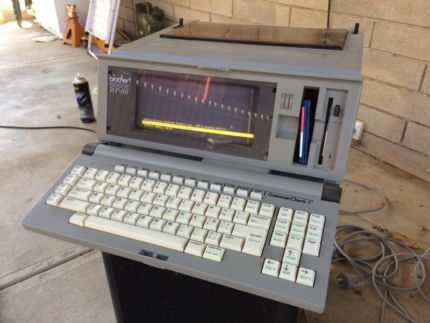
I turned my room into my little home office and typed away. Of course, the resumes never got me really good jobs or anything, but it was the thought that counted. And I used my beloved machine for three years until buying my very first PC, an Acer, in 1995. By then, computers had come down in price and I was able to purchase a full computer system with a printer and color monitor for $1500. But I never gave up on my Brother WP-80.
I moved from Chicago to Los Angeles in 1997 and don’t remember what happened to my beloved Brother WP-80 machine. It represented such pivotal time in my life. Every time I print out a resume, I always see the ghost of my Brother WP-80 in the background. If any family members or friends reads this and knows what happened to my machine, please let me know. To you, the Brother WP-80 is only a machine; to me, it is a lot more.

About Daryl
Daryl Deino has been a technology enthusiast since 1995 and has written for several newspapers and technology sites. Please reach him at [email protected]
This entry was posted in Review and tagged Brother WP-80. Bookmark the permalink.
01.05.2013 Brother
 Posted by MaiklsBlack


Огромное спасибо Мареку за этот экземпляр


+7 (495) 215-16-67
8 (800) 333-16-67
с 9:00-19:00 — ежедневно (МСК)
Заказать звонок
×
Обратный звонок
Представьтесь
Номер вашего телефона
Ваш вопрос
я даю согласие Shopozz на обработку персональных данных
в соответствии с Федеральным законом от 27.07.2006 года №152-ФЗ «О персональных данных», на условиях и для целей, определенных Политикой конфиденциальности.
×
Доставка товаров с аукциона eBay и интернет-магазинов США в
Россию (Москва, Санкт-Петербург, Новосибирск, Екатеринбург,
Казань, Нижний Новгород, Челябинск, Красноярск, Самара, Уфа,
Ростов-на-Дону, Омск, Краснодар, Воронеж, Волгоград, Пермь и
другие города).
© Shopozz — сервис покупок за рубежом